DHAKA – Bijoya Dashami, the final day of the six-day Sharadiya Durga Puja, is being celebrated across the country today with due religious fervour, traditional rituals and communal harmony. The celebrations are drawing to a close with the observance of Sindur Khela during the day, followed by the immersion (Bisarjan) of Durga idols in nearby rivers, ponds and other water bodies this evening.
Devotees are also exchanging Bijoya greetings, marking the departure of Goddess Durga from her earthly abode. Temples across the country, including Dhakeshwari National Temple, Ramna Kali Mandir, Siddheshwari Kalimandir and Ramakrishna Mission and Math, are witnessing large gatherings of worshippers.
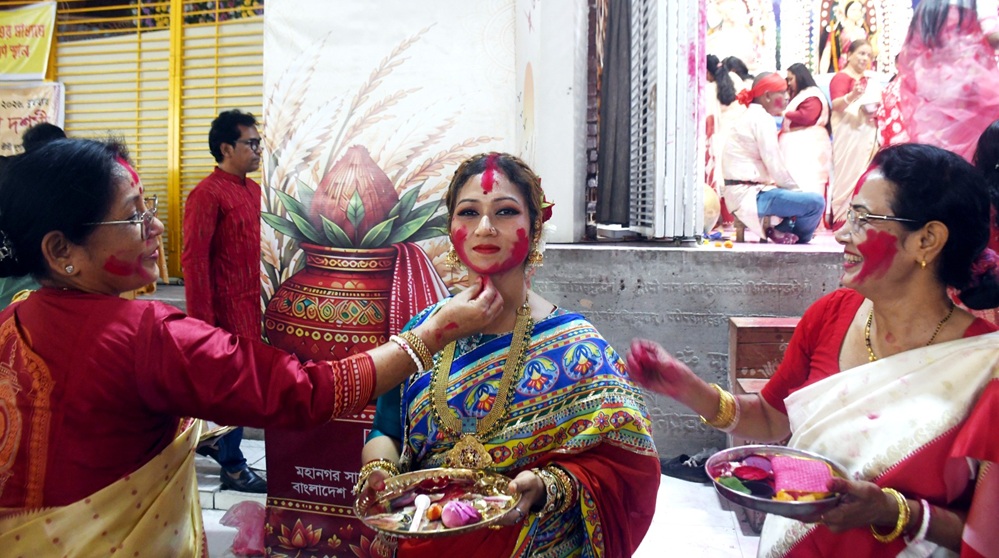
Married Hindu women, dressed in traditional white sarees with red borders, are participating in Sindur Khela, one of the most prominent rituals of Bijoya Dashami. Sindur Khela, meaning the playing with vermilion, is a traditional Hindu ritual observed mainly in Bangladesh and eastern India. During the ritual, married women offer vermilion and sweets to Goddess Durga following the completion of the final Dashami puja. They then smear vermilion on each other’s foreheads and faces, exchange sweets and pray for marital happiness and prosperity.
Although traditionally observed by women, the ritual has increasingly seen the participation of male devotees in recent years, adding to the festive atmosphere. Dashami puja was performed at temples and temporary mandaps in the morning, followed by Darpan Bisarjan, a symbolic ritual in which the reflection of the Goddess is immersed before the formal immersion of the idol. Following the rituals, colourful processions are making their way through city streets towards nearby water bodies for the immersion of the idols.
The idols, traditionally carried on bamboo structures, are now being transported on decorated trucks and pickup vans, with some taken by boat to the middle of rivers for immersion. Devotees are chanting traditional slogans such as “Aschhe bochhor abar hobe” (It will happen again next year), expressing their hope for the Goddess’s return next year.
In Dhaka, major mandaps at Dhakeshwari National Temple, Ramakrishna Mission and Math, Kalabagan, Banani, Shakhari Bazar and Ramna Kali Mandir have drawn thousands of devotees since morning. The immersion ceremonies in the capital are expected to draw large crowds, while law enforcement agencies are maintaining security and taking measures to ensure smooth traffic movement.
Similar celebrations are taking place in major divisional cities, including Chattogram, Rajshahi, Khulna, Sylhet and Barishal, as well as district towns such as Narayanganj, Faridpur, Dinajpur, Jashore, Kushtia, Netrakona, Tangail and Satkhira.
Following the immersion, younger family members seek blessings from elders by touching their feet, while relatives and friends exchange warm embraces and Bijoya greetings. Traditional sweets, including chomchom, kalojam, sandesh and narkeler naru (coconut and jaggery balls), are being distributed among family members, friends and neighbours as part of the Bijoya celebrations.

