Tarique Rahman Urges Expatriates to Help Build a Better Bangladesh

TOKYO – Prime Minister Tarique Rahman today called on expatriate Bangladeshis and people living at home to work together for the country’s development and the welfare of its people, saying that a better Bangladesh would benefit all citizens, both at home and abroad.

“Our first plan is to do something good for the country. Whether we live at home or abroad, wherever we are, we should try to do whatever we can to benefit the country and its people,” he said while addressing a views exchange with members of the Bangladeshi community in Japan at Hotel New Otani in Tokyo this evening.

His wife, Dr Zubaida Rahman, was present at the meeting. Reiterating his call for collective efforts for national development, the Prime Minister said Bangladeshis living abroad remained citizens of the country and had opportunities to contribute to its progress. He stressed the need for joint efforts to strengthen the economy, education, healthcare and workforce skills, urging everyone to work from their respective positions for the welfare of the people.

Responding to questions from expatriate Bangladeshis about various issues, Tarique Rahman outlined the government’s plans to improve education and healthcare, develop a skilled workforce and expand Bangladeshis’ participation in Japan’s labour market. Emphasising the importance of developing a skilled workforce for Japan, the Prime Minister said Bangladeshi workers should receive proper training, Japanese-language education and an understanding of Japanese culture before being sent to the country.

Such preparation would help strengthen Bangladesh’s position in Japan’s labour market and sustain the acceptance of Bangladeshi workers there in the long term, he added. On engaging expatriate Bangladeshis proficient in Japanese as language instructors in the country, Tarique Rahman said interested individuals should also come forward. He noted that a recruitment notice for Japanese-language teachers had attracted fewer applications than expected.

Expatriates skilled in Japanese could contact the Ministry of Education or the Ministry of Expatriates’ Welfare and Overseas Employment to explore possible initiatives in this regard, he said. On education, the Prime Minister said the government was prioritising a stronger foundation in primary education while planning to introduce a third language alongside English to expand students’ opportunities for higher education and employment.

“Opportunities will be created to learn Japanese, German, French and several other foreign languages. Students will be able to choose a language according to their preferences,” he said.
He said planning for the initiative had already begun, expressing hope that schools could start offering Japanese and several other foreign languages next year.

The government also wants to provide students with opportunities to participate in sports, arts and cultural activities alongside academic studies, he said, adding that technical and vocational education would receive priority. Tarique Rahman said equipping students with foreign-language skills and opportunities to develop their abilities in sports and cultural activities would give them additional advantages in education and employment at home and abroad.


PM arrives in Tokyo on four-day official visit

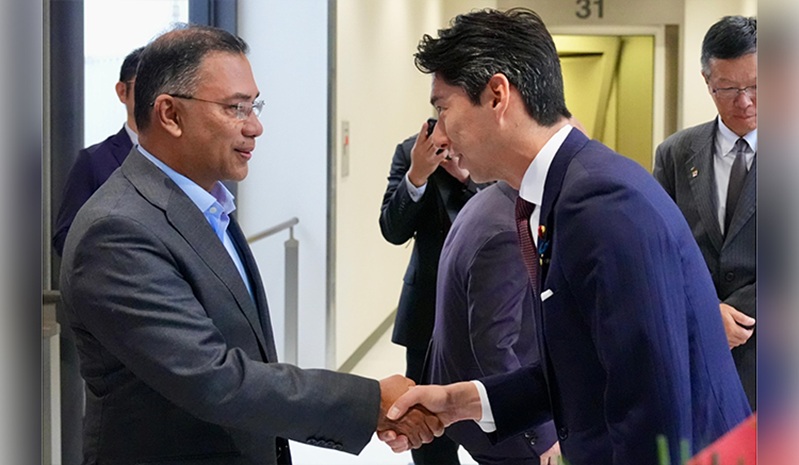
TOKYO – Prime Minister Tarique Rahman arrived in Tokyo this morning (local time) on a four-day official visit at the invitation of his Japanese counterpart Sanae Takaichi, aiming to deepen bilateral ties, attract investment and expand trade and development cooperation. A Biman Bangladesh Airlines flight carrying the prime minister, his wife Dr Zubaida Rahman, and members of his entourage landed at Narita International Airport at 9:07 am local time.

The prime minister was received at the airport by State Minister for Foreign Affairs Yasutaka Nakasone. A motorcade then escorted him to Tokyo’s Imperial Hotel, where he will stay during his visit. Prime Minister’s Adviser for Posts, Telecommunications and Information Technology and Science and Technology Rehan Asif Asad, Special Assistant to the Prime Minister for Foreign Employment in the Asia-Pacific region Dr Md Shakirul Islam Khan, and senior officials of the Bangladesh Embassy in Tokyo were also present.

Earlier, the prime minister left Hazrat Shahjalal International Airport in Dhaka early today Bangladesh time for Japan aboard a Biman Bangladesh Airlines flight, accompanied by a small delegation. Tarique Rahman is scheduled to hold a high-level bilateral talk with Japanese Prime Minister Sanae Takaichi at her office on October 27, followed by a joint press announcement and a luncheon hosted by the Japanese premier, according to the Prime Minister’s press wing.

During the four-day visit, the prime minister will also meet Japanese government officials, development institutions and business leaders, visit industrial and energy facilities, and deliver the keynote address at the Bangladesh-Japan Economic Forum. The premier’s visit is expected to deepen the existing strategic partnership, attract fresh Japanese investment, expand trade and accelerate ongoing development projects, Foreign Secretary Asad Alam Siam told journalists at a curtain-raiser media briefing at the Foreign Ministry on October 20.

Discussions will focus on the effective implementation of the Bangladesh-Japan Economic Partnership Agreement (EPA), signed in February 2026, expanding access for Bangladeshi products to the Japanese market and strengthening business engagement. The two sides will also explore wider cooperation in renewable energy, agriculture, science and technology, digital transformation, skills development and human resource development.

His tentative programme includes engagements with the Japan-Bangladesh Parliamentary Friendship League and the chairman of the Japan-Bangladesh Committee for Commercial and Economic Cooperation. Meetings are also being planned with the president of the Japan International Cooperation Agency (JICA), the governor of the Japan Bank for International Cooperation (JBIC), the president of the Japan External Trade Organization (JETRO) and the chairman of the Sasakawa Peace Foundation, said the foreign secretary.

The proposed itinerary includes visits to an LNG terminal and power plant in Futtsu City, Chiba, the headquarters of UNIQLO and a Toyota factory in Nagoya. The foreign secretary said the two sides were discussing draft memoranda of understanding and cooperation agreements covering agriculture, fisheries, human resource development, skills enhancement, civil aviation, trade, environmental conservation and local government modernisation.

“We hope that many of these MoUs will be signed during the visit,” he said. Around eight MoUs are under discussion, of which three to four could be signed during the visit. Separate agreements are also being pursued in education and human resource development. Detailed discussions are planned on Japanese support for establishing factories in Bangladesh, generating employment and developing human resources in line with the prime minister’s priorities.

The two sides are also expected to discuss regional and international peace and stability, a sustainable and peaceful solution to the Rohingya crisis, stronger cooperation in addressing the energy crisis and efforts to end international conflicts. The visit follows the prime minister’s participation in an online meeting in April at the invitation of the Japanese premier, during which Bangladesh welcomed a Japan-led initiative to address energy challenges across Asia.

Japan has been a major development partner of Bangladesh since the establishment of diplomatic relations in 1972. Japanese assistance has supported major infrastructure projects, including the Dhaka metro rail, the third terminal of Hazrat Shahjalal International Airport and infrastructure development in Matarbari. Shaheed President Ziaur Rahman visited Japan in 1978 and 1980, while former Prime Minister Khaleda Zia visited the country in 1994 and 2005.