Michael Rubin Questions UN’s Role in Bangladesh’s 2024 Political Upheaval

Shibbir Ahmed , New York – American analyst Michael Rubin has questioned the United Nations’ role in assessing the violence surrounding Bangladesh’s July–August 2024 uprising and the fall of former Prime Minister Sheikh Hasina. Rubin alleges that the UN’s death toll and its broader interpretation of the crisis warrant greater scrutiny and transparency. Rubin argues that international officials have not adequately examined the role of Islamist political groups in Bangladesh’s political transition. He also questions whether Western governments and the United Nations have approached allegations against Hasina’s government with sufficient impartiality.

Rubin’s article highlights a discrepancy between the UN’s estimate of approximately 1,400 deaths during the 2024 unrest and a figure of around 800 deaths that he attributes to the Awami League. He calls on international officials to publish a comprehensive list identifying those killed, along with evidence supporting the reported figures. According to Rubin, such disclosure would allow the public and independent investigators to examine the numbers and the circumstances surrounding the deaths.

Rubin compares Bangladesh’s political transition with the Iranian Revolution of 1979 and Egypt’s political upheaval in 2013. He argues that international policymakers should carefully assess the potential influence of Islamist political movements and their implications for secular governance, democracy and social tolerance. He also raises concerns about Jamaat-e-Islami, referring to the party’s historical role during Bangladesh’s 1971 Liberation War. Rubin contends that international responses to Bangladesh’s political crisis have insufficiently addressed the risks he associates with Islamist political influence.

Following Hasina’s removal from office in August 2024, Nobel Peace Prize laureate Muhammad Yunus led Bangladesh’s interim administration. Rubin questions the relationship between Yunus, international officials and the political narrative surrounding the uprising. He also criticizes UN Secretary-General António Guterres and Western officials, arguing that the organization should disclose the evidence and methodology underlying its casualty estimates.

The central issue, according to Rubin, is whether international assessments of the crisis have been sufficiently transparent and impartial.

Rubin calling for a political process that allows competing parties to participate freely in elections. He argues that Bangladesh’s future should protect democratic participation, secular governance, economic development and social tolerance. His remarks makes serious allegations about the United Nations and the political forces involved in Bangladesh’s transition.
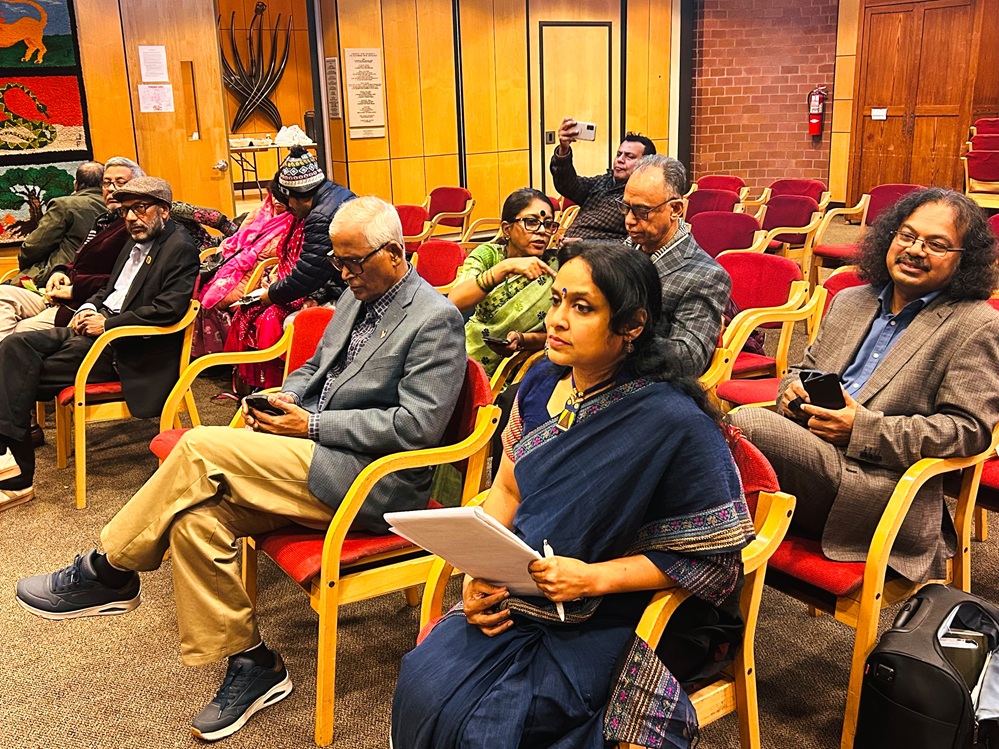


‘The Yunus Files: Unmasking a Fake Saint’ Launched in Jackson Heights

Special Correspondent | New York – A book launch and discussion for The Yunus Files: Unmasking a Fake Saint, authored by Aminul Haque Polash and Probir Bidhan, was held in Jackson Heights, Queens, on Friday, October 23, 2026. The event took place at 6 p.m. at the Jewish Center of Jackson Heights, located at 37-06 77th Street. Organized by Nalanda Publications, the gathering brought together members of the Bangladeshi diaspora, journalists, writers, educators and cultural figures for a discussion of the book and its political and social themes.

The book examines Muhammad Yunus’s international public image, his activities and his various roles, presenting the authors’ critical perspectives on his public record. Speakers at the event discussed the book’s chapters and its relevance to contemporary political debates in Bangladesh. Veteran journalist Fazlur Rahman chaired the event. Tajul Imam addressed the gathering as the chief guest, while poet and analyst Hasan Al Abdullah served as the keynote discussant.

Hasan Al Abdullah referred to selected passages from the book and presented his assessment of Yunus’s role in Bangladesh’s political and social developments. His remarks included criticism of Yunus’s leadership and its implications for the country.

Freedom fighter Golam Miraj attended as a special guest and criticized what he described as the treatment of freedom fighters during the period of Yunus’s leadership. Awami League leaders Pradip Kar and Mohammad Ali Siddiqui also shared their critical views on Yunus’s political positions and activities.

Co-author Aminul Haque Polash joined the event online and spoke about the background to the book and his personal motivations for writing it. Educator and social activist Hosne Ara Begum discussed the book’s central themes, overall arguments and contemporary relevance.

Writer and children’s literature author Humayun Kabir Dhali addressed the historical significance of Bangabandhu Sheikh Mujibur Rahman’s March 7 speech and criticized the handling of the commemorative day during the period of Yunus’s leadership.

Journalist and writer Shibbir Ahmed presented his views on Yunus’s past activities, while poet and filmmaker Rowshan Ara Nipa offered an analytical discussion of several chapters of the book. Other attendees included Sirajul Islam, Amanul Islam, Shawkat Akbar, Manzur Talukder, Rashid Abedin, Salma Begum, Rumana Akter, Farhin Shah and Jalal Uddin, among others.

Redwanur Rahman Jewel, publisher representing Nalanda Publications, thanked the attendees for participating. Poet and short-story writer Nazneen Siman moderated the program. Speakers expressed hope that the book would encourage readers to examine contemporary history and politics and engage with the questions raised by its authors. The program concluded with refreshments for guests and readers.