US, S.Korea, Japan vow ‘complete’ N.Korea denuclearization

SEOUL – The United States, South Korea and Japan reaffirmed their commitment to the “complete denuclearization” of North Korea on Saturday, as Pyongyang continues to reject disarmament ahead of possible talks with Washington. Speculation is mounting over a potential meeting between US President Donald Trump and North Korean leader Kim Jong Un at next month’s APEC summit in China, with Trump making repeated overtures to Pyongyang for nuclear talks.

US Secretary of State Marco Rubio, South Korean Foreign Minister Cho Hyun and his Japanese counterpart Toshimitsu Motegi “reaffirmed their resolute commitment to the complete denuclearization” of North Korea during talks on Friday on the sidelines of a Group of 20 (G20) meeting in Atlanta in the US state of Georgia, the US State Department said. They also pledged “full implementation” of UN Security Council resolutions, including a ban on supporting revenue for North Korea’s nuclear and ballistic missile programmes.

Despite long-running UN sanctions, North Korea, which is backed by Russia and China, has enshrined its status as a nuclear-armed state in law, with its regime repeatedly declaring its atomic arsenal permanent and irreversible.

Trump has made repeated overtures to Pyongyang for nuclear talks, while scaling back joint military drills with ally South Korea. The mercurial US leader even bucked long-held US policy last year by conceding that North Korea was already “sort of a nuclear power”, while reaching out to Pyongyang for talks, saying he was “100 percent” open to a meeting — a suggestion that went unanswered.

Analysts and South Korea’s spy agency say Kim may have conveyed Pyongyang’s position on potential talks with Trump to Beijing during a recent visit to the Chinese border city of Dandong. South Korea’s dovish President Lee Jae Myung — who has repeatedly offered Pyongyang talks without preconditions — suggested in September that Washington seek a freeze, rather than the immediate elimination, of the North’s nuclear programme in return for sanctions relief.

Critics have said such an approach risks tacitly accepting North Korea as a nuclear-armed state while allowing Pyongyang to win sanctions relief without giving up its arsenal. Analysts say China may also be moving towards tacit acceptance, pointing to the omission of North Korean denuclearisation from statements after Kim and Chinese President Xi Jinping met in June.

Pyongyang denounced a joint statement on Saturday by a group of nations monitoring sanctions implementations against it, vowing that “the stereotyped sanctions racket of the US and the West can neither influence the position of the DPRK (North Korea) as a nuclear weapons state”.
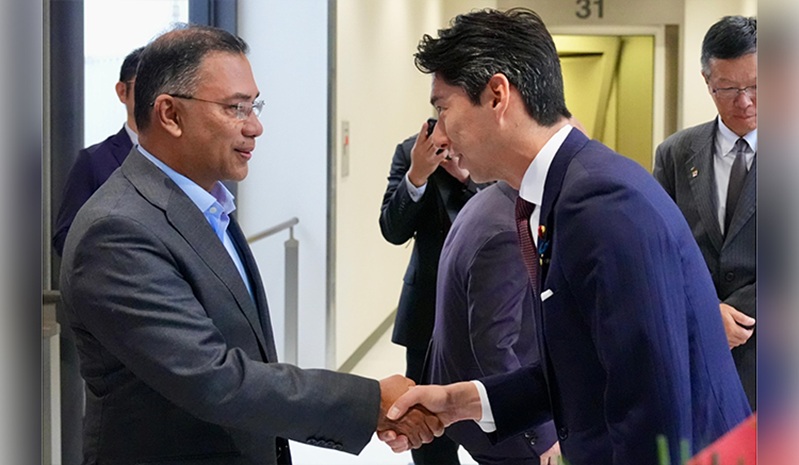


PM arrives in Tokyo on four-day official visit

TOKYO – Prime Minister Tarique Rahman arrived in Tokyo this morning (local time) on a four-day official visit at the invitation of his Japanese counterpart Sanae Takaichi, aiming to deepen bilateral ties, attract investment and expand trade and development cooperation. A Biman Bangladesh Airlines flight carrying the prime minister, his wife Dr Zubaida Rahman, and members of his entourage landed at Narita International Airport at 9:07 am local time.

The prime minister was received at the airport by State Minister for Foreign Affairs Yasutaka Nakasone. A motorcade then escorted him to Tokyo’s Imperial Hotel, where he will stay during his visit. Prime Minister’s Adviser for Posts, Telecommunications and Information Technology and Science and Technology Rehan Asif Asad, Special Assistant to the Prime Minister for Foreign Employment in the Asia-Pacific region Dr Md Shakirul Islam Khan, and senior officials of the Bangladesh Embassy in Tokyo were also present.

Earlier, the prime minister left Hazrat Shahjalal International Airport in Dhaka early today Bangladesh time for Japan aboard a Biman Bangladesh Airlines flight, accompanied by a small delegation. Tarique Rahman is scheduled to hold a high-level bilateral talk with Japanese Prime Minister Sanae Takaichi at her office on October 27, followed by a joint press announcement and a luncheon hosted by the Japanese premier, according to the Prime Minister’s press wing.

During the four-day visit, the prime minister will also meet Japanese government officials, development institutions and business leaders, visit industrial and energy facilities, and deliver the keynote address at the Bangladesh-Japan Economic Forum. The premier’s visit is expected to deepen the existing strategic partnership, attract fresh Japanese investment, expand trade and accelerate ongoing development projects, Foreign Secretary Asad Alam Siam told journalists at a curtain-raiser media briefing at the Foreign Ministry on October 20.

Discussions will focus on the effective implementation of the Bangladesh-Japan Economic Partnership Agreement (EPA), signed in February 2026, expanding access for Bangladeshi products to the Japanese market and strengthening business engagement. The two sides will also explore wider cooperation in renewable energy, agriculture, science and technology, digital transformation, skills development and human resource development.

His tentative programme includes engagements with the Japan-Bangladesh Parliamentary Friendship League and the chairman of the Japan-Bangladesh Committee for Commercial and Economic Cooperation. Meetings are also being planned with the president of the Japan International Cooperation Agency (JICA), the governor of the Japan Bank for International Cooperation (JBIC), the president of the Japan External Trade Organization (JETRO) and the chairman of the Sasakawa Peace Foundation, said the foreign secretary.

The proposed itinerary includes visits to an LNG terminal and power plant in Futtsu City, Chiba, the headquarters of UNIQLO and a Toyota factory in Nagoya. The foreign secretary said the two sides were discussing draft memoranda of understanding and cooperation agreements covering agriculture, fisheries, human resource development, skills enhancement, civil aviation, trade, environmental conservation and local government modernisation.

“We hope that many of these MoUs will be signed during the visit,” he said. Around eight MoUs are under discussion, of which three to four could be signed during the visit. Separate agreements are also being pursued in education and human resource development. Detailed discussions are planned on Japanese support for establishing factories in Bangladesh, generating employment and developing human resources in line with the prime minister’s priorities.

The two sides are also expected to discuss regional and international peace and stability, a sustainable and peaceful solution to the Rohingya crisis, stronger cooperation in addressing the energy crisis and efforts to end international conflicts. The visit follows the prime minister’s participation in an online meeting in April at the invitation of the Japanese premier, during which Bangladesh welcomed a Japan-led initiative to address energy challenges across Asia.

Japan has been a major development partner of Bangladesh since the establishment of diplomatic relations in 1972. Japanese assistance has supported major infrastructure projects, including the Dhaka metro rail, the third terminal of Hazrat Shahjalal International Airport and infrastructure development in Matarbari. Shaheed President Ziaur Rahman visited Japan in 1978 and 1980, while former Prime Minister Khaleda Zia visited the country in 1994 and 2005.