Lockheed Martin to Pay $29.5 Million in Employment Discrimination Settlement

Shibbir Ahmed, Washington, DC — Lockheed Martin has agreed to pay approximately $29.5 million to resolve allegations of race and sex discrimination in its employment practices, the U.S. Department of Justice (DOJ) and the Equal Employment Opportunity Commission (EEOC) announced Tuesday, November 3. Under the two-part settlement, the Bethesda, Maryland-based defense and aerospace company will pay $22 million to the United States and more than $7.5 million to over 1,000 affected employees.

The Justice Department alleged that, from 2019 to the present, Lockheed Martin falsely certified compliance with federal anti-discrimination requirements while engaging in employment practices that allegedly took race and sex into account in hiring, compensation, promotions, and other workplace decisions. The $22 million agreement resolves allegations under the False Claims Act, which allows the federal government to pursue companies that allegedly submit false claims or certifications in connection with government contracts.

A central focus of the government’s allegations was Lockheed Martin’s incentive compensation program known as “Compensation Adder,” or “Comp Adder.” Introduced in 2021, the program provided additional pay increases to the top 20% of employees within each business area, beyond the company’s annual standard salary increase.

According to the Justice Department, managers initially nominated employees based on merit and performance. However, before final selections were made, the company allegedly conducted statistical analyses to identify potential disparities in the racial and gender composition of the lists.

The government alleged that some human resources personnel subsequently pressured business leaders to change their selections to address race-related statistical flags. In certain cases, the Justice Department alleged, non-minority employees were removed from the lists while minority employees who had not initially been nominated were added.

The government’s filing quoted one HR employee as saying that increasing the number of people of color on the Comp Adder list would require removing an equal number of non-minority employees. The Justice Department also alleged that Lockheed Martin considered race and sex in certain hiring and promotion decisions to advance internal workforce demographic targets.

Additionally, the company allegedly offered certain training, mentoring, and leadership development opportunities based on employees’ race or sex, potentially affecting their career advancement opportunities.

The separate EEOC settlement resolves a 2025 Commissioner’s Charge filed by EEOC Chair Andrea Lucas. The charge alleged that Lockheed Martin discriminated against white employees on the basis of race in performance evaluations, bonuses, and other compensation decisions, including through its Comp Adder program. Under the agreement, more than 1,000 employees will receive a combined total exceeding $7.5 million.

The EEOC described the settlement as the largest publicly announced class of workers to recover under an EEOC settlement involving alleged Title VII violations arising from or relating to a diversity, equity, and inclusion (DEI) program or practices.

The Justice Department’s settlement also resolves a whistleblower lawsuit filed by Tim Booher, a former Lockheed Martin vice president. Under the False Claims Act’s whistleblower provisions, private individuals may bring lawsuits on behalf of the federal government and receive a share of any financial recovery. As part of the settlement, Booher will receive $4.4 million.

EEOC Chair Andrea Lucas said Title VII of the Civil Rights Act requires employers to treat employees as individuals and prohibits employment decisions motivated by race or sex. She said the settlement reflects the agency’s priority of identifying and addressing alleged unlawful discrimination carried out under the banner of diversity, equity, and inclusion.

Associate Attorney General Stanley E. Woodward Jr. said companies doing business with the federal government should not make compensation decisions that prioritize an employee’s race over the merit of their work. Assistant Attorney General Brett A. Shumate also emphasized that federal contractors must make hiring, promotion, and compensation decisions without regard to race or sex.

In addition to financial payments, the EEOC agreement requires Lockheed Martin to comply with Title VII of the Civil Rights Act and Executive Order 14151. The company must maintain a merit-based workplace in which race and sex are not considered in hiring, compensation, bonus, or promotion decisions. The EEOC may monitor the company’s compliance throughout the agreement’s term. The Justice Department said Lockheed Martin cooperated in resolving the matters.

The coordinated resolution involved the EEOC, the Justice Department’s Civil Division, the U.S. Attorney’s Office for the Northern District of Texas, and investigative assistance from the Department of War’s Office of Inspector General.
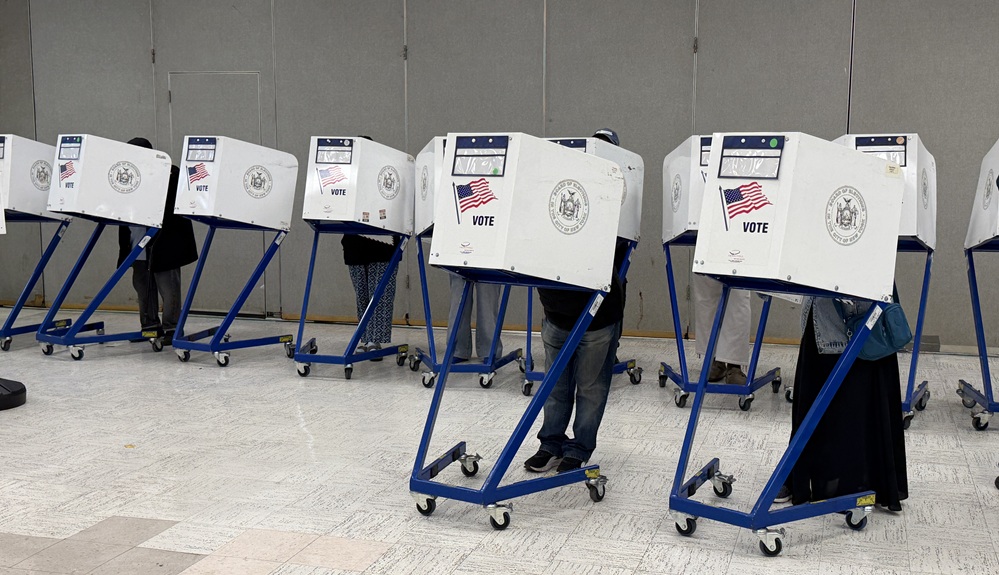


DOJ Deploys Election Monitors Across All 50 States for First Time in History

Shibbir Ahmed, Washington, D.C. — For the first time in U.S. history, the Department of Justice (DOJ) is deploying election monitors across all 50 states. The initiative aims to promote transparency in the electoral process, protect voting rights, and ensure compliance with federal election laws during the 2026 midterm elections.

On Tuesday, November 3, the Justice Department announced that approximately 1,000 election monitors and observers would be deployed for this year’s elections. This marks the largest election-monitoring operation in the department’s history. Although the DOJ has deployed election monitors under previous administrations, this is the first time the initiative has covered all 50 states.

The operation is being coordinated by the DOJ’s Civil Rights Division. The monitoring teams will include personnel from the division, representatives from other DOJ divisions and components, officials from U.S. Attorney’s Offices, and federal observers from the Office of Personnel Management. Throughout Election Day, Civil Rights Division personnel will maintain contact with state and local election officials.

Assistant Attorney General Harmeet K. Dhillon of the DOJ’s Civil Rights Division said, “Election integrity has been one of the top priorities for this Administration and this Division. I am very proud we are deploying the largest monitoring effort in DOJ history, and pursuing transparency for elections in an assertive and nondiscriminatory manner.”

The Justice Department said election monitors would examine whether federal voting rights laws are being properly followed. The Voting Section of the Civil Rights Division is responsible for enforcing the civil provisions of several federal laws designed to protect voting rights.

These laws include the Voting Rights Act, the National Voter Registration Act, the Help America Vote Act, the Uniformed and Overseas Citizens Absentee Voting Act, and the Civil Rights Acts.

In addition, the division’s Disability Rights Section will oversee compliance with the Americans with Disabilities Act (ADA) to ensure that people with disabilities have a full and equal opportunity to vote. Meanwhile, the Criminal Section will enforce federal criminal laws prohibiting voter intimidation and voter suppression based on race, color, national origin, or religion.

The Justice Department also announced that its officials would remain available throughout Election Day and the following week to receive public questions, complaints, and reports of potential violations involving federal voting rights laws.

U.S. residents can report election-related concerns by calling the department’s election issues hotline at 1-800-253-3931. Complaints can also be submitted by email at VEM@usdoj.gov or through the department’s website at www.civilrights.justice.gov/report.

For complaints involving the voting rights of people with disabilities, the DOJ’s ADA Information Hotline can be reached toll-free at 1-800-514-0301. The TTY number is 1-833-610-1264. Complaints can also be filed through www.ada.gov.

The department advised that any disruptions at polling places should be reported to local election officials, including officials stationed at the polling locations. Incidents involving violence, threats of violence, or intimidation at polling places should be reported immediately to local police by calling 911. After contacting local law enforcement authorities, individuals should also notify the Justice Department.

The DOJ said election monitors would be deployed in selected cities, counties, and other jurisdictions across all 50 states. The designated locations include Jefferson, Montgomery, and Mobile in Alabama; Anchorage, Dillingham, and Kusilvak in Alaska; Maricopa, Pima, Apache, and Navajo in Arizona; and Pulaski and Washington in Arkansas.

The monitoring effort will also cover Los Angeles, Alameda, Sacramento, and San Diego in California; Adams in Colorado; New Haven in Connecticut; New Castle in Delaware; Leon, Hillsborough, Miami-Dade, Broward, and Palm Beach in Florida; and Cobb, DeKalb, Fulton, Gwinnett, Chatham, and Bibb in Georgia.

Additional locations include Honolulu in Hawaii; Ada in Idaho; and Chicago, Cook, Champaign, Sangamon, St. Clair, and Madison in Illinois. Monitors will also be assigned to Lake and Marion in Indiana; Linn and Polk in Iowa; Johnson, Wyandotte, and Sedgwick in Kansas; and Fayette and Jefferson in Kentucky.

In Louisiana, the designated areas are Orleans, East Baton Rouge, and Lafayette. In Maine, they include Lewiston, Portland, and South Portland. The monitoring operation will also cover Prince George’s in Maryland; Lowell and Boston in Massachusetts; and Lansing, East Lansing, Grand Rapids, Flint, Detroit, Hamtramck, Warren, and Dearborn in Michigan.

The DOJ’s list further includes Minneapolis, Hennepin, and Ramsey in Minnesota; Lafayette and Hinds in Mississippi; St. Louis, Jackson, and Clay in Missouri; Yellowstone in Montana; Douglas in Nebraska; and Clark in Nevada. In New Hampshire, monitors will cover Manchester and Nashua, while Middlesex, Bergen, and Union are included in New Jersey.

Other designated areas include Bernalillo in New Mexico; New York, Westchester, Kings, Albany, and Erie in New York; Alamance, Mecklenburg, and Wake in North Carolina; and Cass in North Dakota. The monitoring effort will also extend to Cuyahoga, Franklin, and Medina in Ohio; Muskogee, Tulsa, and Oklahoma in Oklahoma; and Multnomah in Oregon.

In Pennsylvania, the designated jurisdictions are Philadelphia, Allegheny, Luzerne, and Lehigh. Other locations include Pawtucket in Rhode Island; Charleston in South Carolina; Minnehaha in South Dakota; and Davidson, Knox, and Shelby in Tennessee.

In Texas, election monitors will be deployed to Bexar, Dallas, Harris, Waller, Blanco, Bowie, and Nueces. The list also includes Salt Lake in Utah; Burlington in Vermont; Charlottesville, Fairfax, Prince William, and Virginia Beach in Virginia; and King and Yakima in Washington state. The remaining designated areas are Kanawha in West Virginia; Madison and Milwaukee in Wisconsin; and Laramie County in Wyoming.

The Justice Department’s nationwide initiative is being described as the largest election-monitoring operation in U.S. history, highlighting the department’s efforts to promote election transparency and protect voting rights across the country.