SPECIAL INVESTIGATIVE REPORT: Higher Ground: How New York is Raising a Park to Hold Back the Sea
Shibbir Ahmed, New York — When nature retaliates, even the most powerful cities on Earth can find themselves utterly defenseless. New York remains a grim witness to this reality. During those ill-fated 48 hours of Hurricane Sandy in 2012, 44 New Yorkers lost their lives, two million people were plunged into sudden darkness, and $19 billion in wealth evaporated in the blink of an eye. Standing on those very ruins, New York has refused to surrender.
Instead, the city has launched an unprecedented “climate war.” To suppress the ravenous waves of the Atlantic and the relentlessly rising sea levels, a massive $2 billion (approx. 24,000 crore BDT) megaproject is being carved directly through the Manhattan waterfront.
A recent on-site report by the United Nations has revealed the thrilling realities of this ultra-modern engineering feat—a saga blending science, architecture, and the raw survival of millions.
An Impregnable Fortress Disguised as a Park
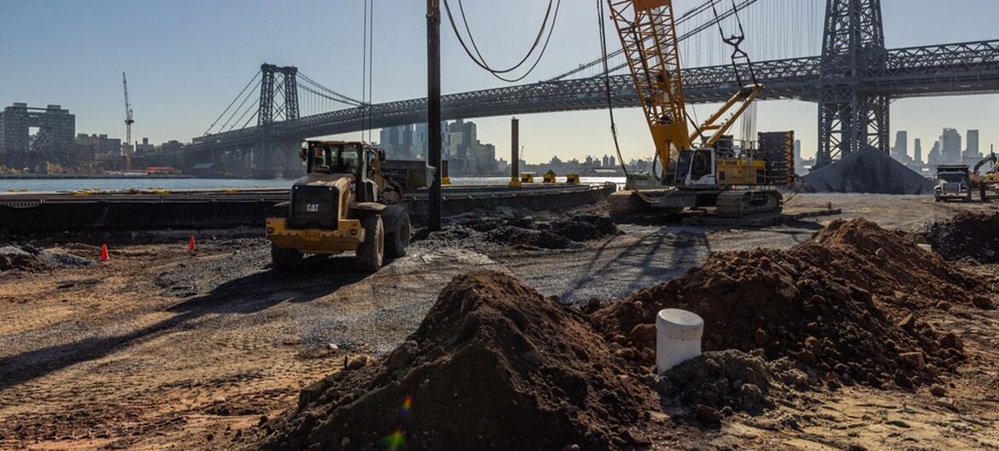
The most magical transformation of this master plan is unfolding across Manhattan’s historic East River Park. Just north of the Williamsburg Bridge, the roar of giant cranes and heavy machinery echoes day and night. Millions of tons of specialized soil brought from the riverbed are being deposited to raise the entire park up to 10 feet (3 meters) above sea level.
Yet, what meets the eye is only one-third of the actual reality. Below the surface lies an invisible, titanic shield. Extending 100 feet (30 meters) deep into the reclaimed earth along the riverbank are massive concrete and steel piles. These piles were driven with immense force, crushing ancient shipwreck remains and forgotten piers to anchor themselves directly into bedrock. Right above them runs a colossal, hidden floodwall. While it appears to be an ordinary recreation park on top, it conceals a state-of-the-art fortress beneath.
Preparing for the Surge: When the City Locks Down Automatically
The impacts of climate change are no longer a distant future; they are a merciless present-day reality. Data from the World Meteorological Organization (WMO) indicates that the rate of global sea-level rise has doubled since satellite measurements began in 1993. For a city boasting 520 miles of coastline, the ultimate threat is no longer just a singular superstorm, but the creeping menace of the everyday high tide.
Kathryn Prybylski, New York City’s Assistant Commissioner of the Bureau of Coastal Resilience, issued a stark warning: “Without these walls, many New Yorkers would face regular tidal flooding in the decades ahead—once, twice, or even 10 times a month. It would disrupt daily commutes and change how people send their children to school.”
To counter this, the entire system has been engineered with incredible foresight. If a severe storm approaches, no human deployment will be required inside the park itself. Elsewhere along the waterfront, 18 massive sliding floodgates will be swung shut, while farther south, nearly 100 mechanical ‘flip-up’ barriers will rise from the ground to block incoming surges. The blueprint successfully factors in an extra 30 inches (76 centimeters) of sea-level rise. With 90 percent of the project now operational, the city stands structurally prepared for volatile weather events.
Global Disparity: The Luxury of Rich Cities vs. the Anguish of South Asia
While New York’s $2 billion megaproject wins global applause, it simultaneously exposes a cruel, naked economic disparity in global climate politics. The United Nations has explicitly pointed out that wealthy megacities like New York, Miami, or Guangzhou possess the capital to build multi-billion-dollar defenses to save themselves. But for low-lying, developing cities in South Asia, the roar of rising seas is an immediate death knell.
According to UN reports, permanent inundation puts more than 14 million people across South Asia—particularly in low-lying hubs like Dhaka, Kolkata, and Mumbai—at catastrophic risk of losing their homes forever. Pacific island communities in Fiji, Vanuatu, and the Solomon Islands have already begun fleeing their ancestral lands.
Navid Hanif, a representative from the UN’s Department of Economic and Social Affairs (DESA), noted: “What New York is doing is a commendable step forward and a message to all big cities. But it is also a reminder that funding must be accessible so that less developed nations are not left to drown.”
Life Beyond the Wall: Where Dreams Flourish
The most beautiful aspect of this project is that it is not a concrete jungle built at the expense of the environment. The newly elevated East River Park is carpeted with lush green lawns. It features modern running tracks, children’s playgrounds, sports fields, and community barbecue spots. In the evenings, as the sun sets over the Brooklyn skyline, local residents gather to walk their dogs and breathe freely.
Liz, a neighborhood resident walking her dog, shared her thoughts: “We’re in this park twice a day, every day. We love it! We don’t always think about what is built underneath, but the beautiful life we enjoy on top is a perfect example of how climate resilience can help people enjoy their lives.”
As New York races toward its final 2027 completion date, this project offers a definitive message to the world: fighting climate change does not mean simply cowering in fear of the ocean. It means adapting intelligently, embracing nature, and elevating the very quality of human life.