Bangladesh situation has triggered debate in the British Parliament
The ongoing political and human rights situation in Bangladesh has triggered debate in the British Parliament, with MPs highlighting bans on political parties, corruption allegations against a UK lawmaker, and actions taken by the interim government.
Concerns over democratic norms and human rights
Over the past year, MPs have repeatedly raised concerns about human rights in Bangladesh. In a December 2024 House of Commons session, Labor MP Barry Gardiner and former home secretary Priti Patel warned about rising violence against the Hindu community. Catherine West, minister for the Indo-Pacific, said the UK government is closely monitoring the situation and remains in contact with the administration of Chief Adviser Dr Muhammad Yunus to ensure minority protection.
On July 15, MP Bob Blackman and the Bangladesh Unity Forum hosted a parliamentary event highlighting Bangladesh’s constitutional crisis. Speakers denounced the use of anti-terror laws against political opponents and described the May 2025 ban on Awami League activities as an unprecedented assault on democracy. A message was also sent to the International Criminal Court (ICC), detailing allegations of arbitrary arrests and extrajudicial killings.
UK’s stance on upcoming election
The Foreign, Commonwealth and Development Office (FCDO) has stressed the need for elections within a set timeframe to restore stability. It said free, fair and participatory polls are vital for a functioning democracy. British MPs have urged the interim government to publish a roadmap and call early elections, while also demanding guarantees of freedom of expression and protection for political dissent.
Corruption allegations and MP’s resignation
Another issue drawing attention was the corruption allegation raised by Bangladesh against British MP Tulip Siddiq, niece of former prime minister Sheikh Hasina. Following Hasina’s ouster, Siddiq was accused of corruption and resigned from the post of economic secretary to the treasury and city minister in January 2025, following allegations of misconduct. She has denied the allegations, calling them politically motivated propaganda.
Withdrawal of controversial report
The All-Party Parliamentary Group (APPG) on the Commonwealth faced criticism over a November 2024 report accused of being biased in favors of Hasina’s ousted government. The report was withdrawn in January 2025. Labor MP Rupa Huq dismissed it as irrelevant and described it as a vicious attack on Bangladesh’s interim government.
Times Square shooting leaves 3 hurt, suspect in custody
Three people were shot and wounded in New York’s Times Square, the New York Police Department said on Saturday (9 August). The people – an 18-year-old female, 19 19-year-old male, and a 65-year-old male – are in a stable condition in hospital, an NYPD spokesperson said. A 17-year-old male is in custody, the NYPD added. The police also recovered a firearm.
The shooting took place at around 1:20am ET (0520 GMT) and followed a verbal altercation with one of the victims, the NYPD added. It said it was not known at this time whether the shooter or the victims knew each other. Mass shootings are relatively common in the United States, where guns are widely available.
The incident at one of New York’s most iconic tourist spots comes after July’s high-profile shooting in a Manhattan office tower, which left four people dead, including a senior Blackstone executive and an NYPD officer.
New York experienced record-low shooting incidents and victims in the first seven months of this year, and in July, according to a statement published by the city’s police department on 4 August. Crime is a key electoral issue for America’s largest city, which is set to hold mayoral elections in November.
UK minister Rushanara Ali resigns after tenant eviction claims
Bangladesh-born British minister for dealing with homelessness, Rushanara Ali, resigned from the government late Thursday after it was revealed that she had considerably hiked the rent at a property she owns.
“It is with a heavy heart that I offer you my resignation as a minister,” said Ali, under-secretary of state for homelessness in the Labour government, in her letter to Prime Minister Keir Starmer.
Her resignation came a day after the I-Paper daily reported she had given four tenants four months to leave a London house she owned and then leased it again a few weeks later with the rent more than 700 pounds higher. Several associations campaigning against homelessness and opposition lawmakers said the 50-year-old had to resign.
“Further to recent reporting, I wanted to make it clear that at all times I have followed all relevant legal requirements. I believe I took my responsibilities and duties seriously, and the facts demonstrate this,” Ali said in her letter, released by the prime minister’s office.
“However, it is clear that continuing in my role will be a distraction from the ambitious work of the government,” she added.
In response, Starmer thanked Ali for her “diligent work” at the housing ministry, adding: “Your efforts to put in measures to repeal the Vagrancy Act will have a significant impact.”
Ali’s early life began in Sylhet before she moved to the UK with her family at the age of 7. She pursued higher education at St John’s College, Oxford, where she earned a bachelor’s degree in philosophy, politics and economics.
Police Officer Didarul Islam Posthumously Promoted to Detective First Grade at Funeral Service
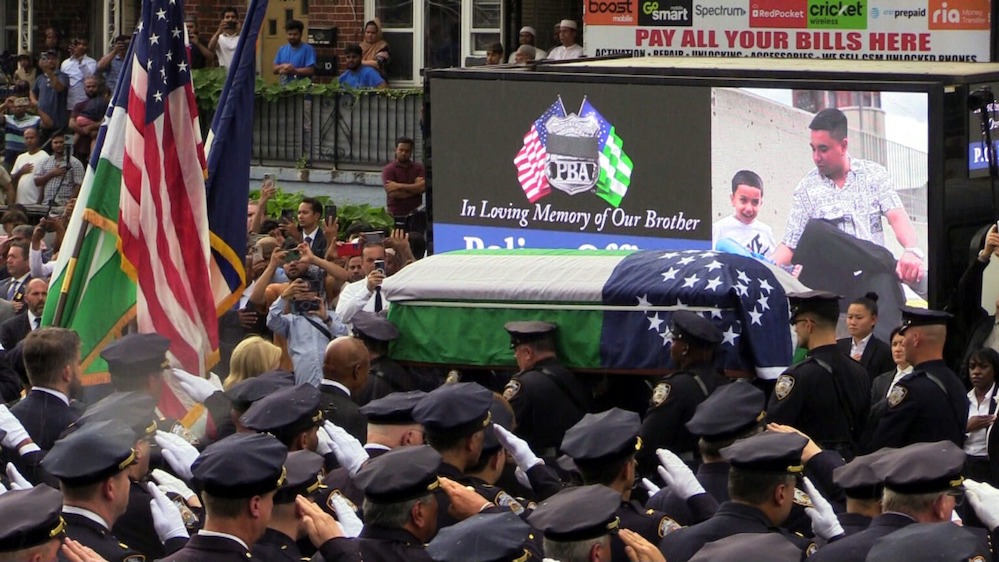
Thousands of police officers from across the New York metropolitan area and beyond gathered at the Parkchester Jame Masjid on Virginia Avenue on Thursday, July 31, to pay their respects and say goodbye to slain Police Officer Didarul Islam, 36, a Bangladeshi American immigrant, father of two, with another baby on the way, who was promoted to detective first grade by Police Commissioner Jessica Tisch during the service.
As reported, police said Islam was one of four people killed by gunman, Shane Tamura, 27, from Las Vegas who carried out the killings using an assault rifle which he carried inside 345 Park Avenue in Midtown Manhattan on Monday, July 28, and who reportedly had mental health issues. Police said Tamura later turned the gun on himself and also died. Islam’s body had been transferred from Midtown to Parkchester on Tuesday, July 29, as reported, as New Yorkers reacted to the shocking events and Gov. Kathy Hochul and others called again for a nationwide ban on assault rifles.
On Thursday, members of the Bangladeshi community from Parkchester, Norwood, and elsewhere joined thousands of other residents as police officers flooded the surrounding streets of Islam’s local mosque, and several NYC Department of Sanitation (DSNY) trucks blocked nearby intersections. Tisch had previously served as DSNY Commissioner.
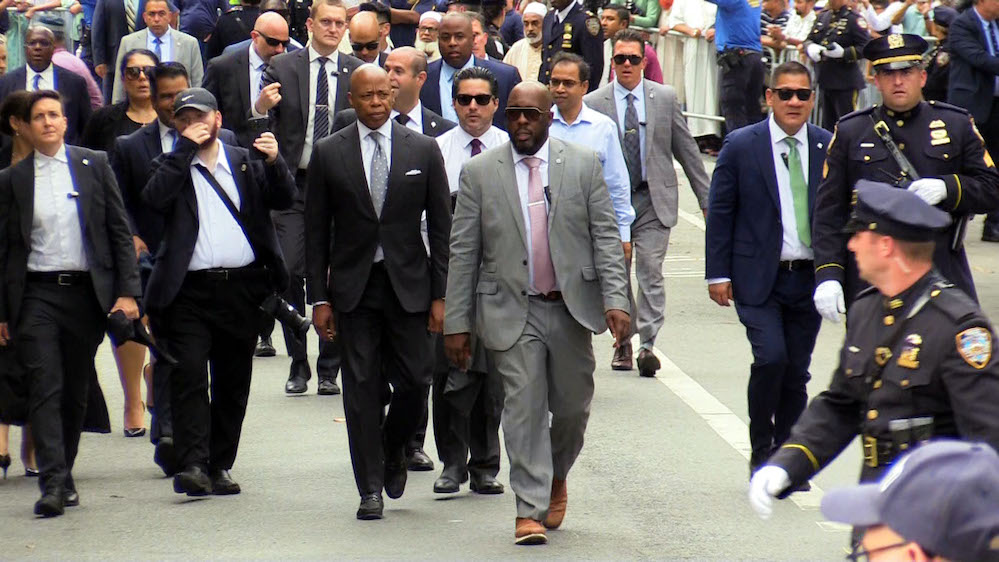
In addition to Tisch, elected officials in attendance included Hochul, NYC Mayor Eric Adams, Bronx Borough President Vanessa Gibson, Bronx District Attorney Darcel Clark, NYC Public Advocate Jumaane Williams, Congressman Adriano Espaillat (NY-13), who represents parts of the West Bronx and northern Manhattan, and Congressman Ritchie Torres (NY-15), who represents a large section of The Bronx stretching from the northwest to the south.
Also seen were Manhattan District Attorney Alvin Bragg, and City Councilman Dr. Yousef Salaam (C.D 9) who represents parts of Harlem and is one of the Exonerated Five having spent between several years behind bars for a crime he did not commit.
Addressing the congregation, Hochul said in part, “Today our hearts are broken. The dam is searing.” Referring to Islam’s relatives, she said, “They’re a family that expected to see their beloved son, husband, father for many more dinners, birthdays and life celebrations, but because of a madman who traveled a thousand miles with such evil in his heart to come and destroy all that is good about New York City.”
For his part, the mayor, a former police officer, said in part, “This murder and the murder of others who were in the building, it cut me to my core. I spent my entire life defending and fighting for innocent people of this city, and each death I take personal because as a mayor, I am responsible for the safety of New Yorkers.”
For her part, Tisch said of Islam, “He stepped into a new land and chose to become part of its promise to believe in its dream, and he did believe in the American dream, not as something handed down, but as something built with your own hands.”
She continued, “Didarul Islam came to this country as an immigrant with no guarantees, only the hope that hard work, that humility, that purpose might lead him somewhere meaningful and it did. He earned the respect of his peers. He believed in this department. With only four years on the job, he did the work of a cop with twice that time, and in a command where the work never slowed.”
The commissioner said in addition to his work assignment in Midtown Manhattan on the day he was killed, Islam had been on duty the previous day at the Bronx Dominican Day Parade, a day which proved very challenging for the NYPD due to several shootings reported after the parade. Such was the number of violent incidents on the day, when contacted by Norwood News on Monday, the NYPD press office said they had to be provided with a specific time and location before they could share details of each incident.
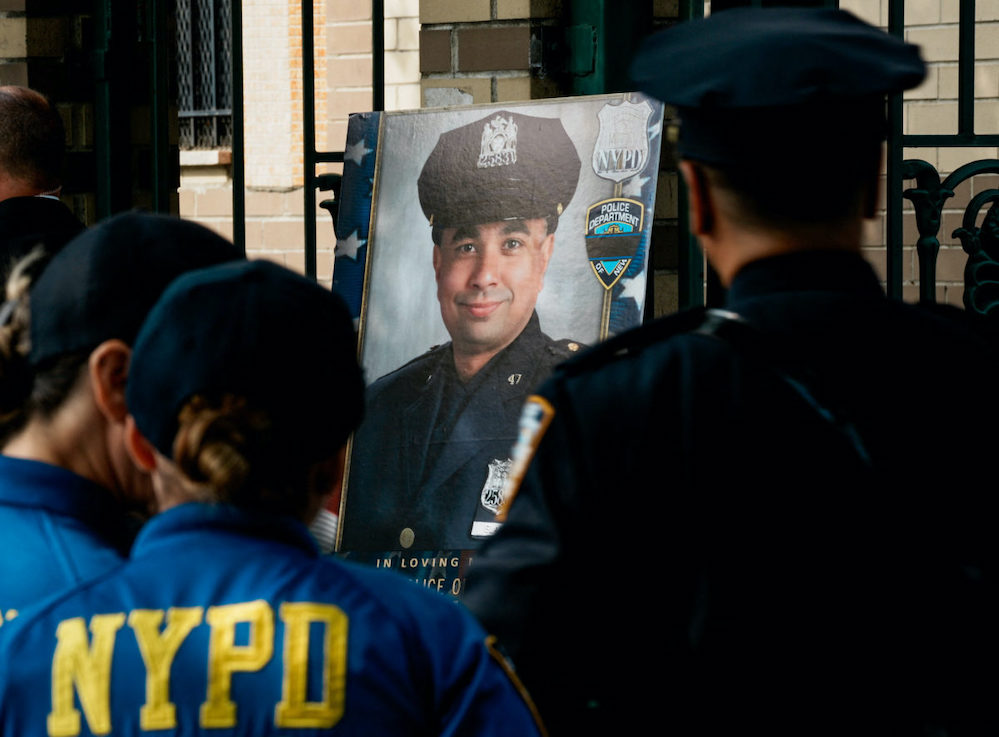
People stand near a picture of New York City Police Department (NYPD) officer Didarul Islam, killed during a mass shooting event at a midtown Manhattan office tower on July 28, on the day of his funeral, in New York City, U.S., July 31, 2025. REUTERS/Eduardo Munoz
At times sounding almost defiant on Islam’s behalf in the wake of Monday’s tragedy, Tisch added, “But no matter what this job threw at him, you could count on Didar to get it done, and to get it done right, and though his journey was cut too short, the way he lived his job, with steadiness, with heart, with conviction, it reflected everything this title represents. So, today, it is my honor and my great privilege to promote Police Officer Didarul Islam to Detective First Grade.”
The congregation applauded as NYPD personnel rose to their feet. Tisch was later seen embracing one of Islam’s mourning family members. Islam’s brother-in-law, Police Officer Kamrul Hasan, who called Islam his “protector” and “best friend,” shared some memories to demonstrate their solidarity and Islam’s strength of character. “Anything, everything anybody needed, anything, they come to us,” he said. “He was helping everybody.” Hasan concluded, “On behalf of our whole family, I would like to thank everybody for coming here and staying with us and being here for us.”
In addition to public statements already made by a number of elected officials including the mayor and governor, other elected officials had also shared their reaction to the tragedy. Clark lamented what she called “yet another act of senseless gun violence with a high-powered weapon brought to the city by an allegedly mentally disturbed man.”
The district attorney added in part of Islam, “My heart goes out to his pregnant wife, sons, the members of the NYPD, and the families of all the victims. This incident is a reason I urge and advocate for mental health services in our city!”
On Tuesday, Gibson had offered her condolences and paid tribute to Islam, writing, “On behalf of our Borough, we extend our deepest condolences and prayers to the four victims of yesterday’s horrific shooting in Midtown, including one of our own, decorated Police Officer Didarul Islam of the 47th Precinct.”
Gunman kills four including Bangladeshi immigrant police officer
A gunman with mental health issues opened fire in a central Manhattan skyscraper on Monday, killing four people including a policeman before apparently taking his own life, officials said. Mayor Eric Adams said the fallen police officer was a 36-year-old immigrant from Bangladesh.
Two other males and a female died and another man remained in a critical condition, officials said without giving any preliminary motive for the shootings.
An NFL employee was stable after being ‘seriously injured’ in the attack, ESPN reported, quoting an internal memo from league commissioner Roger Goodell. A fifth victim was in critical condition after being shot, Eric Adams told a late-night press briefing at a nearby hospital.
The gunman was caught on surveillance footage leaving a black BMW and carrying an M-4 rifle, police commissioner Jessica Tisch told the news conference.
On entering the building, he immediately opened fire on a police officer before ‘spraying the lobby’ with bullets, she said.
The gunman then took an elevator to the 33rd floor of Rudin Management, which owns the building, and continued his spree before apparently shooting himself. He was later discovered by officers next to his weapon.
The office tower block at 345 Park Avenue — home to the National Football League, hedge fund giant Blackstone, and auditor KPMG — was apparently targeted by the gunman, who is believed to have acted alone, Tisch said.
The police commissioner identified the shooter as Shane Tamura from Las Vegas and said a revolver, ammunition and magazines were found in his vehicle.
Tamura had a history of mental health issues, she said.
The incident began around 6:00pm (2200 GMT) when reports of gunfire prompted hundreds of police to swarm a busy office district on Park Avenue, an area popular with tourists and businesspeople.
A worker from a nearby office building wept as she left the area after a local lockdown was lifted. Another office worker described the gunman going floor-to-floor as staff prepared to leave for the day.
‘We lost four souls to another act of senseless violence,’ the city’s mayor said, excluding the shooter, who died by an apparently self-inflicted gunshot. CNN and NBC cited unnamed officials as saying the shooter had a grievance with the NFL and its handling of CTE, a brain condition linked to head trauma.
The gunman had a note in his pocket saying he suffered from CTE, the news channels said, quoting a source with knowledge of the investigation. Office worker Shad Sakib said that he was packing his things to leave work when a public address announcement warned him and his colleagues to shelter in place.
‘Everyone was confused with like, ‘wait, what’s going on?’ And then someone finally realised that it’s online, that someone walked in with a machine gun,’ the witness said.
‘He walked right into a building right next door. We saw the photo of him walking through the same area that I walked through to get lunch here.
‘You would think it won’t happen to you, and then it does.’
Another witness, a woman who declined to give her name as she left the vicinity of the shooting, said: ‘I was in the building. He went floor by floor.’
A second woman wept as she left the scene.
There have been 254 mass shootings in the United States this year including Monday’s incident in New York, according to the Gun Violence Archive — which defines a mass shooting as four or more people shot.
Russia Intensifies Air War in Ukraine
Everyone agrees: it’s getting worse. The people of Kyiv have, like the citizens of other Ukrainian cities, been through a lot. After three and a half years of fluctuating fortunes, they are tough and extremely resilient. But in recent months, they have been experiencing something new: vast, coordinated waves of attacks from the air, involving hundreds of drones and missiles, often concentrated on a single city.
Last night, it was Kyiv. And the week before too. In between, it was Lutsk in the far west. Three years ago, Iranian-supplied Shahed drones were a relative novelty. I remember hearing my first, buzzing a lazy arc across the night sky above the southern city of Zaporizhzhia in October 2022. But now everyone is familiar with the sound, and its most fearsome recent iteration: a dive-bombing wail some have compared to the German World War Two Stuka aircraft.
The sound of swarms of approaching drones have sent hardened civilians back to bomb shelters, the metro and underground car parks for the first time since the early days of the war.
“The house shook like it was made of paper,” Katya, a Kyiv resident, told me after last night’s heavy bombardment.
“We spent the entire night sitting in the bathroom.”
“I went to the parking for the first time,” another resident, Svitlana, told me.
“The building shook and I could see fires across the river.”
The attacks don’t always claim lives, but they are spreading fear and eroding morale.
After an attack on a residential block in Kyiv last week, a shocked grandmother, Mariia, told me that her 11-year old grandson had turned to her, in the shelter, and said he understood the meaning of death for the first time.
He has every reason to be fearful. The UN’s Human Rights Monitoring Mission in Ukraine (HRMMU) says June saw the highest monthly civilian casualties in three years, with 232 people killed and over 1,300 injured. Many will have been killed or wounded in communities close to the front lines, but others have been killed in cities far from the fighting.
“The surge in long-range missile and drone strikes across the country has brought even more death and destruction to civilians far away from the frontline,” says Danielle Bell, head of HRMMU.
Children queuing for supplements killed in Israeli strike in Gaza, hospital says
At least 15 Palestinians, including eight children and two women, have been killed in an Israeli strike while queuing for nutritional supplements in front of a clinic in central Gaza, a hospital says.
Video from al-Aqsa Martyrs hospital in Deir al-Balah showed the bodies of several children and others lying on the floor as medics treated their wounds.
US-based aid group Project Hope, which runs the clinic, said the attack was a blatant violation of international law. The Israeli military said it struck a “Hamas terrorist” and regretted any harm to civilians.
They were among 66 people reportedly killed in Israeli strikes on Thursday, as Israel and Hamas continued talks on a ceasefire deal. Despite optimism expressed by the US, which is acting as a mediator along with Qatar and Egypt, they do not so far seem to be close to a breakthrough.
Project Hope said Thursday morning’s strike in front of its Altayara health clinic in Deir al-Balah happened as patients had gathered outside, awaiting its opening to receive treatment for malnutrition, infections, chronic illnesses and more.
“Suddenly, we heard the sound of a drone approaching, and then the explosion happened,” witness Yousef al-Aydi told AFP news agency. “The ground shook beneath our feet, and everything around us turned into blood and deafening screams.”
Graphic footage posted on social media, which was verified by the BBC, showed the immediate aftermath of the attack, with adults and young children lying in a street, some severely wounded and others not moving.
At the mortuary of nearby al-Aqsa hospital, relatives of those killed wept as they wrapped the dead children in white shrouds and body bags before performing funeral prayers.
One woman told the BBC that her pregnant niece, Manal, and her daughter, Fatima, were among them, and that Manal’s son was in the intensive care unit.
“She was queuing to get the children supplements when the incident happened,” Intisar said.
Another woman standing nearby said: “For what sin were they killed?”
“We are dying before the ears and eyes of the whole world. The whole world is watching the Gaza Strip. If people aren’t killed by the Israeli army, they die trying to get aid.”
Project Hope’s president and CEO, Rabih Torbay, said the aid group’s clinics were “a place of refuge in Gaza where people bring their small children, women access pregnancy and postpartum care, people receive treatment for malnutrition, and more”.
“Yet, this morning, innocent families were mercilessly attacked as they stood in line waiting for the doors to open,” he added. “Horrified and heartbroken cannot properly communicate how we feel anymore.”
“This is a blatant violation of international humanitarian law, and a stark reminder that no-one and no place is safe in Gaza, even as ceasefire talks continue. This cannot continue.”
Unicef boss Catherine Russell said: “The killing of families trying to access life-saving aid is unconscionable.”
The Israel Defense Forces (IDF) said in a statement that it struck a member of the elite Nukhba forces of Hamas’s military wing who had taken part in the 7 October 2023 attack on Israel.
“The IDF is aware of reports regarding a number of injured individuals in the area. The incident is under review,” it added. “The IDF regrets any harm to uninvolved individuals.”
Trump says EU and Mexico face 30% tariff from August
President Donald Trump has announced that the European Union and Mexico will face a 30% tariff on imports to the US from 1 August. He warned he would impose even higher import taxes if either of the US trading partners decided to retaliate. The 27-member EU – America’s biggest trading partner – said earlier this week it hoped to agree a deal with Washington before 1 August.
Trump has this week also said the US will impose new tariffs on goods from Japan, South Korea, Canada and Brazil, also starting from 1 August. Similar letters were sent this week to a number of smaller US trade partners.
In the letter sent on Friday to European Commission President Ursula von der Leyen, Trump wrote: “We have had years to discuss our trading relationship with the European Union, and have concluded that we must move away from these long-term-large, and persistent, trade deficits, engendered by your tariff, and non-tariff, policies and trade barriers.”
“Our relationship has been, unfortunately, far from reciprocal,” the letter added.
The EU has been a frequent target of Trump’s criticism. On 2 April, he proposed a 20% tariff for goods from the bloc, as well as dozens of other trade partners. He then threatened to raise the EU import taxes to 50% as trade talks stalled.
Washington and Brussels had hoped to reach an agreement before a deadline of 9 July, but there have been no announcements on progress.In 2024, the US trade deficit with the bloc was $235.6bn (€202bn; £174bn), according to the office of the US trade representative. Von der Leyen said the EU remained ready “to continue working towards an agreement by Aug 1”.
“Few economies in the world match the European Union’s level of openness and adherence to fair trading practices,” her statement added.
“We will take all necessary steps to safeguard EU interests, including the adoption of proportionate countermeasures if required.”
Italy Prime Minister Giorgia Meloni said in a statement she trusted “a fair agreement” could be reached, adding: “It would make no sense to trigger a trade war between the two sides of the Atlantic.” Dutch Prime Minister Dick Schoof said on social media that the EU “must remain united and resolute” in its aim to reach a “mutually beneficial” deal with the US.
Germany’s Association of the Automotive Industry warned about the prospect of rising costs for German carmakers and suppliers, and said it was “regrettable that there is a threat of a further escalation of the trade conflict”.
In his letter to Mexico’s leader, Trump said the country had not done enough to stop North America becoming a “Narco-Trafficking Playground”.
“Mexico has been helping me secure the border, BUT, what Mexico has done, is not enough,” Trump added.
In his letters to the EU and Mexico, Trump warned that if either trade partner retaliated with import duties of their own against the US, he would hit back by raising tariffs by a similar percentage over and above the 30%.
Mexico responded to Trump’s threat on Saturday, calling it an “unfair deal”.
Trump’s letter did not say if Mexico goods traded within the 2020 United States-Mexico-Canada Agreement would be exempt from the proposed 1 August tariff hikes, as the White House said would be the case with Canada.
Earlier this week, the White House sent a letter to Canada threatening a 35% tariff. As of Saturday, the Trump administration has now proposed tariff conditions on 24 countries and the EU. On 12 April, White House trade adviser Peter Navarro set a goal to secure “90 deals in 90 days”. So far, the president has announced the outlines of two such pacts with the United Kingdom and Vietnam amid ongoing negotiations.
Some Walmart garment orders from Bangladesh on hold due to US tariff threat
Suppliers to Walmart (WMT) have delayed or put on hold some orders from garment manufacturers in Bangladesh, according to three factory owners and correspondence from a supplier seen by Reuters, as U.S. President Donald Trump’s threat of a 35% tariff on the textile hub disrupts business.
Bangladesh is the third-largest exporter of apparel to the United States, and it relies on the garment sector for 80% of its export earnings and 10% of its GDP. The factory owners all said they expected orders to fall if the August 1 tariffs go into effect, as they are unable to absorb that 35% rate.
Iqbal Hossain, managing director of garment manufacturer Patriot Eco Apparel Ltd, told Reuters an order for nearly 1 million swim shorts for Walmart was put on hold on Thursday due to the tariff threat. “As we discussed please hold all below Spring season orders we are discussing here due to heavy Tariff % imposed for USA imports,” Faruk Saikat, assistant merchandising manager at Classic Fashion, wrote in an email to Hossain and others seen by Reuters. Classic Fashion is a supplier and buying agent that places orders for retailers.
“As per our management instruction we are holding Bangladesh production for time being and IN case Tariff issues settled then we will continue as we planned here.”
The hold was not decided by Walmart, Saikat told Reuters, but by Classic Fashion itself.
Walmart did not respond to a request for comment.
Bangladesh is currently in talks with the United States in Washington to try to negotiate a lower tariff. Trump in recent days has revived threats of higher levies on numerous nations.
“If the 35% tariff remains for Bangladesh, that will be very tough to sustain, honestly speaking, and there will not be as many orders as we have now,” said Mohiuddin Rubel, managing director at jeans manufacturer Denim Expert Ltd in Dhaka.
Rubel, whose company produces jeans for H&M and other retailers, said he expects clients will ask him to absorb part of the tariff, but added this would not be possible financially. Manufacturers have already absorbed part of the blanket 10% tariff imposed by the U.S. on April 2.
“Only probably the big, big companies can a little bit sustain (tariffs) but not the small and medium companies,” he said.
Retailers have front-loaded orders since Trump returned to the White House, anticipating higher tariffs. Jeans maker Levi’s, which imports from Bangladesh, said on Thursday it has 60% of the inventory it needs for the rest of 2025.
Israeli settlers beat American to death in West Bank; US says it’s aware
Israeli settlers in the occupied West Bank have beaten to death a 20-year-old United States citizen, the victim’s family members and rights groups have said. Settlers attacked and killed Sayfollah Musallet in the town of Sinjil, north of Ramallah, on Friday, according to the Palestinian Health Ministry. Relatives of Musallet, who was from Tampa, Florida, were also quoted by The Washington Post as saying he was beaten to death by Israeli settlers.
“We are aware of reports of the death of a US citizen in the West Bank,” Reuters reported a State Department spokesperson as saying. The official declined to comment further “out of respect for the privacy of the family and loved ones” of the reported victim.
Muslat had travelled from his home in Florida to visit family in Palestine, his cousin Fatmah Muhammad said in a social media post.
Another Palestinian, identified by the Health Ministry as Mohammed Shalabi, was fatally shot by settlers during the attack.
Rights advocates have documented repeated instances where Israeli settlers in the West Bank ransack Palestinian neighbourhoods and towns, burning homes and vehicles in attacks sometimes described as pogroms.
The Israeli military often protects the settlers during their rampages and has shot Palestinians who show any resistance.
The United Nations and other prominent human rights organisations consider the Israeli settlements in the West Bank violations of international law, as part of a broader strategy to displace Palestinians.
While some Western countries like France and Australia have imposed sanctions on violent settlers, attacks have increased since the outbreak of Israel’s war in Gaza in October 2023.
When President Donald Trump took office earlier this year, his administration revoked sanctions on settlers imposed by his predecessor, Joe Biden.
Israeli forces have killed at least nine US citizens since 2022, including veteran Al Jazeera reporter Shireen Abu Akleh.
But none of the incidents have resulted in criminal charges.
The US provides billions of dollars to Israel every year. Advocates have accused successive US administrations of failing to protect American citizens from Israeli violence in the Middle East.
On Friday, the Council on American-Islamic Relations (CAIR) called on Washington to ensure accountability for the killing of Musallet.
“Every other murder of an American citizen has gone unpunished by the American government, which is why the Israeli government keeps wantonly killing American Palestinians and, of course, other Palestinians,” CAIR deputy director Edward Ahmed Mitchell said in a statement.
He then pointed out that Trump has repeatedly promised to prioritise American interests, as typified by his campaign slogan “America First”.
“If President Trump will not even put America first when Israel murders American citizens, then this is truly an Israel First administration,” Mitchell said.
The Institute for Middle East Understanding (IMEU) also called for action from the US administration, noting that settlers are “lynching Palestinians more frequently – with full support from Israel’s army and government”.
“The US government has a legal and moral obligation to stop Israel’s racist violence against Palestinians. Instead, it’s still backing and funding it,” the group said in a statement.
The US Department of State did not respond to Al Jazeera’s request for comment about the killing of Musallet.
The Palestinian group Hamas condemned the murder of Muslat, describing it as “barbaric”, and called on Palestinians across the West Bank to rise up to “confront the settlers and their terrorist attacks”.
Israel said it was “investigating” what happened in Sinjil, claiming that the violence started when Palestinians threw rocks at an Israeli vehicle.
“Shortly thereafter, violent clashes developed in the area between Palestinians and Israeli civilians, which included the destruction of Palestinian property, arson, physical confrontations, and stone-throwing,” the Israeli military said in a statement. Israeli investigations often lead to no charges or meaningful accountability for the abuses of Israeli officers and settlers.
As settler and military violence intensifies in the West Bank, Israel has killed at least 57,762 Palestinians in Gaza in a campaign that rights groups have described as a genocide.