Brooklyn Children’s Museum to Celebrate Diwali with Family Activities on November 12

Brooklyn, New York – The Brooklyn Children’s Museum will celebrate Diwali, the Hindu festival of lights, on Thursday, November 12, from 2 p.m. to 5 p.m., in collaboration with The Culture Tree. The special family-friendly program will introduce children and families to the traditions and cultural significance of Diwali through interactive activities and creative experiences.

Visitors will have the opportunity to enjoy puppet storytelling about the history and meaning of Diwali, make traditional Indian sweets known as mithai, and create their own traditional diya lamps at the museum’s ColorLab art studio. The celebration will take place during the museum’s free Community Access Thursday hours, held every Thursday from 2 p.m. to 5 p.m.

The program is sponsored by Amazon, Citizens Philanthropic Foundation, and Investors Foundation. Families interested in attending can find additional information and RSVP through the Brooklyn Children’s Museum website: https://www.brooklynkids.org/programs/celebrate-diwali/


Durga Puja Celebrated in Festive Spirit in New Jersey

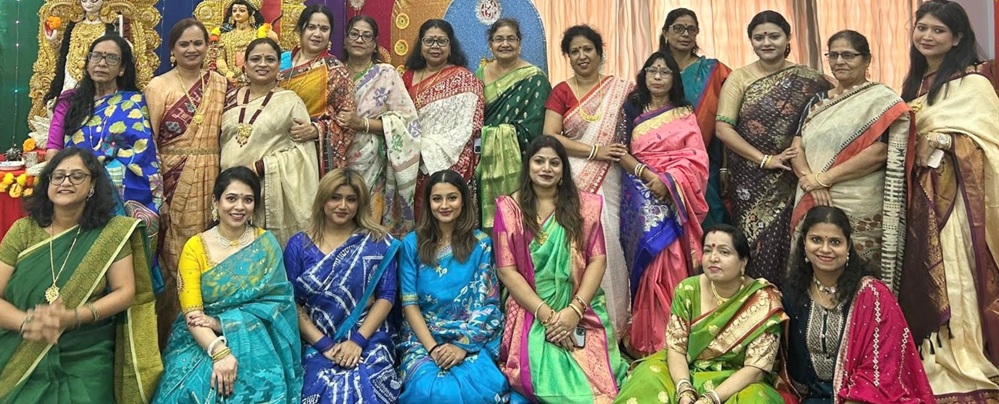
Subrata Chowdhury, New Jersey — Sharadiya Durga Puja was celebrated in a festive atmosphere across New Jersey, bringing together members of the Bengali Hindu community for religious rituals, cultural performances, and community gatherings. The celebrations featured traditional worship, Anjali (prayer offerings), Aarti (ritual worship with lamps), and a variety of cultural programs. The festival grounds transformed into vibrant gathering places where devotees and community members shared in the spirit of devotion, joy, and togetherness.

For followers of Hinduism, Goddess Durga symbolizes the victory of good over evil. Through prayers and worship, devotees sought peace, prosperity, and well-being for their families and communities. Daily religious observances began with traditional rituals and Anjali, drawing participants of all ages.

Throughout the festival, the sound of drums, cymbals, and ululation filled the venues, creating a lively and traditional festive atmosphere. Celebrations continued from morning until night, alongside cultural performances featuring music, dance, and other artistic presentations that entertained attendees.

Men and women, children, young adults, and senior citizens joined the festivities dressed in colorful traditional and festive attire. Families and friends gathered to celebrate together, reconnect with one another, and share the joy of the occasion. For many expatriates, such events offer a welcome opportunity to strengthen community bonds amid the demands of everyday life.

Beyond its religious significance, Durga Puja serves as an important platform for preserving and showcasing Bengali heritage and culture in the United States. The celebrations also help introduce younger generations to their cultural roots, traditions, and identity. Through religious devotion, cultural expression, and community fellowship, Durga Puja continues to strengthen unity and solidarity among Bengali communities in New Jersey.


NYC Mayor Zohran Mamdani Calls for Unity at Durga Puja Celebration

NEW YORK — New York City Mayor Zohran Mamdani has warned against attempts to undermine social unity and create divisions in the United States, calling for collective efforts against forces of hatred and evil. “Evil forces have not stopped. Durga Puja has arrived with a resolve to stand united against the forces of evil,” Mamdani said.

He made the remarks Tuesday evening while addressing the closing ceremony of Durga Puja celebrations organized by the Bangladeshi community at Om Shakti Temple in Jackson Heights, Queens. The mayor was welcomed at the temple by its founder, Gouranga Kundu; temple committee president Swarup Saha; and general secretary Bhavatosh Pal. He was then presented with a traditional uttariya, a ceremonial shawl.

This year, Bangladeshi communities organized Durga Puja celebrations at 18 venues across New York City, including Times Square and locations in Queens, the Bronx, Brooklyn, Manhattan and Staten Island. Mamdani said Goddess Durga symbolizes the destruction of evil and the triumph of good. Inspired by this belief, Bangladeshi Hindus gathered to celebrate the festival with hopes for peace and prosperity.

He also praised the contributions of Bangladeshi Hindus to the city’s multicultural identity, saying their role in making New York more vibrant and prosperous would be remembered. Other speakers at the event included attorney Ashok Karmakar, Professor Dwijen Bhattacharya, City Council Member Shekar Krishnan and one of the event’s organizers, Dinesh Majumdar.

Majumdar said events of this kind were essential to presenting Durga Puja, the largest religious festival of Bengali Hindus, to an international audience. He added that the growing popularity of Durga Puja celebrations at Times Square reflected this ambition.


Bijoya Dashami being celebrated with traditional Sindur Khela at mandaps

DHAKA – Bijoya Dashami, the final day of the six-day Sharadiya Durga Puja, is being celebrated across the country today with due religious fervour, traditional rituals and communal harmony. The celebrations are drawing to a close with the observance of Sindur Khela during the day, followed by the immersion (Bisarjan) of Durga idols in nearby rivers, ponds and other water bodies this evening.

Devotees are also exchanging Bijoya greetings, marking the departure of Goddess Durga from her earthly abode. Temples across the country, including Dhakeshwari National Temple, Ramna Kali Mandir, Siddheshwari Kalimandir and Ramakrishna Mission and Math, are witnessing large gatherings of worshippers.

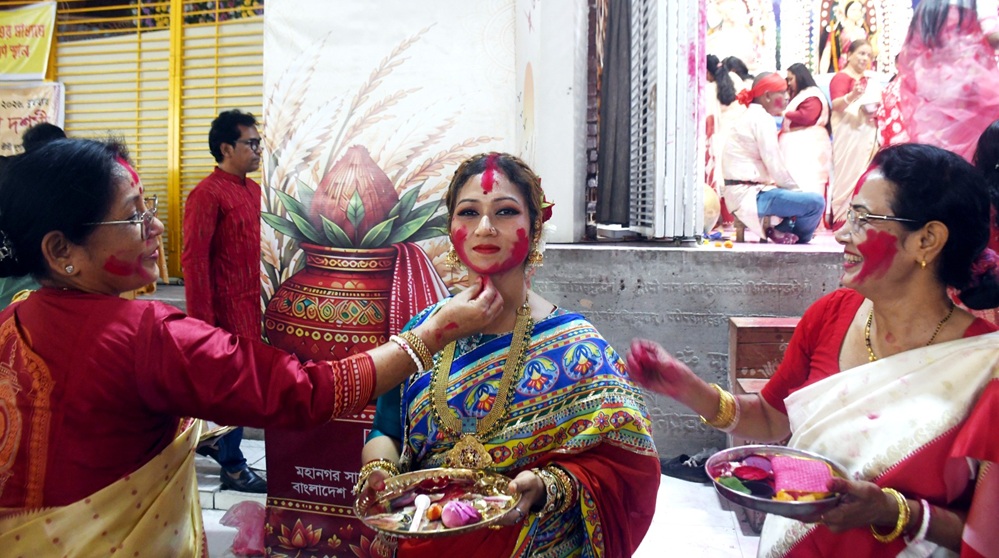
Married Hindu women, dressed in traditional white sarees with red borders, are participating in Sindur Khela, one of the most prominent rituals of Bijoya Dashami. Sindur Khela, meaning the playing with vermilion, is a traditional Hindu ritual observed mainly in Bangladesh and eastern India. During the ritual, married women offer vermilion and sweets to Goddess Durga following the completion of the final Dashami puja. They then smear vermilion on each other’s foreheads and faces, exchange sweets and pray for marital happiness and prosperity.

Although traditionally observed by women, the ritual has increasingly seen the participation of male devotees in recent years, adding to the festive atmosphere. Dashami puja was performed at temples and temporary mandaps in the morning, followed by Darpan Bisarjan, a symbolic ritual in which the reflection of the Goddess is immersed before the formal immersion of the idol. Following the rituals, colourful processions are making their way through city streets towards nearby water bodies for the immersion of the idols.

The idols, traditionally carried on bamboo structures, are now being transported on decorated trucks and pickup vans, with some taken by boat to the middle of rivers for immersion. Devotees are chanting traditional slogans such as “Aschhe bochhor abar hobe” (It will happen again next year), expressing their hope for the Goddess’s return next year.

In Dhaka, major mandaps at Dhakeshwari National Temple, Ramakrishna Mission and Math, Kalabagan, Banani, Shakhari Bazar and Ramna Kali Mandir have drawn thousands of devotees since morning. The immersion ceremonies in the capital are expected to draw large crowds, while law enforcement agencies are maintaining security and taking measures to ensure smooth traffic movement.

Similar celebrations are taking place in major divisional cities, including Chattogram, Rajshahi, Khulna, Sylhet and Barishal, as well as district towns such as Narayanganj, Faridpur, Dinajpur, Jashore, Kushtia, Netrakona, Tangail and Satkhira.

Following the immersion, younger family members seek blessings from elders by touching their feet, while relatives and friends exchange warm embraces and Bijoya greetings. Traditional sweets, including chomchom, kalojam, sandesh and narkeler naru (coconut and jaggery balls), are being distributed among family members, friends and neighbours as part of the Bijoya celebrations.


Times Square Durga Utsav 2026 Concludes in New York

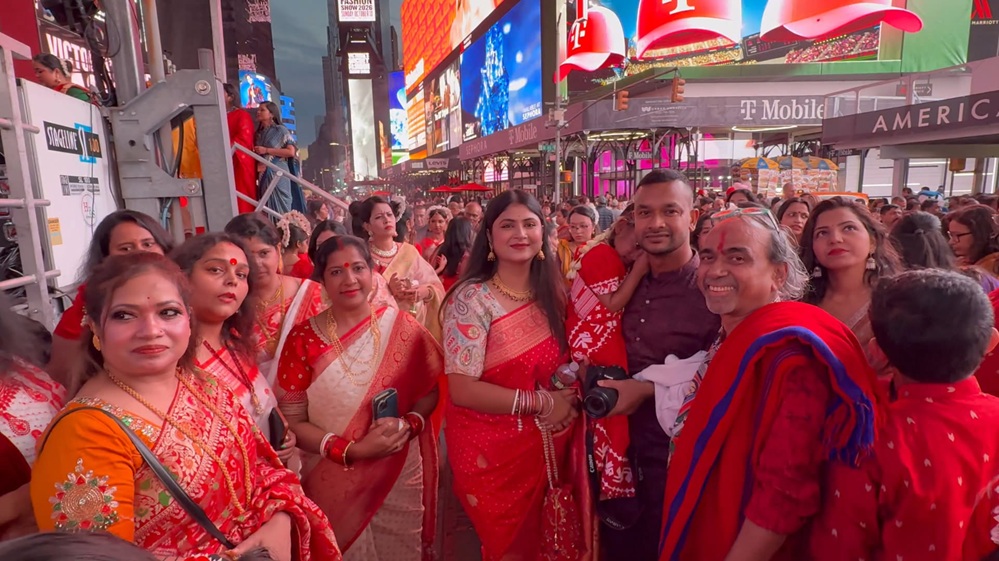
New York Correspondent — The two-day Times Square Durga Utsav 2026 concluded successfully in the heart of New York City, bringing together members of the Bengali diaspora for a vibrant celebration of religious tradition, culture, music, and dance. The festival, held on October 10 and 11, drew enthusiastic participation from the Bengali community despite challenging weather conditions on the second day.

Following the conclusion of the event, the Times Square Durga Utsav Association expressed its heartfelt gratitude to everyone who attended, volunteered, contributed, and supported the celebration.

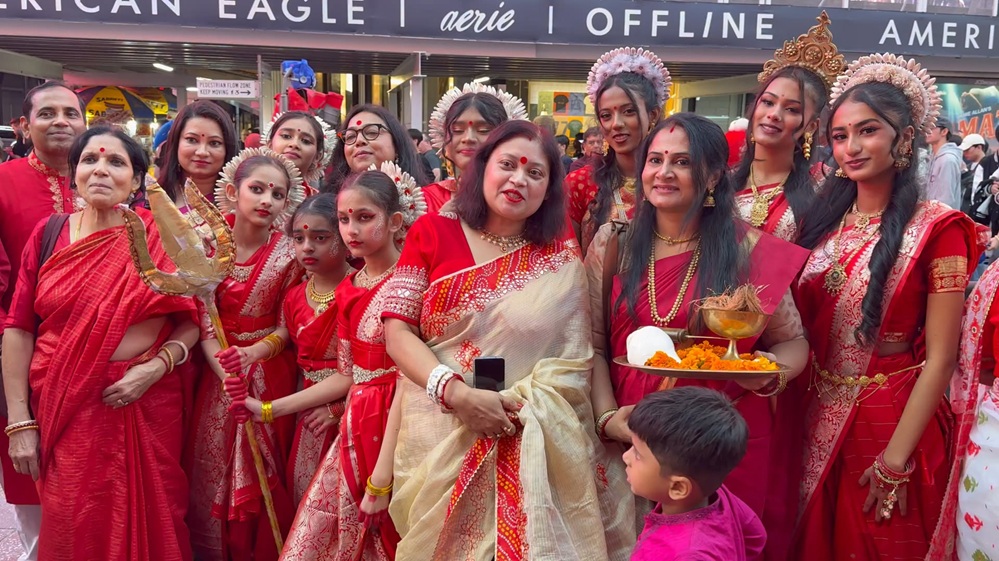
On Saturday, October 10, thousands of Bengalis gathered at Times Square under bright, sunny skies to celebrate the spirit of Durga Puja. The event transformed the iconic Manhattan destination into a lively gathering place for Bengali culture, devotion, and community spirit. Participants from New York and surrounding areas came together to pay their respects to Goddess Durga and celebrate their cultural heritage far from their ancestral homeland.

The festival provided an opportunity for members of the Bengali diaspora to reconnect with their traditions while sharing their rich cultural identity with the wider public. Weather conditions changed on Sunday, October 11, as rain swept through the area. Despite the unfavorable weather, hundreds of people continued to visit the festival venue to offer their prayers and pay homage to Goddess Durga.

Their presence reflected the deep devotion, enthusiasm, and cultural bonds that unite Bengalis across geographical boundaries. The turnout demonstrated that adverse weather could not dampen the community’s spirit or its connection to one of its most cherished festivals.

The two-day celebration featured religious rituals, prayers, floral offerings, the distribution of prasad, music, dance, and other cultural activities. Through these programs, the organizers sought to showcase Bengali heritage and the traditions of Durga Puja on an international platform. The celebration also served as an opportunity for younger generations of Bengali Americans to connect with their cultural roots.

For many members of the diaspora, the gathering represented more than a religious celebration. It was a moment to strengthen community ties, preserve traditions, and share Bengali culture with people from different backgrounds.

One of the notable highlights of this year’s festival was the recognition of six organizations for their contributions to preserving Bengali culture and the tradition of Durga Puja in the United States. The organizations honored were Bay Area Probashi Incorporated, Bengali Association of Greater Chicago, Bengali Cultural Society, East Coast Durga Puja Association, Kallol, and Pragati.

Their work in maintaining Bengali cultural traditions, promoting community engagement, and passing heritage on to younger generations was recognized as an important contribution to the Bengali diaspora.

In a message following the conclusion of the festival, the Times Square Durga Utsav Association thanked everyone who contributed their time, effort, and support to make the event possible.

The organizers highlighted the enthusiastic participation on the first day and the determination of devotees who attended despite the rain on the second day. They said the community’s love, devotion, and cooperation would remain a source of inspiration for future events.

The association also emphasized that although this year’s celebration had come to an end, the spirit of unity, friendship, and cultural harmony would continue. Organizers expressed their hope of welcoming Goddess Durga again next year with renewed enthusiasm and fresh aspirations.

The Times Square Durga Utsav has become an important occasion for the Bengali community to celebrate its religious traditions and showcase its cultural identity in one of the world’s most recognizable public spaces.

Beyond the religious ceremonies, the event highlighted the importance of preserving Bengali language, heritage, and traditions among communities living abroad. As the 2026 celebration concludes, organizers and participants look forward to returning next year for another gathering centered on devotion, cultural pride, and community solidarity. The Times Square Durga Utsav Association concluded its message by wishing peace, prosperity, and well-being for all and thanking everyone who helped make the festival memorable.


Flushing Town Hall to Host 12th Annual Diwali Festival

QUEENS, NY — Flushing Town Hall will celebrate its 12th annual Diwali Festival on Sunday, November 1, with an Indian wedding-themed cultural event featuring traditional Kathak dance, Indian cuisine, live drumming, and interactive arts workshops for families. The festival, titled Diwali Festival: The Indian Wedding, will take place from noon to 4 p.m. at Flushing Town Hall, 137-35 Northern Boulevard in Flushing, Queens. The event will bring Indian wedding traditions to life through live performances and hands-on activities designed to introduce audiences of all ages to South Asian culture. Admission is free for children.

The centerpiece of the festival will be a wedding dance drama presented by Abha B. Roy and the Srijan Dance Company at 2:15 p.m. The performance will showcase traditional Indian wedding customs, including henna application, the haldi ceremony, regional dances, marriage rituals, and the bride’s farewell. A tassa drumming procession will welcome the bridal party, inviting audiences to experience the atmosphere of a traditional Indian wedding.

Throughout the afternoon, visitors can participate in Indian classical and folk dance workshops, explore block printing with Dr. Alka Mukerji, and create colorful rangoli designs with Josh Roychowdhury. Additional activities will include henna art by Bella Beauty and Hindi calligraphy with Jasbir Bhatia.

Food will also be a central part of the celebration. Queens Curry Kitchen will offer Indian food and beverages, while Chef Nupur Arora will demonstrate how to prepare traditional vegetarian Indian dishes.

“Our theme for this year’s Diwali Festival is the Indian Wedding, offering audiences a festive window into one of India’s most cherished cultural traditions,” said Ellen Kodadek, executive and artistic director of Flushing Town Hall.

Kodadek said the festival reflects the organization’s commitment to presenting international arts and creating meaningful cultural experiences for the diverse communities of Queens and the greater New York City area. She also acknowledged the Guru Krupa Foundation for its longstanding support of the annual event.

Diwali, also known as Deepavali, is widely celebrated as the Festival of Lights. Its name comes from a Sanskrit expression meaning “row of lights,” and the holiday symbolizes the triumph of light over darkness, hope over despair, and knowledge over ignorance.

Celebrated by millions of people around the world, Diwali is marked by the lighting of traditional oil lamps, festive gatherings, family activities, and cultural performances. While the festival has deep roots in Hindu traditions, it is also observed by people from different religious and cultural backgrounds.

Gabrielle M. Hamilton, director of education and public programs at Flushing Town Hall, said the Indian wedding theme would allow visitors to experience the vibrant colors, music, dance, and traditions associated with the celebrations.

The festival’s teaching artists will encourage participants to engage directly with Indian art and performance traditions, making the event an opportunity for both cultural discovery and family entertainment.

Roy, artistic director of Srijan Dance Center, has led Flushing Town Hall’s annual Diwali Festival since its inception. A specialist in Kathak, a classical dance form from northern India, she trained under renowned gurus Kundan Lal Gangani and Pandit Durgalal and completed her specialization at Kathak Kendra in New Delhi. She has performed and taught internationally, including appearances at Lincoln Center, Flushing Town Hall, and the Queens Museum.

Arora, founder of Queens Curry Kitchen and author of The Vegan Indian Home, combines her culinary background with a passion for Indian home-style cooking. Mukerji, a professor in the Studio Art Department and director of the Berger & Brownson Art Gallery at Manhattanville University, explores themes of cultural identity, coexistence, social justice, and peace through her artistic practice.

Adult admission is $20, while adult members can purchase tickets for $15. Children will be admitted free. Tickets and additional information are available at https://www.flushingtownhall.org/show-details/diwali-festival-the-indian-wedding.

Flushing Town Hall will continue its international music programming on Saturday, November 14, with GLOBAL MASHUP: Bollywood Meets Hollywood. The concert will bring together musicians from both traditions, blending Bollywood rhythms with Hollywood musical classics and pop anthems. The evening will begin with a dance lesson at 7 p.m., followed by individual performances and a collaborative musical finale.

Flushing Town Hall is a nonprofit cultural institution operated by the Flushing Council on Culture and the Arts. Located in a historic 1862 landmark, the organization presents international and local artists through performances, arts education, and community programs. As a Smithsonian Affiliate and a member of New York City’s Cultural Institutions Group, it promotes cultural exchange and artistic engagement across Queens and beyond. For more information, visit www.flushingtownhall.org or call (718) 463-7700, extension 222.
PM to open honorarium distribution programme for religious leaders tomorrow

DHAKA – Prime Minister Tarique Rahman is set to inaugurate a programme for providing monthly honorarium to religious leaders of different religions tomorrow. The inauguration ceremony will be held at 10:00am at the Osmani Memorial Auditorium in the capital, according to an official release of the Ministry of Information and Broadcasting.

Under the programme, monthly honorariums will be provided to imams, muezzins and khadems of mosques, priests and sebaits of temples, principals and vice-principals of Buddhist monasteries, and priests and assistant priests of churches. The Prime Minister will formally launch the initiative at the ceremony.