Tarique Rahman: The Bengali people saw who they are in 1971

BNP Chairman Tarique Rahman has bashed Jamaat-e-Islami and the party’ recent activities during the launch of the election campaign at a rally at the Alia Madrasa ground in Sylhet. He called a member of the audience to the stage and said, “You have been to the Kaaba Sharif. Who owns the Kaaba Sharif?” The man responded, “Allah.”

Tarique then said, “We are all Muslims. Who is the owner of this world that we see in this day and age?” The man again responded, “Allah.”

“Who is the owner of the sun and the stars that we see?” Tarique asked, and the answer came “Allah.”

The BNP Chairman asked, “Who is the owner of heaven?”

“Allah.”

“Who is the owner of hell?”

“Allah,” the man said, as the crowd chanted in unison, “Allah, Allah.”

Then Tarique said: “You all bore witness that the owner of hell is Allah; the owner of heaven is Allah; the owner of this world is Allah; the owner of the Kaaba is Allah. Brother, does anyone else have the power to give away what is owned by Allah? No. So, before the election, if a party says, ‘We will give you this, we will give you that,’ doesn’t that mean ‘I will sell you tickets?’”

“If they speak of things that are not owned by humans – isn’t that ‘Shirk’? If they speak of something that is owned by Allah, which only Allah has control over? Only Allah has rights over everything – Allah has rights above all.

“That is why they are cheating you already. Then think how they will cheat you after the election.”

The BNP chairman said, “They are not only deceiving the people, they are making those who are Muslims commit ‘Shirk’. We seek refuge in Allah.”

“Dear brothers and sisters, this country, this country, this beloved motherland, was liberated at the cost of the lives of millions of people during the war in 1971. We saw what roles people played during the liberation of this motherland. We saw who played a role in hundreds and thousands of our brothers being martyred. The honour of hundreds of thousands of the mothers and sisters of this country was defiled. The people of Bangladesh already know them.”

Tarique said, “We have to unite against this apostacy, this rashness, this lie. We have to take back Bangladesh.

“We have freed the country from tyranny, now we have to establish human rights. Just establishing the right to vote and speak is not enough; we have to make arrangements to empower people and raise them onto their own feet. We have to make arrangements so that every person in Bangladesh can eat properly and live well. We have to make arrangements so that every person can walk safely on the streets. That is what it means to take back Bangladesh.”


500% tariffs on India? About the Russia sanctions bill that Trump has ‘greenlit’

India, China and Brazil are expected to come under scrutiny under the proposed legislation, echoing Trump’s earlier warnings to BRICS nations over their economic ties with Russia. US President Donald Trump has “greenlit” a sweeping bipartisan sanctions bill targeting Russia and its trade partners, including India, as part of renewed efforts to end the Ukraine war through intensified economic pressure on Moscow.

Republican Senator Lindsey Graham said Trump has approved the proposed legislation, which would significantly expand sanctions not only on Russia but also on countries continuing trade with Moscow, particularly those purchasing Russian oil.

“After a very productive meeting today with President Trump on a variety of issues, he greenlit the bipartisan Russia sanctions bill,” Graham told reporters. “I look forward to a strong bipartisan vote, hopefully as early as next week.”

Graham said the bill would empower Trump to “punish countries who buy cheap Russian oil fueling Putin’s war machine.”

India, China and Brazil are expected to come under scrutiny under the proposed legislation, echoing Trump’s earlier warnings to BRICS nations over their economic ties with Russia.

What does the bill propose?
The proposed legislation, titled the Sanctioning Russia Act of 2025, aims to impose sanctions on individuals and countries deemed by the US president to be acting on Russia’s behalf or obstructing efforts to end the war in Ukraine.

  • The bill outlines four conditions under which sanctions may be imposed:
  • Refusing to negotiate a peace agreement with Ukraine
  • Violating a negotiated peace agreement
  • Initiating another invasion of Ukraine
  • Overthrowing, dismantling or attempting to subvert the Ukrainian government
  • If triggered, the bill mandates the president to impose a range of penalties, including visa restrictions and tariffs of up to 500%.

It also directs the US Treasury Department to impose property-blocking sanctions and instructs the Commerce Department to ban the export, re-export or in-country transfer of US-produced energy or energy products to or within Russia.

India is already facing elevated US tariffs. In August 2025, Trump imposed an additional 25% tariff on Indian goods, citing New Delhi’s purchase of Russian oil as “fueling the war in Ukraine.” This came on top of an earlier 25% tariff announced during Trump’s so-called “Liberation Day” trade measures, bringing the total tariff on Indian goods to 50%, placing India alongside Brazil among the countries facing the highest US tariffs.

With the start of 2026, Trump has hinted at the possibility of further tariff hikes on India due to its continued imports of Russian oil.

“Modi is a good guy. He knew I was not happy, and it was important to make me happy,” Trump told reporters aboard Air Force One. He added that India continues to trade with Russia and that the US “can raise tariffs very quickly.”

If the proposed bill is passed, Trump would be required to raise tariffs to at least 500% on all goods and services imported into the United States from countries that knowingly engage in the trade of Russian-origin uranium and petroleum products.


Govt approves fuel oil import from India

The advisory committee on government purchase at a meeting on Tuesday approved a proposal to purchase fuel oils at a cost of Tk 1,462 crore from India amid tensions between Dhaka and New Delhi over a series of incidents. The latest was Dhaka’s decision to shut down the broadcasting of the Indian Premier League after Bangladesh pace bowler Mustafizur Rahman, also known as Fizz, was released by IPL franchise Kolkata Knight Riders, following directives by the Indian Cricket Board.

Dhaka has also asked India to sift Bangladesh matches in the forthcoming T20 World Cup to Sri Lanka from India on ground of security of national cricketers. Finance adviser Salehuddin Ahmed, who presided over the meeting of the advisory committee on government purchase, called the rows over Mustafizur disappointing.

The release of the pace bowler all of a sudden was unfortunate, he said, adding that the fallout of the incident was also unexpected. There have been diplomatic rows between Bangladesh and India since New Delhi gave shelter to deposed prime minister Sheikh Hasina who fled there amid a mass uprising on August 5, 2024. Salehuddin, however, said that the Mustafizur issue had not put any impact on the procurement of goods from India under the government purchase.

At Tuesday’s meeting, a Bangladesh Petroleum Corporation proposal to import 1.8 lakh tonnes of refined diesel from India’s Numaligarh Refinery Limited for the January-December period at a cost of Tk 1,462 crore was approved.

The import price of a litre of diesel from Numaligarh Refinery in Assam has been estimated at Tk 88 while the average price of a litre of diesel on the international market recently was about $1.24, equivalent to Tk 175.

Responding to questions from reporters about diesel imports from India amid the tensions, energy adviser Muhammad Fouzul Kabir Khan said that the diesel import was being carried out under an agreement signed previously.

‘This is a 15-year contract signed long ago,’ he said, adding that the latest import was part of the contract. The day’s meeting also approved three more proposals on imports of fuel oils with the overall amount standing at 30.6 lakh tonnes at an estimate cost of Tk 24,150.84 crore. The imports are to meet the country’s fuel oil demand until June.

The BPC will import 15 lakh tonnes of crude oil from the United Arab Emirates and Saudi Arabia for state-run Eastern Refinery Limited at a cost Tk 11,863 crore. It will import 13.80 lakh tonnes of refined fuel oils from seven companies from six countries under government-to-government arrangements at an estimated cost of Tk 10,826 crore. The six countries are India, China, Malaysia, the UAE, Thailand and Indonesia.


3 Chinese nationals arrested for running illegal iPhone plant

Dhaka police detectives have arrested three Chinese nationals for allegedly running an illegal iPhone assembly factory in the capital’s Uttara and Nikunja areas. The arrestees were identified as Tan Jian, Wu Jun, and Dong Hongwei. During drives conducted yesterday, DB officials seized 363 iPhones of various models, a large cache of spare parts, machinery used for assembling phones, eight bottles of foreign liquor, and Tk 26,000 in cash.

Mohiuddin Mahmud Sohel, Detective Branch deputy commissioner of Mirpur Division, disclosed the information during a press briefing at the DMP Media Centre today, saying that a gang had been operating this clandestine business for one year and a half, evading taxes and deceiving customers by selling assembled phones as original products.

Acting on a tip-off, a detective unit conducted a drive at a house in Sector 13 of Uttara West around 3:30pm yesterday. They arrested Tan Jian and seized 58 iPhones from his possession. Based on information provided by him, the team raided a house in Nikunja-1 under Khilkhet Police Station around 5:30pm, where they arrested Wu Jun and Dong Hongwei and discovered a “secret lab”. Police recovered another 305 iPhones, spare parts, and assembly machinery from the Nikunja residence.

DC Mohiuddin said the gang used to import iPhone parts separately to evade taxes. They would then assemble these components in their secret lab to create counterfeit phones that looked identical to the original ones.

“These phones were then supplied to the local market and sold as original iPhones,” the DC said.

“They have been running this fraud for about a year and a half. It is suspected that they have already supplied a large number of fake phones to the market during this period,” he added. When asked if any Bangladeshi nationals were involved, the DB official said they had found the names of some local individuals during the preliminary investigation. “However, we cannot disclose the names at this moment for the sake of the investigation.”

Police said legal action against the arrestees is underway. The DB official also urged the public to remain cautious while purchasing mobile phones. He advised customers to buy phones only from authorised showrooms or reliable sources to avoid being duped by cheap offers for “original” devices.


US adds Bangladesh to visa bond list; travellers required to deposit up to $15,000

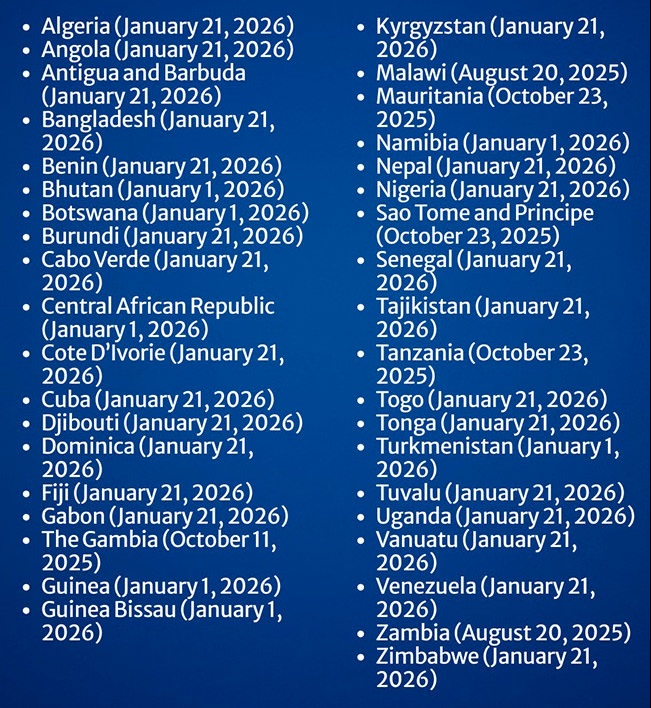
US President Donald Trump’s administration has put 25 more countries, including Bangladesh, on a list of nations whose citizens could be required to post bonds of up to $15,000 to apply for entry into the US, Reuters reported quoting the State Department website on Tuesday.

“Any citizen or national travelling on a passport issued by one of these countries, who is found otherwise eligible for a B1/B2 visa, must post a bond for $5,000, $10,000, or $15,000,” the State Department website said, adding the amount was determined at the time of the visa interview.

Applicants must agree to the terms of the bond through the US Treasury Department’s online payment platform, Pay.gov, the State Department said.

The list mostly included countries from Africa, Latin America and South Asia. It had a total of 38 countries as of Tuesday. The policy for the newly added nations will go into effect on January 21, the State Department website said.

A State Department pilot programme was launched in August with an initial list of nations. The US government has said the bonds seek to deter visitors from overstaying their visas intended for tourism or business purposes.

Since taking office last January, Trump, a Republican, has pursued a hard-line immigration policy, involving an aggressive deportation drive, revocations of visas and green cards and screening of social media posts and past speeches of immigrants.

Human rights groups have widely condemned Trump’s immigration and travel-related policies, saying they curb due process guarantees and free speech. Trump and his allies say the policies seek to improve domestic security.

    • Preventing overstays: The primary purpose is to create a strong financial incentive for travellers to leave the US before their visa expires.
    • High-risk designation: As of early 2026, the US has expanded this requirement to nearly 38 countries (including many in Africa, such as Nigeria and Angola, as well as nations like Bangladesh and Nepal) that have historically high rates of visa overstays.
    • Compliance insurance: It ensures that if a visitor violates their visa terms, the government has already collected a penalty.
      Key Facts-
    • Refunds: The money is returned if the traveller departs on time or if the visa is denied.
    • Restrictions:Travellers on this programme are often limited to a single entry, a maximum stay of 30 days, and must enter through specific designated airports (like JFK, Dulles, or Boston Logan).
  • Affordability: Because the bond is per person, it has become a significant barrier for families or travellers from lower-income backgrounds.

List of the Countries:


BNP announces seven-day mourning

Bangladesh Nationalist Party has announced a seven-day mourning period following the death of the party’s chairperson and Bangladesh’s three-time former prime minister Khaleda Zia. The announcement was made at a press conference held at Evercare Hospital in Dhaka on Tuesday morning by BNP senior joint secretary general Ruhul Kabir Rizvi.

Rizvi said that during the seven-day period, party leaders and activists would wear black badges. Quran recitations and prayer gatherings will be held in all offices. Condolence books will be opened at the BNP headquarters in Paltan and Gulshan. The schedule for her burial and final rites will be announced later. Khaleda Zia, Bangladesh’s first female prime minister, passed away at 6:00am on Tuesday.


Workers Party, Jasod, some JP faction leaders stay away from polls

The Workers Party of Bangladesh and the Jatiya Samajtantrik Dal–Jasod have decided to stay away from the forthcoming general elections and the referendum on the July charter, scheduled for February 12. The two political parties, also the allies of the Awami League-led alliance from 2008 to August 2024, in separate statements, said that they did not submit nomination papers to contest the election and alleged that the election would be held in a unilateral manner.

They also said that cases filed against their party leaders in connection with the July uprising had not been withdrawn, and that this was why they had been refraining from participating in the election.

None of the leaders and activists of the Workers Party of Bangladesh, led by Rashed Khan Menon, and Jatiya Samajtantrik Dal–Jasod, led by Hasanul Haque Inu, submitted nomination papers for any of the constituencies across the country.

Besides, several leaders of different Jatiya Party factions who initially collected nomination forms refrained from submitting the papers on Monday, the last date for filing nomination papers.

Jatiya Party faction chairman Anwar Hossain Manju, JP’s another faction secretary general ABM Ruhul Amin Hawlader, senior co-chairman Kazi Firoz Rashid, and Krishok Sramik Janata League president Abdul Kader Siddique are among the senior leaders of the parties who did not submit their nomination papers within the scheduled time, leaders of the parties said.

They alleged that the interim government and the Election Commission had failed to ensure a level playing field for all political parties. They said that cases filed against their leaders after the July uprising had not been withdrawn. The JP faction in November launched a political alliance named ‘National Democratic Front’, comprising 18 political parties, and had initially prepared to contest the national election.

However, JP faction chairman Anisul Islam Mahmud and executive chairman Mujibul Haque Chunnu submitted their nomination papers on Sunday for their respective constituencies. The Awami League regime was ousted from power on August 5, 2024 amid a mass uprising and the Professor Muhammad Yunus-led interim government took office on August 8, 2024.


HSC results published: Pass rate drops to 58.83%

The results of the 2025 Higher Secondary Certificate (HSC) and equivalent examinations have been published. This year, the combined pass rate across nine general education boards, the Madrasah Education Board, and the Technical Education Board stands at 58.83%. Dhaka Education Board Chairman and Inter-Education Board Coordination Committee Chairman Prof Dr Khondokar Ehsanul Kabir announced the results on Thursday.

The pass rate has dropped by 18.95 percentage points compared to last year. A total of 39,097 students achieved a GPA 5 this year. In 2024, the average pass rate was 77.78%, while in 2023 it was 78.64%. This year the pass rates are 64.62% in the Dhaka Board, 59.40% in Rajshahi, 48.86% in Comilla, 50.20% in Jessore, 52.57% in Chittagong, 62.57% in Barisal, 51.86% in Sylhet, 57.49% in Dinajpur, 51.54% in Mymensingh, 75.61% in the Madrasah Education Board, and 62.67% in the Technical Education Board.

Of them, the Madrasah Board topped the pass rate with 75.61% while Comilla Board positioned at the bottom with 48.86%. Ehsanul Kabir informed that a total of 69,097 students secured GPA-5 this year, a cut by 76,814 than that of the past year.

Examinees will be able to get their results through the websites of the country’s education boards, all relevant examination centers, educational institutions, and via SMS. This time, 1,251,111 students participated in the examination under 11 education boards.


John Bolton Indicted for Mishandling Classified Information

Former U.S. National Security Adviser John Bolton, who served under Donald Trump, has been charged with storing and sharing classified documents from his time in government. According to the 18-count indictment filed in Maryland, Bolton kept top-secret materials at his home and shared over 1,000 pages of sensitive notes with family members. Prosecutors also allege Iranian-linked hackers accessed classified information from his hacked email in 2021.

Bolton’s lawyer, Abbe Lowell, said the charges relate to “personal diaries” long known to the FBI, denying any wrongdoing.

The case comes amid recent indictments of James Comey and Letitia James, both of whom deny separate charges. Attorney General Pam Bondi said the Bolton indictment shows “no one is above the law.”

Bolton, a longtime Republican foreign policy figure, previously faced controversy over his 2020 memoir “The Room Where It Happened,” which the Trump administration claimed contained classified material.


Cuomo Calls Mamdani’s NYC Tax Plan an “Impossibility”

NEW YORK — Independent mayoral candidate Andrew Cuomo is taking aim at Democratic nominee Zohran Mamdani’s proposal to raise taxes on corporations and millionaires, calling the plan “an impossibility.”

In an interview with WNYC’s Brian Lehrer, the former governor argued that Mamdani’s idea to boost state corporate and high-income tax rates to fund New York City programs would never pass in Albany.

“A Buffalo assemblyman or a Long Island senator is not going to raise taxes on their corporations to give the money to New York City,” Cuomo said. “It is an impossibility that a state legislature would raise statewide corporate taxes dedicated to only New York City.”

Cuomo, who served as governor for 11 years, said lawmakers from outside the five boroughs would never back a tax hike that doesn’t benefit their constituents. He also noted that Gov. Kathy Hochul, who faces reelection next year, has stated she has no interest in raising taxes on the wealthy or corporations.

Mamdani, a Queens assembly member and democratic socialist, has made tax increases on corporations and high earners the centerpiece of his affordability platform — aimed at funding free city buses, universal subsidized childcare, and other social programs.

Mamdani’s campaign pushed back, accusing Cuomo of defending the interests of the wealthy.

“Don’t get it twisted: Andrew Cuomo will stop at nothing to protect the billionaires and corporations making life more expensive for New Yorkers,” said Mamdani spokesperson Dora Pekec, noting that Cuomo initially resisted but ultimately signed a 2021 tax hike on the rich.

Cuomo’s spokesperson Rich Azzopardi countered that Cuomo’s record speaks for itself.

“The governor proposed a millionaires tax in his 2021 budget amid the financial burdens of the pandemic and it remains on the books,” Azzopardi said. “Mamdani’s operation should get their facts right.”

The sharp exchange comes as Cuomo tries to revive his underdog campaign following a loss to Mamdani in last month’s Democratic primary. Also in the general election race are Mayor Eric Adams (running on an independent line), Republican nominee Curtis Sliwa, and independent candidate Jim Walden.

Cuomo, who resigned in 2021 amid sexual harassment allegations he denies, has since revamped his campaign strategy — spending more time meeting voters and embracing short-form social media videos that proved successful for Mamdani.

“The reason it’s dangerous,” Cuomo said of Mamdani’s proposals, “is because none of it happens, none of it works. Then you just disillusion the public — and nothing changes.”