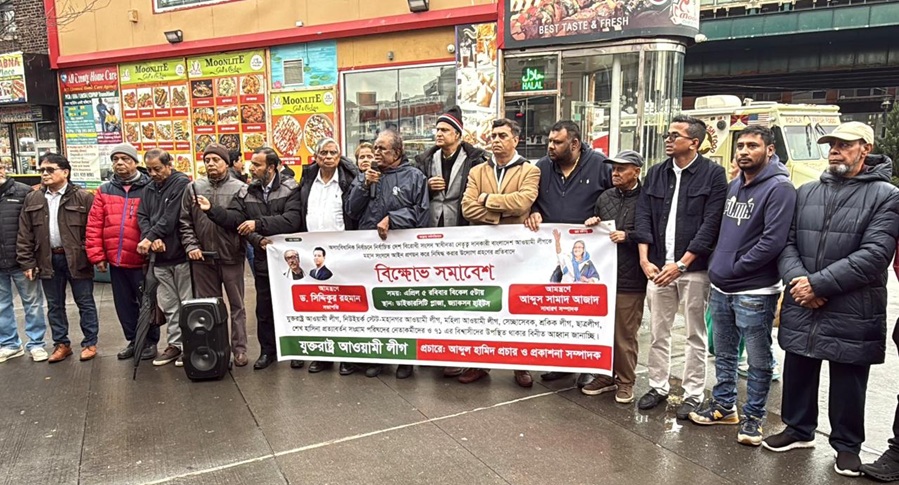
US Awami League Leaders Protest Alleged Conspiracy to Ban Party

New York: Leaders and activists of the United States Awami League have strongly protested what they described as a conspiracy by BNP-Jamaat groups to ban the Bangladesh Awami League, warning of a strong movement if such efforts continue.

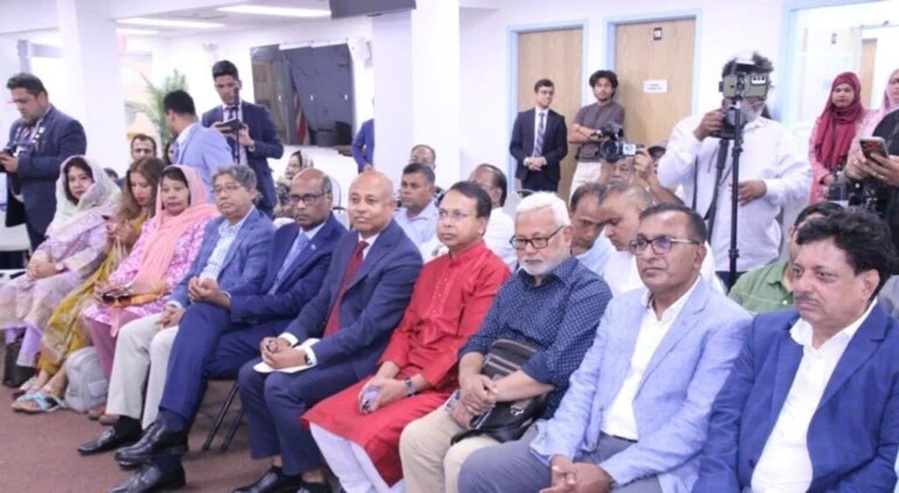
Speaking at a rally held on April 5 in Jackson Heights, New York City, party leaders expressed anger and concern over what they called a political conspiracy. They asserted that Bangladesh did not create the Awami League; rather, Bangladesh itself was born under the leadership of the Awami League. According to the speakers, those who do not believe in the red-and-green national flag are capable of engaging in such actions.

The speakers further noted that even Pakistani military rulers had once banned the Awami League, and alleged that BNP-Jamaat are now attempting to repeat that history. They said such efforts would never be allowed to succeed.

Dr. Siddiqur Rahman, President of the US Awami League, stated that the current government should not forget that the February 12 election lacks legitimacy, as it excluded what he claimed to be 55 percent of Awami League supporters. He added that this issue is increasingly coming to light and that similar voices of protest will soon rise across the United States, including New York. He warned that the power structure of what he described as extremist elements would eventually collapse.

The rally began with an opening speech by Dr. Siddiqur Rahman and was conducted by General Secretary Abdus Samad Azad.

Among those who spoke at the event were Sajjad Hossain Sabuj, Press Minister at the Bangladesh Embassy in Washington, D.C.; Imdad Chowdhury, General Secretary of New York City Awami League; Vice President Sakhawat Hossain Chanchal; Dr. Masudul Hasan, Vice President of US Awami League; freedom fighters Sharaf Sarkar and Solaiman Ali; Zainal Abedin; John Sikdar; Organizing Secretary Mohiuddin Dewan; Sharif Kamrul Hira; M.A. Malek; Professor Shahnaz Mumtaz, President of US Mahila Awami League; Sheikh Atik, Vice President of New York State Awami League; General Secretary Shaheen Azmal; Ashraful Uddin, Vice President of US Swechchhasebak League; Bronx Awami League leader Md. Muhit; US Awami League leader Md. Tulon; Jubo League leader Sebul Mia; Chhatra League leaders Hridoy Mia and Zahid Hasan, among others.

Also present were journalist union leader Saban Mahmud, US Awami League Organizing Secretary Abul Hasib Mamun, and Executive Member Shahanara Rahman.


Protest Held in Front of the United Nations Condemning Ban on Awami League

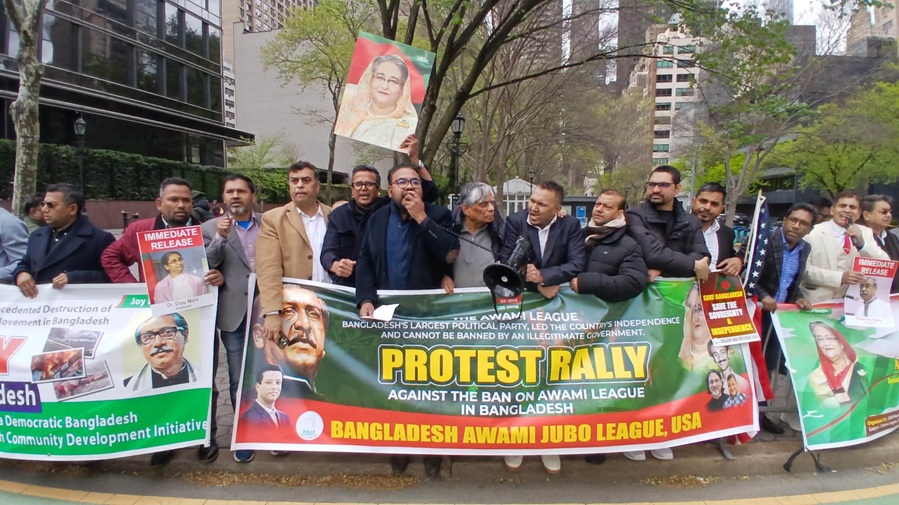
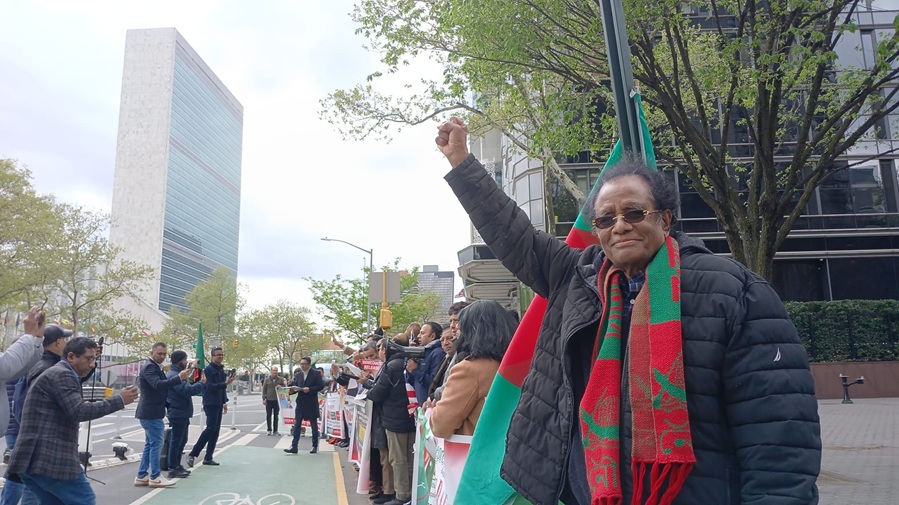
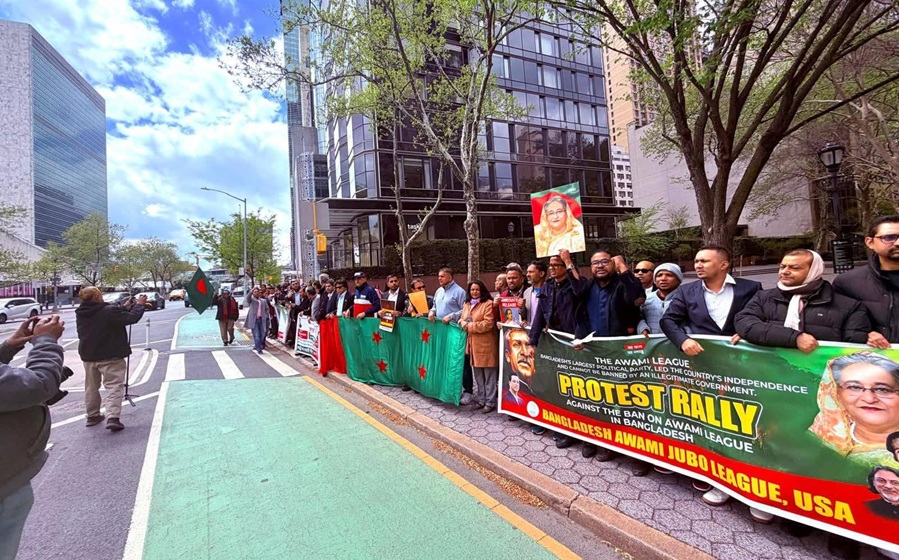
Shibbir Ahmed, United Nations, New York: A large protest rally was held in front of the United Nations on April 20, where demonstrators strongly condemned the reported ban on the Awami League in Bangladesh and demanded its immediate withdrawal. Protesters warned that if the decision is not reversed, a strong আন্দোলন (movement) would be launched from the United States to overthrow the Jamaat-BNP-led government under the leadership of Tarique Rahman.

The main organizer of the program, Dr. Pradip Kar, an advisor to the United States Awami League and a freedom fighter, also called for intervention from President Donald Trump and the United Nations to address the rise of militancy and terrorism in Bangladesh.

Among those who spoke at the rally were leaders and activists from various affiliated organizations, including the Awami League, Jubo League, Chhatra League, and Mohila Awami League. Key speakers included Dr. Siddiqur Rahman, Abdus Samad Azad, Dr. Masudul Hasan, Abul Hasib Mamun, Abdur Rahim Badsha, Rafiqul Rahman, Imdad Chowdhury, Shaheen Azmal, Mohiuddin Dewan, Sheikh Atik, M.A. Karim Jahangir, Hakikul Islam Khokon, Advocate Shah Bakhtiar, Solaiman Ali, Sakhawat Ali, Advocate Rokibuddin Dulal, Advocate Morsheda Zaman, Rumana Akter, Baker Bhuiyan, Jalal Uddin Jalil, Tarek ul Haider Chowdhury, Sheikh Jamal, Jewel Ahmed, Shahidul Islam, and Hriday Mia, among others.

During the rally, Dr. Pradip Kar announced a peaceful human chain demonstration to be held in front of the U.S. State Department on May 4 from 1:00 PM to 2:00 PM, demanding the repeal of the law banning the Awami League. He also stated that a memorandum would be submitted to the U.S. Secretary of State. Additionally, a memorandum has already been submitted to the Secretary-General of the United Nations following the protest.

Meanwhile, the United States Awami League, along with its New York State and city units, has also announced another protest rally scheduled for April 30 at 12:00 PM in front of the State Department and the White House to oppose the passage of the law banning the Awami League.


Court last hope for Awami League after activity ban

With its political activities banned under an amended anti-terrorism law, the Bangladesh Awami League’s only remaining path to resuming operations now lies in the courts, legal experts say. The 13th National Parliament on Wednesday approved the Anti-Terrorism (Amendment) Bill, formalising an ordinance issued during the interim government’s tenure that allows authorities to prohibit activities of individuals or entities accused of involvement in terrorism.

Under the law, the government can ban organisational activities through a gazette notification, restrict public statements, and prohibit meetings, processions and campaigns across all platforms. While the Awami League as an entity has not been dissolved, the ban on its activities effectively sidelines it from political engagement.

Senior Supreme Court lawyer Mamun Mahbub said the party still has a constitutional avenue to challenge the decision. “The Awami League has not been banned as a party, only its activities,” he said. If it wants to return, it must file a writ petition in the High Court. He added that the court could examine whether the restrictions are legally justified and consistent with constitutional provisions.

The ban has sparked debate among legal experts, particularly over its compatibility with Article 38 of the Constitution, which guarantees freedom of association.Human rights lawyer Manzil Morshed said such restrictions may not withstand judicial scrutiny unless clearly justified. Citizens have a fundamental right to organise. If this law is challenged, the court will assess whether that right has been unlawfully curtailed, he said.

He argued that only organisations engaged in activities threatening state security or public order can be legally banned, and any broader restriction could be struck down.

The amendment empowers the government to declare any individual or organisation involved in terrorist activities as banned, either by listing them in an official schedule or by prohibiting all activities. It also restricts any form of communication or mobilisation in support of such entities, including through media and social platforms.

The ordinance was originally issued in May 2025 under presidential powers when Parliament was not in session and has now been enacted into law without changes. Analysts say the issue now shifts from the political arena to the judiciary.

With the law in force, the Awami League’s ability to operate depends largely on whether it chooses to challenge the ban – and how the courts interpret constitutional safeguards against state restrictions. For now, the High Court stands as the final avenue for the party to seek restoration of its political activities.


Rally Held in New York Protesting Alleged Plot to Ban Awami League

Staff Reporter: Leaders and activists of the United States Awami League have strongly protested what they described as a conspiracy to ban the Bangladesh Awami League. They warned that if such activities are not stopped, a widespread movement will be launched across the United States. The remarks were made at a protest rally held on April 5 in Jackson Heights, New York City. Speakers at the event alleged that BNP and Jamaat are involved in efforts to push for a ban on the Awami League.

Addressing the rally, speakers said that the Awami League is not just a political party, but a historic organization that led the birth of Bangladesh. They argued that those who do not believe in the country’s red and green flag are capable of such actions. They further stated that in the past, Pakistani military rulers had also attempted to ban the Awami League, drawing parallels with the current situation.

Speaking at the rally, Dr. Siddiqur Rahman, President of the US Awami League, said, “Those in power through what we consider a staged and illegitimate election should not forget that an election excluding a large portion of Awami League supporters lacks credibility. This issue will soon resonate across New York and the wider United States.”

The rally began with an opening speech by Dr. Siddiqur Rahman and was conducted by General Secretary Abdus Samad Azad.

Among those present were Sajjad Hossain Sabuj, Press Minister at the Bangladesh Embassy in Washington, DC; Imdad Chowdhury, General Secretary of New York City Awami League; Vice President Sakhawat Hossain Chanchal; Dr. Masudul Hasan, Vice President of US Awami League; freedom fighter Sharaf Sarkar; Solaiman Ali; Zainal Abedin; John Sikder; Organizing Secretary Mohiuddin Dewan; Sharif Kamrul Hira; M A Malek; Professor Shahnaz Momtaz, President of US Mahila Awami League; Sheikh Atik, Vice President of New York State Awami League; Shahin Azmal, General Secretary; Ashrafulddin, Vice President of US Swechchhasebak League; Bronx Awami League leader Md. Muhit; US Awami League leader Md. Tulon; Jubo League leader Sebul Mia; Chhatra League leaders Hriday Mia and Zahid Hasan, among others. Also present were journalist union leader Saban Mahmud, Organizing Secretary Abul Hasib Mamun, and Executive Member Shahanara Rahman.


BNP Government Moves to Turn Awami League Ban Ordinance into Law with Punitive Provisions

The BNP government is set to transform the interim government’s “anti-terrorism ordinance,” which banned the activities of the Awami League, into law. The proposed legislation includes punitive measures. During the interim government, the BNP had opposed the idea of banning any political party through executive orders, stating that the public should decide. However, after coming to power, the government is taking steps to convert the ordinance into law. Until the executive order is officially revoked, the Awami League remains under restrictions. Once the law, including punitive provisions, is enacted, the party will face even greater limitations in carrying out political activities.

The 133rd ordinance issued by the interim government was introduced in the 13th Parliament on March 13. On that day, a 14-member special committee was formed to review the ordinances. Under Article 93 of the Constitution, an ordinance lapses if not passed by Parliament within 30 days, which in this case would have been April 12.

Last Thursday, the special committee recommended that 98 ordinances be converted into law without any changes. Fifteen ordinances were proposed for amendments before being presented as bills. Sixteen ordinances are not to be introduced at this time, and four were repealed based on recommendations from Hefazat.

Among the 15 ordinances recommended for amendment and presentation as bills is the “Anti-Terrorism Ordinance” issued on May 11, 2025. This ordinance, by amending Sections 18 and 20 of the 2009 Anti-Terrorism Act, banned the activities of the Awami League and all its affiliated organizations. The same law had banned the activities of the student wing, Chhatra League, in October 2024.

On May 9 last year, NCP leaders staged a protest at the residence of then Chief Advisor Dr. Muhammad Yunus, demanding the ban on the Awami League. Later, other parties, including Jamaat-e-Islami, Gana Odhikar Parishad, Islami Andolon, AB Party, and Bangladesh Khalafat Majlis, joined the movement.

On the night of May 11, an emergency meeting of the advisory council at Yunus’ residence amended two sections of the Anti-Terrorism Act. It allowed the government to ban the activities of individuals or organizations involved in terrorism through executive orders. On the same day, a government notification stated that the Awami League’s activities would remain banned until trials in the International Crimes Tribunal concluded.

The interim government did not directly ban the Awami League. However, under the restrictions of Section 20 of the ordinance, the party cannot hold rallies, meetings, or assemblies; its offices must remain closed; bank accounts can be frozen; posters and banners cannot be displayed; press releases cannot be issued; and the party is barred from publishing in media or social platforms and holding press conferences.

The law proposes that banned organizations conducting activities could face four to 14 years of imprisonment. The ordinance itself did not specify penalties for violations, meaning the Awami League had been under restriction without legal consequences for noncompliance.

The parliamentary special committee, consulting with relevant ministries, recommended the passage of the anti-terrorism ordinance as law. The Ministry of Home Affairs noted that “the ordinance does not contain any penal provisions for banned organizations, but punitive measures can be added.”

Although it is unclear what specific penalties will be included, government sources indicate that existing provisions under Section 16 of the law would apply to restricted organizations. Awami League leaders have refrained from making formal statements on the matter. However, Presidium member and former minister Abdur Rahman told reporters that the public will ultimately decide. He added that facing restrictions is not new for the Awami League, as the party has navigated such challenges in the past.

When asked whether the Awami League would challenge the validity of the ordinance in court, Abdur Rahman said the party would take legal or protest action wherever necessary.


Awami League and Pro-Liberation Groups Celebrate Independence Day in New York

New York: The 56th Independence Day of Bangladesh was celebrated with enthusiasm by the United States Awami League, its affiliated organizations, and various pro-Liberation groups, including political, social, and cultural associations. Journalists, poets, researchers, and prominent expatriate leaders also attended the event.

The program was held on the evening of March 22 at Juice Center in Jackson Heights, New York City. It was presided over by Dr. Pradip Ranjan Kar, veteran freedom fighter, former General Secretary of BAKSU, and advisor to the US Awami League. The event was jointly organized by US Awami League Office Secretary Engineer Mohammad Ali Siddiqui and Legal Secretary Advocate Shah Mohammad Bakhtiar Ali.

The discussion, titled “The Significance of Independence Day and Today’s Bangladesh,” featured speeches by senior journalist and US Awami League advisor Hakikul Islam Khokon, freedom fighters Golam Mostofa Khan Miraj, Shawkat Akbar Richy, Faruk Hossain, Khurshid Anwar Bablu, Ismail Khan Ansari, Helal Majid, poet and freedom fighter Avinash Acharya, and Dr. Selina Afrin Rita, child of a martyr family and YouTube host. Other leaders from Awami League and its affiliated organizations also addressed the gathering.

Patriotic poetry recitations were delivered by Hasan Al Abdullah, Minhaj Ahmed Shammu, Gopon Saha, and Awami League leader Rina Abedin. The program began with a collective rendition of the national anthem, followed by a one-minute silence honoring the martyrs of the 1952 Language Movement, the 1962–1969 education and democracy movements, the 1971 Liberation War, the assassination of Sheikh Mujibur Rahman and his family in 1975, the 2004 grenade attack on Sheikh Hasina, and other struggles for democracy.

Speakers expressed concern over the resurgence of forces defeated in 1971 and emphasized the need for unity at home and abroad. They called for keeping the spirit of liberation alive, strengthening the legacy of Bangabandhu Sheikh Mujibur Rahman, and ensuring that those responsible for historical atrocities face justice.


New York State BNP Pledges Unity in Support of Tarique Rahman’s Development Agenda

New York: Leaders of the New York State unit of the Bangladesh Nationalist Party (BNP) have expressed their commitment to accelerating Bangladesh’s development under the leadership of Tarique Rahman. The pledge was made during a discussion meeting held on March 29 at Diversity Plaza in New York City, organized to mark Independence Day.

In his opening remarks, BNP central committee member Gias Ahmed said that following Tarique Rahman’s vision, expatriate Bangladeshis remain united in working to build a democratic and prosperous Bangladesh, fulfilling the dreams of the late President Ziaur Rahman.

Speaking as a special guest, BNP USA Joint Secretary General Akter Hossain Badal highlighted that party members abroad are committed to supporting Tarique Rahman, the rightful successor to Ziaur Rahman and former Prime Minister Khaleda Zia, in building an equitable society.

Another special guest, Golam Faruk Shaheen, member of the BNP Chairperson’s Foreign Affairs Advisory Committee, said that expatriate activists—long engaged in political struggle—now face the critical task of providing full support for Tarique Rahman’s development mission.

The event, moderated by State BNP General Secretary Saidur Rahman Said and chaired by State BNP President Oliullah Atikur Rahman, was attended by numerous party leaders and activists. The program concluded with a special prayer for the martyrs of Bangladesh’s Liberation War. Organizers expressed gratitude to participants for attending despite adverse weather conditions.


PM exchanges views with party leaders at Nayapaltan office

DHAKA  – BNP Chairman and Prime Minister Tarique Rahman today exchanged views with party leaders, cabinet members and lawmakers at the party’s Nayapaltan central office here this evening. Earlier, he arrived at the central office around 7:20pm while BNP leaders and activists welcomed him upon his arrival.

This is the first time Tarique Rahman visited the party’s Nayapaltan office after assuming office as Prime Minister, said sources at Prime Minister’s Office (PMO). Earlier, he had visited the Nayapaltan office once after returning to the country from London.

A large number of party leaders and activists have gathered in the Nayapaltan area since the afternoon to mark his arrival. They chanted slogans, making the entire area vibrant. Members of law enforcement agencies were seen performing their duties to ensure the safety and security for the event.


Former Adviser Asif Claims “Deep State” Planned to Keep Interim Govt Until 2029

Dhaka: Asif Mahmud Sajeeb Bhuiyan, former adviser to the interim government and spokesperson of the National Citizen Party (NCP), has alleged that a so-called “deep state” had devised a strategy to keep the interim government in power until 2029. He made these remarks at a discussion titled “From Blood-Stained Independence to Reforms and Referendum: The Political Duty of Implementation”, organized by Dhaka Metropolitan South NCP at the party’s central office in Banglamotor on Thursday afternoon, marking Independence Day.

Asif said that during the early days of their tenure in government, they were approached by powerful institutions—referred to as the “deep state”—with an offer. “They told us: ‘Sheikh Hasina’s tenure runs until 2029. You complete that term, and we will support you,’” he stated.

He added that the proposal came with specific conditions, including facilitating certain interests and following a roadmap designed to keep opposition figures—particularly from the BNP—out of elections.

According to him, the plan involved prolonging legal cases against BNP leaders so they would remain ineligible to contest elections. “If their sentences were not overturned, they would not be able to participate even if elections were held,” he said, mentioning Tarique Rahman as an example.

Asif claimed that a full strategy had been presented to them on how to remain in power through compromise, but emphasized, “We did not agree to it.”

He also accused large corporations of hoarding fuel, alleging that parts of the BNP were involved in such syndicates. Drawing from his experience in the previous government’s purchasing committee, he questioned how a crisis could emerge within a month when reserves were supposed to last two months, suggesting involvement of individuals close to the government.

Criticizing BNP further, he alleged that the party had appointed its loyalists as administrators in various institutions, undermining democracy. “If those appointed as administrators later contest elections, what fairness remains for others?” he asked.

Asif maintained that their government remained committed to democracy and ensured elections were held fairly. “To prevent any controversy, we voluntarily resigned before the election,” he said. However, he criticized the current government for appointing two key figures from the previous administration to ministerial positions, despite earlier demands for resignations to ensure a level playing field.

NCP Joint Convener Sarwar Tushar also spoke at the event, criticizing how the study of history in Bangladesh remains confined to narrow debates—particularly over who declared independence first. He emphasized that true history encompasses the broader struggles, sacrifices, and contributions of the people. “Unfortunately, the narrative of history changes with every change in government,” he said.

Tushar expressed disappointment that despite hopes for reform following recent mass uprisings, political parties are still failing to honor their commitments to the public. He drew parallels with unimplemented reform proposals following the 1990 political transition, suggesting a similar pattern continues today.


US Awami League Demands Withdrawal of Ban on Awami League

The US Awami League observed the historic March 7, the birth anniversary of Father of the Nation Bangabandhu Sheikh Mujibur Rahman, and National Children’s Day with due respect and dignity. The program was held at Nabanna Party Center in Jackson Heights, New York—often referred to as the capital of the world—with the presence of leaders and activists from all wings and affiliated organizations of the US Awami League. The hall was filled with party members and supporters.

The event was chaired by US Awami League President Dr. Siddiqur Rahman and conducted by General Secretary Abdus Samad Azad. Speakers at the event expressed concern that the newly elected BNP government has prevented the proper observance of the historic March 7 speech of Bangabandhu Sheikh Mujibur Rahman—an address internationally recognized as an epic declaration of independence—thereby pushing the nation toward division.

The speakers also urged the BNP government to immediately withdraw the ban imposed on the Awami League and its affiliated organizations through what they described as an illegal ordinance issued by the “killer-fascist Yunus government.”

Leaders from the US Awami League, New York State and City Awami League, Mahila Awami League, Swechchhasebak League, Jubo League, and the US Chhatra League took part in the discussion.

—Press Release