Trump congratulates PM Tarique Rahman

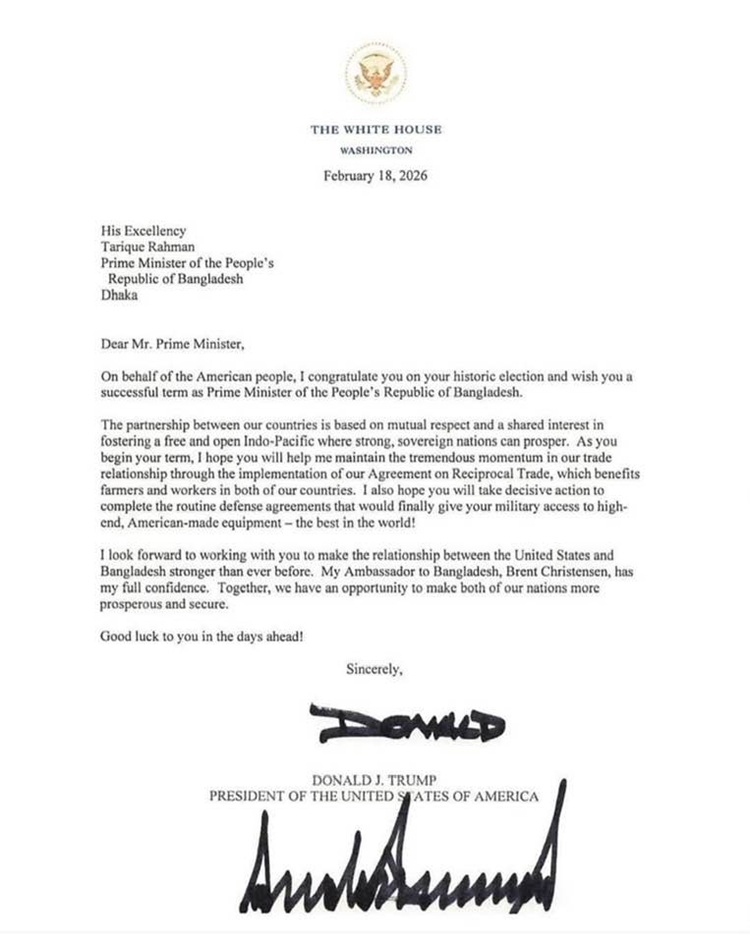
US President Donald J. Trump has congratulated Prime Minister Tarique Rahman on his historic election victory, expressing optimism about strengthening bilateral ties and expanding cooperation in trade, defence and regional stability. In a letter dated February 18, 2026, from the White House, President Trump conveyed his greetings to the Prime Minister of Bangladesh.

“On behalf of the American people, I congratulate you on your historic election and wish you a successful term as Prime Minister of the People’s Republic of Bangladesh,” he wrote.

Highlighting the foundation of bilateral relations, Trump said, “The partnership between our countries is based on mutual respect and a shared interest in fostering a free and open Indo-Pacific where strong, sovereign nations can prosper.”

Referring to economic cooperation, he wrote, “As you begin your term, I hope you will help me maintain the tremendous momentum in our trade relationship through the implementation of our Agreement on Reciprocal Trade, which benefits farmers and workers in both of our countries.”

The US President also underscored defence collaboration, stating, “I also hope you will take decisive action to complete the routine defense agreements that would finally give your military access to high-end, American-made equipment – the best in the world!”

Expressing confidence in future engagement, Trump said, “I look forward to working with you to make the relationship between the United States and Bangladesh stronger than ever before.”

He added, “My Ambassador to Bangladesh, Brent Christensen, has my full confidence. Together, we have an opportunity to make both of our nations more prosperous and secure.”

Concluding the message, the US President wrote, “Good luck to you in the days ahead!”


China Premier greets Bangladesh PM Tarique Rahman

Prime Minister Tarique Rahman on his inauguration, reaffirming Beijing’s support for Bangladesh’s new government. In a congratulatory message sent on Tuesday, Premier Li Qiang conveyed his
warm wishes to Prime Minister Tarique Rahman on assuming office. Li said China and Bangladesh are close neighbours and Comprehensive Strategic Cooperative Partners enjoying long-standing friendship, noting that friendly exchanges between the two countries date back decades.

He recalled that over the 51 years since the establishment of diplomatic relations, Beijing and Dhaka have consistently respected each other, treated one another as equals and pursued mutually beneficial cooperation and win-winoutcomes, setting what he described as a fine example of state-to-state relations.

The Chinese Premier reaffirmed that his government supports the new Bangladeshi administration in ensuring smooth governance and national development. Expressing readiness to work closely with Prime Minister Tarique Rahman, Li said he looks forward to carrying forward the traditional friendship between the two nations, strengthening high-quality cooperation under the Belt and
Road Initiative and expanding exchanges across various sectors.

He voiced confidence that joint efforts would elevate the China-Bangladesh Comprehensive Strategic Cooperative Partnership to a new height and deliver greater benefits to the peoples of both countries.


Congressional Briefing Exposes Pogrom Against Hindus in Bangladesh

Washington, DC, February 11, 2026: The Coalition of Hindus of North America (CoHNA) and HinduAction convened a congressional briefing presenting urgent testimony on the escalating persecution of religious minorities in Bangladesh under Chief Advisor Muhammad Yunus, ahead of a deeply contested national election scheduled for February 12. The briefing amplified voices from the ground—journalists, human rights advocates, survivors, and young Bangladeshi Hindus in the diaspora—who described a deepening climate of fear, institutional collapse, and impunity.

“We need to listen to victim voices”, said CoHNA board member Sudha Jagannathan, emphasizing the depth of state failure in Bangladesh. “Silence is not an option and the congressional briefing is one important way to draw attention to the pogrom underway.”
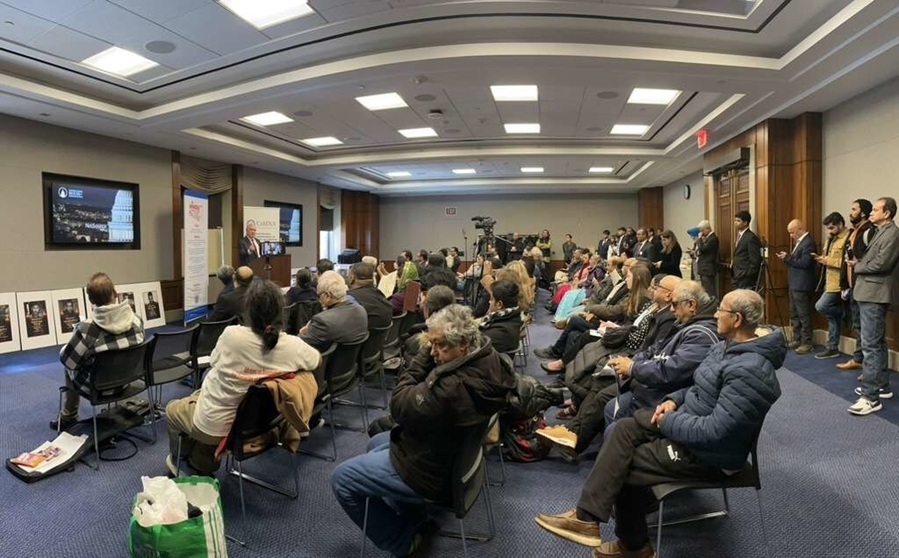
A broad variety of speakers presented data and urged Congress and the State Department to 1) publicly condemn the violence in Bangladesh, and hold congressional hearings, 2) designate Bangladesh as a Country of Particular Concern, 3) designate the Jamaat-e-Islami as a foreign terrorist organization, and 4) apply Magnitsky sanctions on Muhammad Yunus.

Michael Rubin, senior fellow at the American Enterprise Institute, who delivered the keynote address, led the call for sanctions against Yunus under the Global Magnitsky Human Rights Accountability Act—which allows the U.S. to freeze assets and ban entry of foreign human rights violators. He also compared the Islamist crisis in Bangladesh with those in Turkey and Iran, and warned that the U.S. is repeating with Yunus the mistake made with Aung San Suu Kyi in Myanmar—embracing a Nobel laureate whose commitment to liberal principles was “a complete fabrication.”

Congressional Engagement

Rep. Tom Barrett (R-MI), a former U.S. Army officer with 22 years of service, noted that while major battlefronts have wound down, extremist threats have not disappeared. “I know that’s a big reason why you’re here today. I encourage you to continue to advocate, and I appreciate the awareness that you’re raising to bring about a shift in policy,” he said.

Reacting to expert testimony presented at the event, Rep. Suhas Subramanyam (D-VA) wondered if the February 12 elections will be “truly free and fair” as they will proceed without representation from one of the largest mainstream political parties—Sheikh Hasina’s Awami League, which has been banned since May 2025 and its student wing declared a “terrorist organization” since October 2024.

In a recorded message, Samuel Brownback, former U.S. Senator and co-chair of the International Religious Freedom Summit, highlighted the deep impacts of state-sanctioned violence against minorities on population stability and economic prosperity. “If Bangladesh goes in the wrong direction, you’re going to see them drive out most of their religious minorities,” he said.

The briefing drew over 70 attendees including staffers from the offices of Sen. Cory Booker (D-NJ), Rep. Mike Levin (D-CA), Rep. Young Kim (R-CA), and Rep. David Min (D-CA), alongside diplomatic officials, underscoring broad legislative and diplomatic concern over the deteriorating human rights situation in Bangladesh.

Witnesses Testify: “Hindus Will Not Survive Another Decade in Bangladesh”

SriRam, speaking under an alias for safety, and human rights advocate Shubho Roy shared harrowing firsthand accounts of being Hindu in Bangladesh—especially during December 2025, when both witnessed the intensifying crisis on the ground.

In a video testimony, SriRam described coordinated violence and institutional takeover by Islamist groups. He recounted his mother being surrounded by neighbors who chanted that Hindus were traitors and should be expelled from the country. His brother, a doctor, saw his family hospital taken over by Islamist groups and now faces constant threat of attack due to his religious identity. He also noted that December 16—Victory Day, commemorating Bangladesh’s independence from Pakistan in 1971—passed without celebrations, unlike previous years.

Roy, who was also in Dhaka during the same period, testified: “I witnessed it, I went through the trauma. From 1971 till today—we are facing the same. They are going after Hindus. They’re targeting minorities.” Both witnesses warned of imminent erasure. “Hindus will not survive another decade in Bangladesh,” SriRam said. “We will be erased from our homeland.”

The atmosphere of terror in Bangladesh now traumatizes even Hindus living in North America. Gita Sikanji, associate professor at the University of California, Irvine, described organizing rallies in 25 American cities to raise awareness. When she invited an ISKCON leader in California to participate, he began crying and declined. “If I come to the rally and my face is seen in the video, in Bangladesh they will increase the violence on my people,” he told her. “Even American Hindus here are traumatized by this series of events,” Sikanji testified.

Diaspora Youth Mobilizes: Documenting Violence, Demanding Action

Some of the most powerful testimony came from young Hindus raised in America yet deeply moved by events in Bangladesh.

Ritvik Hari, policy analyst at CoHNA, urged Congress to publicly condemn the violence, hold hearings, and designate Bangladesh as a Country of Particular Concern. Puja Debi, Stony Brook University student and co-founder of Bengali Hindus of New York City, described how she has been documenting attacks after realizing mainstream coverage was absent. Pramit Acharjee, senior at Bronx High School of Science, warned that, “minority families are being forced to vote a certain way, and they are killed or displaced if they do not comply.” Swastika Biswas, a Queens high school student, spoke about how language enables violence. “When words strip people of their humanity, violence follows.” Sayan Shil, a young engineer from New York, described the collapse of “psychological safety” for minorities in Bangladesh.

Experts Warn: Bangladesh Risks Becoming a Terrorism Hub

Multiple speakers also documented the systematic breakdown of state institutions and the complicity of security forces in violence against minorities.

Priya Saha, from South Asian Minorities Collective, cited the cases of Hindu police officer Santosh Chowdhury, who was handed over by the Bangladesh army to a mob that lynched and burned him, garment worker Deepu Chandra Das, who was similarly killed after being handed over by factory management, and the violent crackdown in Hazari Goli, where police and military beat and arrested over 80 peaceful Hindu protesters—all of which pointed to direct state involvement, she said. Arifa Rahman Ruma, associate professor at Bangladesh Open University, documented how Islamist militants have been released from prison with full indemnity. National Press Club of Dhaka president Farida Yasmin described the systematic dismantling of a free press with mobs torching major newspaper offices in December 2025.
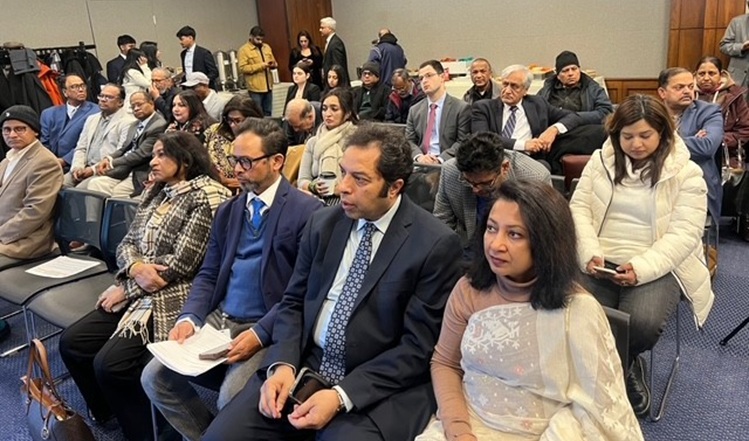
Rana Hassan Mahmud from the Center for U.S.–Bangladesh Relations warned that Bangladesh is heading toward “a sham election with predetermined results.” He cautioned that by allowing Muhammad Yunus to remain in power, “we are enabling the creation of a new hub of terrorism whose repercussions will extend far beyond Bangladesh’s borders.” Utsav Chakrabarti of HinduAction framed the crisis in stark historical terms, warning that “the ongoing pogrom risks escalating into a full-scale repeat of the 1971 genocide—wherein, over the course of 10 months, millions of Hindus were systematically targeted and slaughtered in an orgy of state-backed violence.” He called for the U.S. to hold Jamaat-e-Islami accountable, noting that it is “the very party that collaborated with the Pakistan Army in perpetrating the 1971 genocide, and its return to influence poses a grave threat to regional stability.”

The briefing was part of CoHNA’s sustained grassroots campaign across North America to mobilize attention and defend Hindus in Bangladesh. As the speakers emphasized, the cost of silence extends beyond Bangladesh’s borders—threatening regional stability, emboldening transnational extremism, and undermining American leadership on human rights and religious freedom.


BNP will pursue foreign policy protecting Bangladesh’s interests with China, India, & Pakistan

Bangladesh Nationalist Party (BNP) Chairman Tarique Rahman on Saturday said the party will follow a foreign policy that protects the country’s interests in its dealings with China, India, and Pakistan. Speaking to journalists at a post-election press conference at Hotel Intercontinental in Dhaka, Tarique said Bangladesh’s foreign policy will be guided by “the greater interests of Bangladesh and its people.”

Asked about the main challenges he would face as head of government, Tarique said, “We have several challenges. Our economy faces challenges, and the country’s law and order situation is a concern. We must ensure the security of the people. The previous government politicized almost all institutions. Therefore, we must ensure good governance.”

On Bangladesh’s future relations with China and the Belt and Road Initiative, Tarique said: “We will try to protect the interests of the people of Bangladesh. If something is not in Bangladesh’s interest, naturally we cannot pursue it. I am certain that mutual interests will be our first priority.”

Regarding the Belt and Road Initiative, he added: “If it benefits Bangladesh and supports the economy, we will make a decision.” When asked whether he would consult with youth in decision-making, Tarique said, “People have supported us, and we will certainly listen to the youth. But there are more people in this society. Everyone has some issue or the other; we have to listen to everyone.”

On reviving SAARC, Tarique said: “You know, SAARC was established through Bangladesh’s initiative. We want it to function. We will discuss with our friendly states and try to revive SAARC.”

Asked whether BNP would seek the extradition of Sheikh Hasina from India, he said: “That depends on the legal process.” Responding to another question on China, Tarique said: “They have been Bangladesh’s long-term development partners. We hope to create areas where we can work together.”

On plans to address a fragile economy, low investment, and inflation, the BNP chairman said: “We will bring in new investments and create employment.”


Narendra Modi talks to Tarique over phone, reaffirms India’s support

Indian prime minister Narendra Modi on Friday talked to Bangladesh Nationalist Party chairman Tarique Rahman on the phone about his party’s decisive victory in the national polls held on Thursday. ‘Delighted to speak with Mr Tarique Rahman. I congratulated him on the remarkable victory in the Bangladesh elections,’ Modi said in a statement shared on his social media handle ‘X’.

He said that he had conveyed his best wishes and support in his endeavour to fulfil the aspirations of the people of Bangladesh. ‘As two close neighbours with deep-rooted historical and cultural ties, I reaffirmed India’s continued commitment to the peace, progress, and prosperity of both our peoples,’ Modi said in the statement.

Earlier in the day, the Indian prime minister conveyed congratulations to BNP chairman Tarique Rahman on his party’s decisive victory in the 13th Jatiya Sangsad election. ‘I convey my warm congratulations to Mr Tarique Rahman on leading BNP to a decisive victory in the parliamentary elections in Bangladesh. This victory shows the trust of the people of Bangladesh in your leadership,’ said Modi in another statement shared on ‘X’.

He said India would continue to stand in support of a democratic, progressive and inclusive Bangladesh. ‘I look forward to working with you to strengthen our multifaceted relations and advance our common development goals,’ he said.


China congratulates BNP on taking lead in JS polls

China has congratulated Bangladesh Nationalist Party on taking the lead in the 13th Jatiya Sangsad election held on Thursday. In a message, China also congratulated the people of the country for the smooth and successful JS polls.

‘Congratulations to the people of Bangladesh on the smooth and successful 13th National Parliamentary Election and to the Bangladesh Nationalist Party for taking the lead in the election. We look forward to working together with the new government of Bangladesh and writing new chapters of China-Bangladesh relations,’ said the message shared by the Chinese embassy in Dhaka on Friday.


US congratulates Tarique Rahman on historic victory

The United States has congratulated Bangladesh Nationalist Party (BNP) Chairman Tarique Rahman for the party’s historic victory in the 13th National Parliament Election.

“Congratulations to the people of Bangladesh on a successful election and to the Bangladesh Nationalist Party and Tarique Rahman on your historic victory,” US Embassy in Dhaka said in its official Facebook post this morning.

“The United States looks forward to working with you (Tarique Rahman) to realize shared goals of prosperity and security for both our countries,” it added.


Govt approves fuel oil import from India

The advisory committee on government purchase at a meeting on Tuesday approved a proposal to purchase fuel oils at a cost of Tk 1,462 crore from India amid tensions between Dhaka and New Delhi over a series of incidents. The latest was Dhaka’s decision to shut down the broadcasting of the Indian Premier League after Bangladesh pace bowler Mustafizur Rahman, also known as Fizz, was released by IPL franchise Kolkata Knight Riders, following directives by the Indian Cricket Board.

Dhaka has also asked India to sift Bangladesh matches in the forthcoming T20 World Cup to Sri Lanka from India on ground of security of national cricketers. Finance adviser Salehuddin Ahmed, who presided over the meeting of the advisory committee on government purchase, called the rows over Mustafizur disappointing.

The release of the pace bowler all of a sudden was unfortunate, he said, adding that the fallout of the incident was also unexpected. There have been diplomatic rows between Bangladesh and India since New Delhi gave shelter to deposed prime minister Sheikh Hasina who fled there amid a mass uprising on August 5, 2024. Salehuddin, however, said that the Mustafizur issue had not put any impact on the procurement of goods from India under the government purchase.

At Tuesday’s meeting, a Bangladesh Petroleum Corporation proposal to import 1.8 lakh tonnes of refined diesel from India’s Numaligarh Refinery Limited for the January-December period at a cost of Tk 1,462 crore was approved.

The import price of a litre of diesel from Numaligarh Refinery in Assam has been estimated at Tk 88 while the average price of a litre of diesel on the international market recently was about $1.24, equivalent to Tk 175.

Responding to questions from reporters about diesel imports from India amid the tensions, energy adviser Muhammad Fouzul Kabir Khan said that the diesel import was being carried out under an agreement signed previously.

‘This is a 15-year contract signed long ago,’ he said, adding that the latest import was part of the contract. The day’s meeting also approved three more proposals on imports of fuel oils with the overall amount standing at 30.6 lakh tonnes at an estimate cost of Tk 24,150.84 crore. The imports are to meet the country’s fuel oil demand until June.

The BPC will import 15 lakh tonnes of crude oil from the United Arab Emirates and Saudi Arabia for state-run Eastern Refinery Limited at a cost Tk 11,863 crore. It will import 13.80 lakh tonnes of refined fuel oils from seven companies from six countries under government-to-government arrangements at an estimated cost of Tk 10,826 crore. The six countries are India, China, Malaysia, the UAE, Thailand and Indonesia.


3 Bangladeshi nationals beaten to death in India

Three Bangladeshi nationals were beaten to death, reportedly by Indian nationals in Tripura state of India, on Thursday. The deceased were identified as Pandit Mia, son of Kana Mia; Sajal Mia, son of Kuddus Mia; and Jewel Mia, son of Asrab Ullah, all residents of Chunarughat upazila in Habiganj district.

Lt Col Tanjinul Rahman, commanding officer of BGB-55, said the incident occurred at Karangichhara in Tripura state, about 4–5 kilometres inside India from the zero point of the border. The exact time of the incident, however, could not be confirmed.

According to BGB sources, the three Bangladeshis had allegedly crossed into India two to three days ago when local Indian residents attacked them, suspecting them to be cattle lifters. The attackers allegedly beat and stabbed the men indiscriminately, leaving them dead on the spot.

The bodies were later kept at Sampahar police station. Quoting Pandit Mia’s son, BGB officials said the victims had gone to the hilly area to collect betel leaves on Tuesday morning and had been missing since then.

“On Wednesday, we came to know that the bodies of all three were in India,” said Zahir Mia, son of Pandit. BGB personnel have contacted the Border Security Force (BSF) regarding the incident, said Lt Col Tanjinul.

“Efforts are ongoing to verify the authenticity of the incident and to gather detailed information. All necessary measures are being taken to maintain peace and harmony in the border area and to prevent the recurrence of such unwanted incidents in the future,” he added.


India wants free, fair and inclusive election in Bangladesh: Misri

Indian Foreign Secretary Vikram Misri on Monday said they want to see a free, fair, inclusive, and participatory election in Bangladesh at the earliest possible time. The Indian Foreign Secretary said they are ready to work with the democratically elected government following the results of an inclusive and participatory election.

He made the remarks while interacting with the visiting delegation of Diplomatic Correspondents Association, Bangladesh (DCAB) at the Ministry of External Affairs (MEA), New Delhi. Senior officials of the MEA, DCAB President AKM Moinuddin, and General Secretary Md Arifuzzaman Mamun were present.

During nearly an hour-long interaction, the Indian Foreign Secretary responded to questions on bilateral issues, border issues, water sharing issues, and issues related to former prime minister Sheikh Hasina, who is staying in India. The foreign secretary acknowledged that some issues are natural in any relationship.