Bangladesh calls for stronger global cooperation on safe migration at UN forum

Shibbir Ahmed, UN, New York: Bangladesh called for stronger global cooperation to curb irregular migration, protect migrant rights and ensure fair recruitment, decent work and fair wages for migrant workers.

Speaking at the General Debate of the Second International Migration Review Forum at United Nations Headquarters, Expatriates’ Welfare and Overseas Employment Minister Ariful Haque Choudhury said Bangladesh was strengthening accountability and expanding migrants’ access to justice through a “whole-of-government and whole-of-society” approach.
He said the country had formed a Migration Compact Taskforce and adopted a National Action Plan for 2026–2030 to advance safe, orderly and regular migration under the United Nations Global Compact for Migration (GCM).

The minister said Bangladesh had fulfilled seven of its 10 commitments made at the first review forum, submitted six new pledges and joined two regional initiatives, while presenting its first Voluntary National Review on GCM implementation. Describing climate change as a growing reason of migration, he called for predictable financing and technical support for climate-affected countries. He reaffirmed Bangladesh’s commitment to working with partners to promote safe migration and dignified return and reintegration of migrants.


Bangladesh calls for accelerated nuclear disarmament at NPT Review Conference

Shibbir Ahmed, United Nation, New York: Bangladesh has called for renewed and strengthened global commitment to nuclear disarmament and non-proliferation at the 11th Review Conference of the Treaty on the Non-Proliferation of Nuclear Weapons (NPT) held at the United Nations Headquarters in New York today.

Speaking at the General Debate, Bangladesh’s Permanent Representative, Ambassador Salahuddin Noman Chowdhury, stressed that despite eight decades of the United Nations, the vision of a nuclear-weapon-free world remains unfulfilled. He warned that continued nuclear proliferation poses a grave threat to international peace and security, while also undermining global development aspirations.

Highlighting Bangladesh’s firm commitment to disarmament, the Ambassador noted that the country has consistently advocated for both nuclear and conventional disarmament and has voluntarily remained non-nuclear despite being located in a nuclear-armed region.

Ambassador Chowdhury urged nuclear-weapon States to fulfil their legal obligations under Article VI of the NPT and called for the universalization of disarmament treaties. He also reaffirmed Bangladesh’s strong commitment to advancing global disarmament through dialogue, trust-building, and collective action towards a safer world free from the threat of nuclear weapons.


Bangladesh Highlights Progress on Chittagong Hill Tracts Peace Accord at UN Forum

Shibbir Ahmed, New York, United Nations: Bangladesh has presented its progress on implementing the Chittagong Hill Tracts (CHT) Peace Accord at the 25th session of the United Nations Permanent Forum on Indigenous Issues, currently being held at the United Nations Headquarters.

Speaking at the forum, Mohammad Mizanur Rahman, Secretary of the Ministry of Chittagong Hill Tracts Affairs, outlined the government’s initiatives to implement the peace accord and promote the development, cultural preservation, and rights of indigenous and ethnic communities.

He emphasized that the Constitution of Bangladesh guarantees equal rights to all citizens regardless of religion, ethnicity, caste, gender, or place of birth. Regarding the implementation of the peace accord, he noted that the process is ongoing through an inclusive and participatory approach. Out of the 72 provisions of the accord, 65 have been fully implemented, 3 partially implemented, and 4 are currently in progress.

Rahman also highlighted measures taken to ensure security in the CHT region, maintain environmental balance, and resolve land disputes through land surveys and management initiatives. He informed the forum about broader development efforts undertaken by the government in the region.

He further stated that the government has recently appointed a Special Assistant on ethnic affairs with the status of State Minister, reinforcing its commitment to inclusive governance and participation of indigenous communities in decision-making processes.

In addition, the government’s initiatives to reduce poverty and inequality were highlighted, including expanded social safety nets, rural infrastructure development, digital connectivity, and livelihood diversification programs.

On preserving cultural and linguistic diversity, Rahman reaffirmed the government’s commitment to protecting the unique heritage of indigenous communities. He noted ongoing efforts to expand education and healthcare services, including scholarships, multilingual and e-learning systems, district hospitals, Upazela health complexes, community clinics, and mobile medical teams.

Addressing climate change, he mentioned that the government has adopted a plan to plant two million trees in the hill districts as part of broader environmental initiatives.

The two-week session of the United Nations Permanent Forum on Indigenous Issues is being held from April 20 to May 1, 2026. The Bangladesh delegation, led by Secretary Mohammad Mizanur Rahman, includes the Chairman of the Chittagong Hill Tracts Development Board, Major General (Retd.) Anup Kumar Chakma, along with representatives from the Prime Minister’s Office, Ministry of Foreign Affairs, and members of indigenous communities from both hill and plain regions.

The Permanent Forum on Indigenous Issues operates under the United Nations Economic and Social Council and works on global indigenous issues related to economic and social development, culture, environment, education, health, and human rights.


Militant networks re-emerge using old connections

Jamal Uddin & Sujon KoiriSujon Koiri: Concerns over renewed militant activity in Bangladesh have intensified following the emergence of a warning letter from Police Headquarters, prompting widespread public debate over whether extremist groups, long perceived as dormant, are reorganizing and reactivating. The issue has quickly become a national talking point, raising a central question: why are militant groups appearing to resurface after years of relative silence?

According to law enforcement officials, human rights activists, and security analysts, such groups never fully disappear. Instead, they enter phases of strategic dormancy, using periods of low visibility to restructure, rebuild networks, and consolidate strength.

Experts say this so-called “silence” often reflects a calculated effort to exploit favorable political conditions, institutional weaknesses, and social vulnerabilities. Extremist groups, they note, tend to re-emerge when opportunities align.

In the past, militant organizations such as Lashkar-e-Taiba (LeT) and Jamaat-ul-Mujahideen Bangladesh (JMB) have operated using cross-border networks. Recently, attention has turned to the Pakistan-based Tehreek-e-Taliban Pakistan (TTP), with intelligence sources indicating that possible links involving individuals within Bangladesh are under investigation.

The issue gained further urgency after a warrant officer of the Bangladesh Air Force (BAF), previously reported missing from a base in Chittagong, was located in a camp run by the banned TTP.

The development has prompted a comprehensive internal investigation into potential extremist infiltration within the armed forces. According to relevant sources, Pakistani authorities informed Bangladesh that the individual had been working on behalf of the TTP, an armed group engaged in conflict with the Pakistani state and known for its alignment with the Afghan Taliban.

While the presence of TTP-linked individuals in Bangladesh is not unprecedented, the involvement of a member of the armed forces marks a significant escalation. A 2013 US State Department report noted the arrest of three TTP members in Bangladesh, and as recently as last year, at least four Bangladeshi nationals linked to the group were reportedly killed in a Pakistani military operation.

In response, heightened surveillance and security measures have been introduced at key BAF installations, including Zahurul Haque, AK Khandaker, and Matiur Rahman bases. Law enforcement officials attribute the recent uptick in militant concerns to several factors. Among them is the escape of hardened militants following the fall of the Sheikh Hasina government on August 5, 2024. A number of detainees fled from Kashimpur High Security Prison during that period of instability.

Police Headquarters data indicates that as of December 2025, 133 of the 202 escaped prisoners remain at large. A senior officer of the Counter Terrorism and Transnational Crime (CTTC) unit, speaking anonymously, expressed frustration over what he described as a lack of clear directives regarding fugitives and individuals released on bail.

“The home affairs advisor of the interim government and the IGP have repeatedly said that militancy does not exist in Bangladesh,” the officer said. “After such statements from the top level, there is little we can do at the field level.”

Intelligence officials have also pointed to changes in regional mobility. The easing of visa procedures for travel to Pakistan since the political transition has increased cross-border movement, which some believe may be contributing to the current security concerns. Additionally, unease has been expressed among field-level officers over reports of visits by influential figures linked to the Taliban administration in Afghanistan, coupled with what critics describe as a lack of official response.

Dr Md Tawohidul Haque, an associate professor of Institute of Social Welfare and Research and criminologist at the University of Dhaka, described the developments as a serious warning signal.

“The significance of this issue extends beyond internal discipline within a force,” he told. “It raises broader concerns about national security. If extremist influence penetrates sensitive institutions such as law enforcement, it could pose a major threat.”

Human rights activist Nur Khan Liton echoed similar concerns, arguing that the current situation is not a sudden development but the result of long-standing structural issues.“Milit ants have not suddenly emerged,” he said. “They have existed at various levels within the state, society, and system for a long time.”

According to him, militant groups have continued covert organizational activities even during periods of apparent inactivity. The political changes following the fall of the Awami League government have, he suggested, created new opportunities for previously fragmented networks to regroup and expand. He also pointed to a recent explosion at a madrasa in Keraniganj as a possible indicator of militant activity. Investigations and media reports have suggested links to extremist elements, raising concerns that explosives produced there may have been distributed to other parts of the country.

“Militants are not only increasing their activities but also making various preparations,” Nur Khan said, adding that allegations of involvement by members of certain forces have resurfaced, heightening the need for vigilance. Despite these concerns, he expressed cautious optimism: “Since the issue has been identified, the government is expected to take necessary steps to restore public confidence and prevent further criminal activities.”

Additional Inspector General of Police (Crime and Operations) Khandaker Rafiqul Islam said that law enforcement agencies remain vigilant. “Bangladesh Police is always on alert to prevent militant activities,” he told. He added that specialized units, including the CTTC and Anti-Terrorism Unit (ATU), are actively monitoring developments. Rafiqul Islam noted that several militant suspects released on bail over the past year and a half have been rearrested, while others remain under surveillance. However, he said there is no confirmed information regarding the involvement of police personnel in extremist activities.


Bangladesh urges information integrity and inclusive global communication at UN

Shibbir Ahmed, New York: Bangladesh called for enhanced global efforts to ensure information integrity, combat misinformation and promote inclusive communication at the 48th session of the Committee on Information at United Nations Headquarters in New York today.

Addressing the general debate of the committee that takes place annually at the UN headquarters and deals with global communication, public information, and outreach efforts, Bangladesh’s Permanent Representative Ambassador Salahuddin Noman Chowdhury highlighted the growing challenges posed by misinformation, disinformation, hate speech and the misuse of artificial intelligence and digital platforms, which are fueling divisions and eroding trust across societies. He stressed the need for responsible use of information and communication technologies as well as for bridging the digital divide both between and within countries.

Highlighting Bangladesh’s contributions to UN peacekeeping including the deployment of women peacekeepers, the Permanent Representative called for continued efforts to counter anti-peacekeeping narratives and to promote accountability and environmental responsibility.

Ambassador Chowdhury also drew attention to disinformation-driven crises, including the Rohingya situation in Myanmar and the humanitarian crisis in Gaza, calling for accurate information dissemination and increased global awareness. He reaffirmed Bangladesh’s strong commitment to strengthening global communication efforts in line with the principles and values of the United Nations.


Where does garment industry stand now in Bangladesh!

Shaikh Shahrukh: Thirteen years after the Rana Plaza collapse reshaped Bangladesh’s ready-made garment sector, the industry has undergone sweeping changes — safer factories, stricter compliance and global recognition for green manufacturing. Yet beneath these gains lies a more complex reality: workers still face pressure on the factory floor, survivors continue to struggle with long-term hardship, and manufacturers are grappling with rising costs and financial strain. Workers across major industrial hubs say workplace safety has improved significantly since the 2013 disaster.

“Now there are fire exits, and we have regular drills,” said a female worker in Narayanganj. But concerns remain. “The production pressure is still very high. If we fail to meet targets, wages can be deducted,” she added. A worker in Gazipur said union activities remain sensitive in some factories. “There is always fear of losing jobs,” he said. Others noted that while safety awareness has increased, preparedness during real emergencies still needs improvement.

“Before Rana Plaza, we didn’t even know what a fire exit was. Now we get training, but in a real situation, not everyone can respond properly,” another worker said. For factory owners, the transformation has required heavy financial investment. “After Rana Plaza, entrepreneurs had to invest heavily to ensure safety,” said Faiz Ahmed Khan, managing director of Haseen Kayaba Group.

While necessary, he said, these investments have not been matched by higher prices from international buyers. “Many factories took bank loans to upgrade compliance. Those liabilities still remain,” he said.

Ahsanul Russel, managing director of Tua Ha Textile Mills Ltd, echoed the concern. “We carried out extensive renovations to meet compliance standards. But order prices did not increase accordingly,” he said, adding that many factories are still repaying loans taken during that period. Industry insiders say smaller factories were particularly vulnerable, with many unable to survive the financial shock.

One of the most visible outcomes of post-Rana Plaza reforms has been the growth of environmentally sustainable factories. Bangladesh now has more than 210 LEED-certified green garment factories, many with top-tier Platinum and Gold ratings—the highest number in the world. These facilities incorporate energy-efficient systems, water recycling and environmentally friendly designs, marking a shift toward sustainable production. Before 2013, only a handful of factories met such standards.

However, industry leaders say green transformation has also increased production costs without ensuring better returns. “Compliance and sustainability have improved our global reputation,” said Fazlul Hoque, managing director of Plummy Fashions Ltd and former BKMEA president. “But production costs have risen sharply, while buyers continue to negotiate lower prices,” he added.

In the aftermath of the collapse, international initiatives such as the Accord and the Alliance carried out extensive inspections, focusing on structural, electrical and fire safety. Factories were required to reinforce buildings, upgrade electrical systems and introduce modern fire safety measures, including sprinkler systems and emergency drills. These reforms significantly improved safety standards across the sector. But they also raised the cost of doing business.

Industry estimates suggest that between 2,000 and 2,500 garment factories have closed over the past decade. Key factors include high compliance costs, shrinking profit margins, rising utility expenses and intense global competition. A factory owner in Gazipur said compliance upgrades alone cost between $700,000 and $800,000.

“Buyers did not increase prices. Loans went up, profits declined, and many factories could not survive,” he said, requesting anonymity. Manufacturers say pricing pressure from international buyers remains a major challenge, with some buyers continuing to negotiate aggressively despite demanding higher compliance standards.

Compared to the pre-2013 period, the industry now operates under stricter regulations, higher costs and tighter margins. Safety investment has increased, but so have operational challenges—from energy shortages to persistent loan burdens. Thirteen years on, Bangladesh’s garment sector stands as both a success story of reform and a reminder of unresolved pressures. While factories are safer and more sustainable, workers, survivors and business owners alike say the journey toward a fully balanced and resilient industry is still far from complete.


Bangladesh Pushes Fair Finance, LDC Graduation at UN Forum

Shibbir Ahmed, New York: Bangladesh called for urgent global action to bridge the widening SDG financing gap and to establish a fair, inclusive and responsive international financial system. At the General debate in ECOSOC Financing for Development Forum 2026 held at the UN Headquarters in New York today, Bangladesh’s Permanent Representative Ambassador Salahuddin Noman Chowdhury underscored that geopolitical conflicts, declining ODA, climate shocks, trade barriers and energy uncertainties were shrinking the policy space for developing countries. In this context, Bangladesh had sought an extension of its LDC graduation preparatory period to ensure a smooth and sustainable transition.

The Permanent Representative also highlighted the country’s progress in political and economic recovery with the government focusing on macroeconomic stability, rebuilding business confidence, strengthening the banking sector, promoting investment, and expanding direct support to vulnerable people.

Stressing the need to lower debt costs, avoid inefficient infrastructure-related debt, and channel FDI into productive, job-creating sectors with technology transfer, Ambassador Chowdhury called for a more representative global financial system, climate justice, action on loss and damage, and the return of stolen assets to their rightful owner.


US Awami League Leaders Protest Alleged Conspiracy to Ban Party

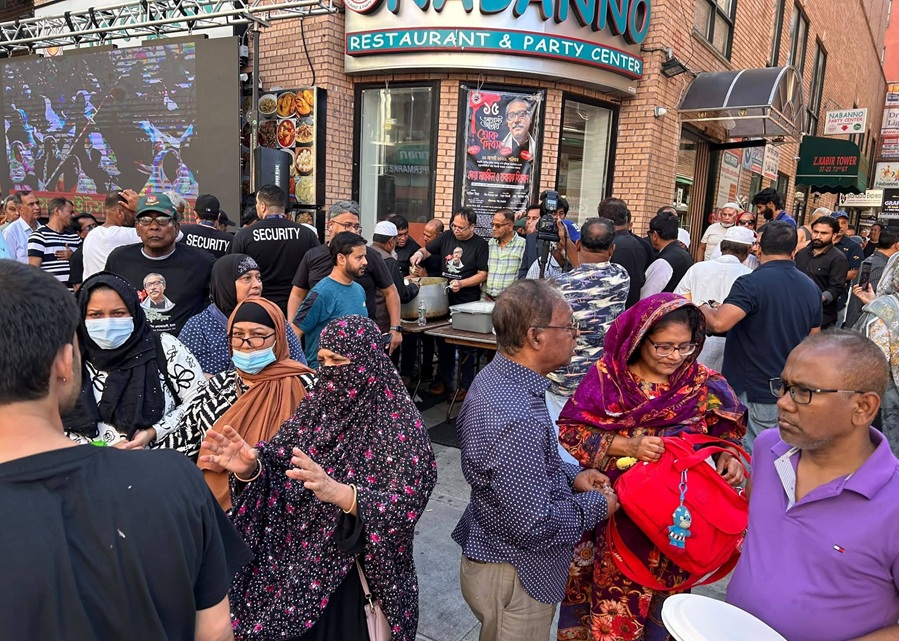
New York: Leaders and activists of the United States Awami League have strongly protested what they described as a conspiracy by BNP-Jamaat groups to ban the Bangladesh Awami League, warning of a strong movement if such efforts continue.

Speaking at a rally held on April 5 in Jackson Heights, New York City, party leaders expressed anger and concern over what they called a political conspiracy. They asserted that Bangladesh did not create the Awami League; rather, Bangladesh itself was born under the leadership of the Awami League. According to the speakers, those who do not believe in the red-and-green national flag are capable of engaging in such actions.

The speakers further noted that even Pakistani military rulers had once banned the Awami League, and alleged that BNP-Jamaat are now attempting to repeat that history. They said such efforts would never be allowed to succeed.

Dr. Siddiqur Rahman, President of the US Awami League, stated that the current government should not forget that the February 12 election lacks legitimacy, as it excluded what he claimed to be 55 percent of Awami League supporters. He added that this issue is increasingly coming to light and that similar voices of protest will soon rise across the United States, including New York. He warned that the power structure of what he described as extremist elements would eventually collapse.

The rally began with an opening speech by Dr. Siddiqur Rahman and was conducted by General Secretary Abdus Samad Azad.

Among those who spoke at the event were Sajjad Hossain Sabuj, Press Minister at the Bangladesh Embassy in Washington, D.C.; Imdad Chowdhury, General Secretary of New York City Awami League; Vice President Sakhawat Hossain Chanchal; Dr. Masudul Hasan, Vice President of US Awami League; freedom fighters Sharaf Sarkar and Solaiman Ali; Zainal Abedin; John Sikdar; Organizing Secretary Mohiuddin Dewan; Sharif Kamrul Hira; M.A. Malek; Professor Shahnaz Mumtaz, President of US Mahila Awami League; Sheikh Atik, Vice President of New York State Awami League; General Secretary Shaheen Azmal; Ashraful Uddin, Vice President of US Swechchhasebak League; Bronx Awami League leader Md. Muhit; US Awami League leader Md. Tulon; Jubo League leader Sebul Mia; Chhatra League leaders Hridoy Mia and Zahid Hasan, among others.

Also present were journalist union leader Saban Mahmud, US Awami League Organizing Secretary Abul Hasib Mamun, and Executive Member Shahanara Rahman.


Christensen sees stronger Bangladesh-US ties under Trump

DHAKA – US Ambassador to Bangladesh Brent T. Christensen has expressed optimism over advancing bilateral relations, saying Washington is working to elevate ties with Dhaka under a clear vision set by President Donald Trump. In a video message, released on today marking 100 days since his arrival, the ambassador said, “After 100 days, I am even more optimistic about the future of US-Bangladesh relations.

“I can’t wait to see what we all accomplish next,” he said.

The envoy noted that Bangladesh and the United States have signed a ‘historic trade agreement’ aimed at balancing the trade deficit and enhancing mutual prosperity. “I have tirelessly advocated for U.S. businesses across Bangladesh to build those trade ties,” he said.

Christensen said the two countries are cooperating to combat illegal migration and strengthen a ‘closer security partnership’ for a free and open Indo-Pacific. “We are combating diseases like tuberculosis and measles through a new health partnership with Bangladesh,” he said.

The envoy said the United States remains the largest donor supporting Bangladesh’s hosting of the Rohingya people and will continue to push for a political solution to the crisis.

Reflecting on his time in Bangladesh, he said he received a warm welcome from the people and enjoyed engaging with the country’s culture, including Pahela Baishakh festivities, cricket, and local cuisine.

“We could not have asked for anything more. I came at an important time, just before Bangladesh’s historic February election,” he said.

He noted that the United States was the first country to recognise the election results and congratulate the new government led by Prime Minister Tarique Rahman. The ambassador said he has worked for over two decades on US policy toward Bangladesh and the broader region, reaffirming his commitment to advancing American interests and strengthening bilateral ties.

Christensen presented his credentials to President Mohammed Shahabuddin on January 15 at Bangabhaban and expressed his eagerness to deepen cooperation. He added that over the past five decades, Bangladesh and the United States have worked together to promote regional stability, economic growth, and sovereignty.


Historic Resolution in New York Recognizes April 14 as Bengali New Year Day

Shibbir Ahmed, New York: A historic milestone has been achieved in New York, as a resolution has been adopted recognizing April 14 as “Bengali New Year Day,” marking a significant acknowledgment of Bengali culture and heritage. The resolution was passed on April 22 during a legislative session held in the state capital, Albany, bringing a grand conclusion to three days of vibrant New Year celebrations.

The proposal was introduced in the New York State Senate by Senators Luis Sepúlveda, Nathalia Fernandez, and Toby Ann Stavisky. Speaking in support of the resolution, Senator Stavisky emphasized the vital contributions of the Bengali community in education, business, and culture across New York’s diverse society. Her remarks were met with enthusiastic applause from fellow lawmakers and attendees. Approximately 50 prominent members of the Bengali diaspora were present at the session, rising to their feet in recognition of the moment.

The resolution calls upon Governor Kathy Hochul to officially proclaim April 14, 2026, as Bengali New Year Day in New York State. It highlights the festival as a secular and inclusive cultural celebration with roots in the agrarian economy of the Mughal era, bringing together people of all backgrounds through music, dance, art, and traditional heritage.

It further acknowledges the Bengali-speaking population—one of the largest linguistic communities in the world—for its strong cultural presence in New York. From the late 19th century to the present day, Bengalis have made notable contributions in education, research, business, healthcare, and literature across the United States.

The resolution also recognizes the decades-long cultural contributions of Muktadhara Foundation, including its festivals and book fairs, and highlights the role of its founder Biswajit Saha. His contributions have been formally acknowledged by the state legislature, as his name is included among those receiving official copies of the resolution.

Following the formal proceedings, a cultural program began at 1:00 PM. The event opened with Rabindra Sangeet performances led by music director Mahitosh Talukder Tapas. Senator Stavisky delivered remarks during the program, praising the role of community organizations such as NRB Worldwide and the Muktadhara Foundation in promoting Bengali language and culture in New York.

Additional speakers included NRB Worldwide Vice President Kallol Basu, General Secretary Tofazzal Liton, and Mahitosh Talukder Tapas. In his remarks, Biswajit Saha expressed his vision of elevating Bengali New Year celebrations beyond the diaspora and into the broader American mainstream.

The cultural segment featured performances by young dancer Bhasha Saha and singer Durga Khatriya. Folk artist MD Shahin Hossain captivated the audience with traditional music. Under the musical direction of Mahitosh Tapas, five special songs were performed, making the hour-long program lively and festive. The event concluded with a collective rendition of the national anthem of Bangladesh.

The celebration, organized by the New York State Senate and led by Biswajit Saha under the banner of NRB Worldwide, began on April 11–12 in New York City—notably in Times Square and Jackson Heights—and concluded on April 22 at the State Capitol in Albany.

With the adoption of this resolution, Bengali New Year is now on a clear path toward official recognition as a cultural observance in New York State—marking a proud and historic achievement for the Bengali community in the United States.