Hasina Vows Return to Bangladesh, Demands Free Elections

Shibbir Ahmed, New York — Awami League President and former Bangladesh Prime Minister Sheikh Hasina has expressed her desire to return to Bangladesh in December, calling for the restoration of democracy, voting rights, and the rule of law in the country.

In an interview with the Press Trust of India (PTI), Hasina said Bangladesh was going through a serious national crisis. According to her, democratic space had narrowed, the judiciary was being used for political retaliation, media freedom had been restricted, and law and order had deteriorated. She also said that minorities were facing insecurity, extremist forces had regained ground, and the economy had suffered. She said factory closures, rising unemployment, declining investment, electricity and gas shortages, and increasing prices were putting pressure on ordinary families.

Hasina said returning to Bangladesh could expose her to the risk of arrest, imprisonment, or even death. Referring to the killing of members of her family in 1975, her return to Bangladesh in 1981, and the grenade attack on August 21, 2004, she said those experiences had not changed her determination.

According to Hasina, the death sentence handed down against her was politically motivated and delivered without giving her an adequate opportunity to defend herself. She said many Awami League leaders had left the country to protect their lives, while those remaining in Bangladesh were also facing pressure.

Hasina said the Awami League maintained an organisational base across Bangladesh. According to her, the party was demanding democracy, the rule of law, the release of political prisoners, the withdrawal of what she described as false cases, protection for minorities, action against extremism, and economic recovery.

She said the Awami League wanted to return to power through free and fair elections. However, she added that the party would have to accept the people’s decision if voters elected another political party.

Hasina said Bangladesh’s foreign policy should be guided by the principle of “friendship to all, malice towards none.” She described India as Bangladesh’s closest neighbour and historic friend, while identifying China as an important partner. She also stressed the importance of maintaining relations with Japan, the United States, Europe, ASEAN, and the Muslim world.

She highlighted cooperation with India during her government’s tenure in security, connectivity, energy, trade, and border management. She referred to the Ganges water-sharing treaty, the Chittagong Hill Tracts Peace Accord, the Land Boundary Agreement, the exchange of enclaves, bus and train links, port access, and energy cooperation.

Speaking about the Teesta River management project, Hasina said it should be transparent, technically sound, and environmentally responsible. According to her, the issue was connected to water resources, agriculture, the environment, people’s livelihoods, and relations between Bangladesh and India. She said a solution should be pursued through dialogue and mutual respect to ensure Bangladesh’s fair share of Teesta waters.

Hasina described Bangladesh’s decision not to participate in the BRICS summit held in India as unfortunate and immature. In her view, the decision had harmed Bangladesh’s national interests and caused the country to miss opportunities for international cooperation. She said foreign policy should not be driven by personal considerations or political reactions, adding that Bangladesh needed to maintain balanced relations with different countries.

Hasina said Bangladesh’s economy had expanded from approximately $70 billion to $450 billion during the Awami League government’s tenure. According to figures she cited, per capita income had increased from $482 to $2,784. She said the poverty rate had fallen from 41 per cent to 18.6 per cent, while extreme poverty had declined from 25.1 per cent to 5.6 per cent.

She also said Bangladesh’s power generation capacity had increased from 3,782 megawatts to more than 28,000 megawatts. Among the development projects she highlighted were the Padma Bridge, metro rail, the Rooppur Nuclear Power Plant, the Matarbari project, the Karnaphuli Tunnel, the Bangabandhu Satellite, roads, bridges, ports, economic zones, community clinics, and housing projects for landless families.

Discussing the current economic situation, Hasina said GDP growth had slowed, non-performing loans had increased, investment had declined, and unemployment had risen. She claimed that more than 500 factories had closed and over 20 million people had become newly unemployed.

She also said many industrialists and businesspeople were in prison or in hiding. According to her, the government was borrowing between Tk 7 billion and Tk 9 billion daily from banks, while the costs of various projects had increased by between 50 per cent and 250 per cent.

Addressing the measles situation, Hasina said there had been delays in procuring vaccines and that Muhammad Yunus had been warned about shortages of vaccines for children. She alleged that vaccines had not been procured on time and that the issue had not subsequently been addressed with the urgency required. Hasina claimed that more than 1,000 children had died and held Muhammad Yunus and Tarique Rahman responsible for the situation.

Speaking about the 2024 student movement, Hasina said her government had taken steps to resolve the dispute over quotas. She noted that the quota system had been abolished following the student movement in 2018. According to her, the protests continued in 2024 even after the demands had been addressed and later developed into a movement to bring down the government.

Referring to a statement by Muhammad Yunus, Hasina questioned who had been involved in planning, financing, and organising violence during the movement. She said a judicial commission had been formed to investigate violence on July 18, 2024, but alleged that it was discontinued after Yunus came to power. She further claimed that participants in the movement had received legal protection while numerous cases had been filed against Awami League leaders and activists. Hasina said an independent investigation was needed to identify those who ordered, organised, financed, or benefited from killings, arson, and other acts of violence.

Hasina said her government had taken initiatives to encourage the Bangladesh Nationalist Party (BNP) to participate in the 2024 election. She claimed that Khaleda Zia had been invited for talks and that proposals had been made to include representatives of different political parties in the government during the election period. According to Hasina, the BNP rejected these proposals and boycotted the election.

She referred to incidents involving attacks and arson targeting vehicles, trains, schools, and polling centres at different times. She also mentioned the Hefazat-e-Islam movement in 2013, pre-election violence in 2014, the Holey Artisan attack in 2016, and the BNP’s participation in the 2018 election. Hasina said political parties should participate in elections and accept the people’s verdict in a democracy.

Hasina called on the international community to support democracy, human rights, the rule of law, political participation, and media freedom in Bangladesh. She said it would not be possible to build an inclusive Bangladesh by banning a major political party, keeping its leaders in prison, restricting media freedom, and excluding millions of people from the political process. In the PTI interview, Hasina reiterated her desire to return to Bangladesh and emphasised the restoration of democracy, voting rights, and the rule of law.


Sheikh Hasina’s Return, Awami League Ban Withdrawal Demanded at Party Meeting

Shibbir Ahmed, New York: A virtual meeting of the Central Executive Committee of the Bangladesh Awami League was held on Friday, September 18, under the chairmanship of Presidium Member Sheikh Fazlul Karim Selim. Awami League President, Bangabandhu’s daughter and People’s Leader Sheikh Hasina attended the meeting as the chief guest and delivered a keynote address offering guidance to party leaders and activists.

In her address, Sheikh Hasina said she had held consultations in phases with leaders and activists from the Awami League’s 83 district branches and 160 electoral constituencies to learn about the actual situation of the country and its people through grassroots representatives and assess the organisational condition of the party.

Referring to the information gathered through these consultations, she said every sector of the country was on the verge of destruction and that the situation was continuously deteriorating. She stressed the need to protect the country from the prevailing situation.

Instructing leaders responsible for organisational affairs, Sheikh Hasina said priority should be given to those who had suffered various forms of persecution when selecting leadership in areas where organisational gaps existed. She said the strength of the Awami League lay with the people and its grassroots leaders and activists, adding that the party placed its trust in them and did not rely on any other force.

She also called for collecting information about individuals who had faced persecution and repression over the past nearly two years, regardless of their political affiliation, and publicising the information to raise awareness among the people. At the same time, she said the identities and actions of those responsible for persecution and repression should also be exposed. Sheikh Hasina said many innocent military and civilian officials had been arrested in false cases and demanded their release.

Referring to the events of July-August 2024, she said members of law enforcement agencies had made every possible effort to protect lives and property. She said many police officers were killed, their bodies were burned, and police stations were looted and set on fire. She expressed her determination to ensure justice for all the killings through judicial investigations.

Citing information received from across the country, Sheikh Hasina said the country was now plunged into darkness, with indiscriminate killings, rape, looting, extortion, the filing of cases and other forms of wrongdoing taking place. She alleged that the government was turning a blind eye to these activities and allowing its leaders and activists to engage in wrongdoing. She further said that although the government could not provide food for the people, it was able to produce bodies.

Reiterating her intention to return to Bangladesh to save the country from the prevailing situation, Sheikh Hasina expressed surprise at what she described as obstacles being created by the government. “I am eager to return to the country, yet the government is creating obstacles,” she said.

Addressing Awami League leaders and activists, she said that regardless of the extent of persecution or the number of death sentences handed down against them, they must remain beside the people and build resistance together with them.

During the meeting, Awami League leaders demanded the cancellation of what they described as illegal death sentences handed down by the so-called International Crimes Tribunal (ICT) against Sheikh Hasina and other party leaders. They also called for the abolition of the tribunal.

The meeting expressed deep concern and outrage over the prevailing socio-economic and political situation in the country, the transition to a democratic state system, the deterioration in the supply and security of oil, gas, water and electricity, the worsening law and order situation, and the economic deadlock.

The meeting also noted that the so-called International Crimes Tribunal had recently handed down death sentences on what the party described as baseless and fabricated charges against Sheikh Hasina and prominent Awami League leaders. Those named included General Secretary Obaidul Quader, Joint General Secretary Agriculturist A.F.M. Bahauddin Nasim, valiant freedom fighter Asaduzzaman Khan Kamal, Professor Mohammad Ali Arafat, Bangladesh Awami Jubo League Chairman Professor Sheikh Fazle Shams Parash, General Secretary Mainul Hossain Khan Nikhil, and Bangladesh Chhatra League President Saddam Hossain and General Secretary Sheikh Wali Asif Enan, among others. The meeting maintained that the tribunal had no legal basis and strongly rejected its actions.

Following discussions, the Central Executive Committee unanimously adopted proposals calling for reductions in the prices of essential commodities and ensuring the supply of electricity, oil, gas and fertiliser. The meeting also called for employment arrangements for workers who had lost their jobs, the reopening of closed industries and factories, the release of all political prisoners and the withdrawal of all false cases.

The committee further demanded the withdrawal of the ban on the Bangladesh Awami League, the abolition of what the party described as the illegal ICT Tribunal, and the cancellation of its death sentences against Sheikh Hasina and other Awami League leaders. It also called for the withdrawal of cases filed against innocent military and civilian officials of the Republic and the release of those who had been arrested.

The meeting was moderated by Awami League Liberation War Affairs Secretary Advocate Mrinal Kanti Das. General Secretary Obaidul Quader, Presidium Members Mofazzel Hossain Chowdhury Maya Bir Bikram and valiant freedom fighter Advocate Jahangir Kabir Nanak, Joint General Secretary Agriculturist A.F.M. Bahauddin Nasim, Organising Secretaries S.M. Kamal Hossain and Sujit Roy Nandi, Member Professor Mohammad Ali Arafat, Deputy Secretary Raymond Areng and other leaders spoke at the meeting, reviewing the overall situation in the country. Other members of the Central Executive Committee also participated in the virtual meeting.


Two Sent to Jail Over Attempt to Erase Rabindranath Tagore Mural in Dhaka

DHAKA — A court in Dhaka has ordered the detention of two people, including Al Nur Mohammad Ayash, president of the State Dialogue Forum, in a case filed over an attempt to erase a mural of Nobel laureate Rabindranath Tagore outside the Bangladesh Shilpakala Academy. The other accused is Marzia Khandaker Rimi.

Police produced the two accused before the Dhaka Chief Metropolitan Magistrate Court on Tuesday after completing their remand. The investigating officer sought to keep them in custody until the investigation is completed, while their lawyers filed bail petitions. After hearing both sides, Metropolitan Magistrate Riyad Hasan rejected their bail applications and ordered that they be sent to jail.

On October 11, an additional chief metropolitan magistrate in Dhaka, Joshita Islam, had granted three days of remand for Ayash and two days for Rimi. The incident took place on October 10, when a group of young people allegedly attempted to erase Tagore’s mural on a wall outside the Shilpakala Academy. A confrontation reportedly broke out between the group and police after officers intervened to stop them.

A woman was seen applying black ink to the mural, according to the account of the incident. A police officer intervened to prevent her from doing so. Following the incident, Shahbagh Police Station Sub-Inspector Ziaul Haque filed a case alleging criminal conspiracy, the promotion of enmity between different groups, and hurting religious sentiments. The court’s decision to deny bail means the two accused will remain in jail while the investigation proceeds.


Bangladesh delegation walks out during Israeli president’s speech

DHAKA – Bangladesh today staged a walkout during the Israeli president’s address at the seventh summit of the Conference on Interaction and Confidence Building Measures in Asia (CICA) in Baku, Azerbaijan. The Bangladesh delegation, led by State Minister for Foreign Affairs Humaiun Kobir, walked out of the conference hall as the Israeli president began delivering his speech at the summit, said a foreign ministry’s press release here.

Representatives of several other countries also joined the walkout, boycotting the Israeli president’s address, according to information received from Baku. The delegations left the conference hall in protest during the Israeli president’s speech.

The seventh CICA summit is being held in the Azerbaijani capital, bringing together leaders and senior representatives of participating countries to discuss regional cooperation, security and confidence-building measures across Asia.


Bangladesh Urges Global Treaty to Protect Victims of Crimes Against Humanity

Shibbir Ahmed, New York: Bangladesh on Tuesday called for a strong international convention to prevent and punish crimes against humanity, urging special recognition and support for countries hosting victims of such atrocities.

Addressing the Sixth Committee of the 81st United Nations General Assembly, Bangladesh delegate Muhammad Nawshad Zamir proposed three key provisions for the convention: cooperation in preserving evidence and protecting witnesses in receiving States; support for survivors, including access to justice at national and international levels; and international solidarity in sharing the burden borne by host countries.

Citing Bangladesh’s experience sheltering over one million Rohingya forcibly displaced from Myanmar, Zamir stressed that countries receiving victims must be integral to international accountability mechanisms. Referring to Bangladesh’s 2024 uprising, he cited a UN report estimating that up to 1,400 people were killed including children and calling for investigations into possible crimes against humanity.

Bangladesh also advocated universal jurisdiction, stronger extradition mechanisms and an end to impunity, while emphasizing prevention and justice for women and children. Zamir urged that the convention complement the Rome Statute and uphold the International Criminal Court’s independence. “A convention diluted until it offends no one will protect no one,” he warned.


Emotional Fakhrul Seeks MPs’ Votes Ahead of Presidential Election

DHAKA: BNP presidential candidate and outgoing Secretary General Mirza Fakhrul Islam Alamgir made an emotional appeal to the party’s lawmakers on Wednesday, urging them to vote for him in Thursday’s presidential election. Fakhrul made the appeal at a meeting of the BNP Parliamentary Party held at the government party meeting room of the Jatiya Sangsad Bhaban in Dhaka. The meeting was chaired by BNP Chairman and Prime Minister Tarique Rahman.

The meeting began at 2 p.m. and continued for about one and a half hours. According to lawmakers who attended the meeting, Fakhrul became emotional at the beginning of his speech and broke down in tears several times. His emotional remarks created a somber atmosphere in the meeting, with Prime Minister Tarique Rahman also becoming emotional.

Recalling his long political journey with the BNP, Fakhrul said he had served the party as Senior Joint Secretary General, Acting Secretary General and Secretary General. “If I have made any mistake while carrying out my responsibilities, or if I have unintentionally hurt anyone, I ask for forgiveness,” Fakhrul told his colleagues.

He expressed gratitude to the party for giving him what he described as immense respect and responsibility throughout his political career. He also recalled the contributions of the late BNP Chairperson Begum Khaleda Zia and the party’s founder, former President Ziaur Rahman. Fakhrul thanked Tarique Rahman for continuing to place his trust in him and assigning him important responsibilities over the years.

He pledged that he would preserve throughout his life the honor and trust that the party had placed in him. He also said he would never compromise on the issues of Bangladesh’s independence and sovereignty.

Referring to the possibility of moving to Bangabhaban if elected president, Fakhrul said he would miss his longtime colleagues and asked them to pray for him. He then directly appealed to the BNP lawmakers to vote for him in Thursday’s presidential election. Earlier, Chief Whip Md. Nurul Islam Moni welcomed the participants and briefed the lawmakers about the voting procedure for the presidential election. He also sought their votes for Fakhrul.

Moni informed the meeting that the presidential election would be held on Thursday, August 20, and that Fakhrul himself would also cast his vote. He further explained that if Fakhrul is elected president and assumes office, his parliamentary seat in Thakurgaon-1 would become vacant. After Fakhrul, Prime Minister Tarique Rahman addressed the meeting and also urged BNP lawmakers to vote for Fakhrul in the presidential election.

The meeting was attended by BNP Standing Committee members Khandaker Mosharraf Hossain, Gayeshwar Chandra Roy, Abdul Moyeen Khan, Amir Khasru Mahmud Chowdhury, Salahuddin Ahmed, Iqbal Hasan Mahmud, Selima Rahman and A.Z.M. Zahid Hossain, among others.The pre sidential election is scheduled to take place on Thursday, August 20. If elected, Mirza Fakhrul Islam Alamgir will assume the office of President. As a result, Wednesday’s parliamentary party meeting could be Fakhrul’s final such meeting as a sitting member of parliament, giving the gathering an added emotional significance.


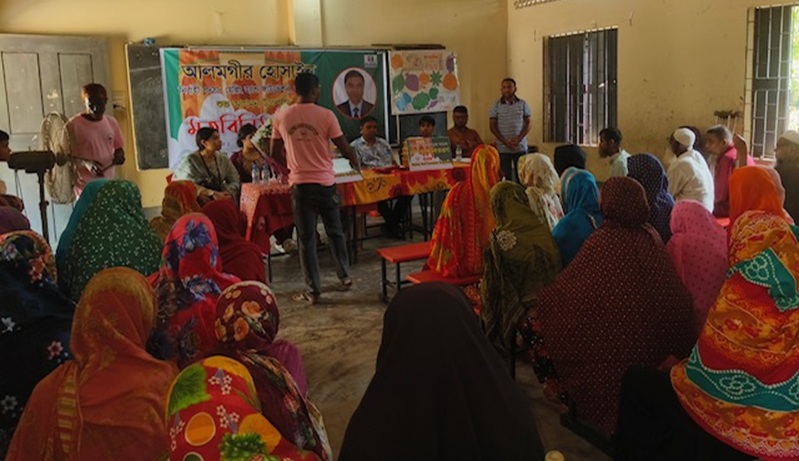
Helping Hand Foundation Executive Member Alamgir Hossain Supports Humanitarian Efforts in Bogura

BOGURA CORRESPONDENT: Alamgir Hossain, an executive member of the Helping Hand Foundation and a Bangladeshi expatriate living in the United States, recently visited Bogura to observe the foundation’s humanitarian activities and meet people who have benefited from its various support programs.

Arriving in Bogura from Dhaka, Hossain, accompanied by his family members, toured several of the foundation’s ongoing initiatives and spoke directly with beneficiaries. He also followed up with people who had previously received assistance from the organization, including financial support, sewing machines, and help with house construction.

During the visit, Hossain personally distributed clothing and cash assistance among beneficiaries. He also listened to their experiences and learned about their current living conditions and the impact of the support they had received from the foundation.

Hossain was accompanied by his wife, one son, and two daughters. Together, they visited several of the foundation’s humanitarian initiatives aimed at supporting underprivileged and disadvantaged people in Bogura.

Foundation officials said the Helping Hand Foundation has been carrying out a range of programs not only to provide immediate humanitarian assistance but also to improve the livelihoods and living standards of disadvantaged people.

They described Hossain’s visit and his direct involvement in the assistance programs as a positive and encouraging development, particularly because he continues to remain connected with the foundation’s activities while living abroad.

At the conclusion of the visit, foundation representatives expressed their gratitude to Alamgir Hossain and his family for their support and participation. They said they hope such humanitarian initiatives will continue in the future for the welfare of vulnerable and underprivileged communities.


All upazila health complexes to become nine-storey facilities: Sakhawat

JHENAIDAH – Health and Family Welfare Minister Sardar Md Sakhawat Hussain has said that, under the Prime Minister’s directives, all upazila health complexes across the country will be transformed into modern nine-storey health complexes within the next three years.

“A long-term plan has been taken to upgrade all 50-bed upazila health complexes in the country into 151-bed hospitals within the next three years,” he said while responding to queries from reporters after making surprise visits to the Maheshpur and Kotchandpur upazila health complexes in the district today.

He said the country’s healthcare sector had been seriously neglected during the 17-year rule of the “fascist Awami League government”. “Looting took place in all sectors, and extensive looting also occurred in the healthcare sector. There was a lack of accountability, which disrupted health services,” he said.

Corruption had also taken place in the purchase of medicines for hospitals during the fascist government, Sakhawat said, adding the government wants to bring the country’s health sector and medical system under a new discipline.

“We have undertaken long-term plans to address the shortage of doctors and medicines and to make services easier for patients. We will not compromise in implementing the plans to restore public confidence in government healthcare services,” he continued.

He said that after the 151-bed upazila health complexes are launched, the hospitals will have a special 25-bed ward for pregnant women and a separate 20-bed ward for children. “We have also taken plans to introduce services such as kidney dialysis at these hospitals. Once these are implemented, the country’s health sector and the system of medical services will be transformed,” he said.

Earlier in the morning, the Health Minister visited different wards of the Maheshpur and Kotchandpur upazila health complexes. During the visits, he enquired about the overall condition of patients receiving treatment at the hospitals. He also spoke with patients and their attendants about the quality of healthcare services and food at the hospitals. Later, he visited the Kaliganj Upazila Health Complex.


Presidential Election: EC validates nominations of Mirza Fakhrul, Oli Ahmed

DHAKA- The Election Commission (EC) has declared valid the nomination papers of Mirza Fakhrul Islam Alamgir, the nominee of the Bangladesh Nationalist Party (BNP), and Dr Oli Ahmed, Bir Bikram, candidate from the Jamaat-e-Islami-led 11-party alliance, in the presidential polls. At Nirbachan Bhaban in the capital today, Chief Election Commissioner (CEC) AMM Nasir Uddin declared their nomination papers valid after verification.

He informed a BNP delegation, led by its standing committee member Dr Abdul Moyeen Khan, that the nomination papers of Mirza Fakhrul Islam Alamgir have been accepted as valid. Earlier, the CEC accepted the nomination papers of 11-party alliance Oli Ahmed Bir Bikram as valid. The presidential election will be held on August 20. The scrutiny of nomination papers began at 11:00 am today (Sunday).

The two candidates submitted their nomination papers on the last day of the presidential election on August 13. On Thursday last, BNP submitted the nomination papers of Mirza Fakhrul Islam Alamgir to the CEC at Nirbachan Bhaban. On the other hand, the 11-party alliance submitted its nomination papers in favour of Liberal Democratic Party (LDP) Chairman Colonel (retd) Oli Ahmed.

EC Secretariat Senior Secretary Akhtar Ahmed said the last date for withdrawal of candidacy is 4:00 pm on August 18 (Tuesday). Voting will be held in the session hall of Jatiya Sangsad from 2:00 pm to 5:00 pm on August 20 (Thursday), he said.


Govt wants to build Bangladesh as a welfare state: PM

KISHOREGANJ (Pakundia) – Prime Minister Tarique Rahman today said the government wants to build Bangladesh as a welfare state through people-oriented initiatives to improve people’s living standards. In this connection, he urged all to remain patient and vigilant against attempts to create disorder and impede the country’s development.

“Our goal is to build a welfare state. That is why we are taking various measures for the welfare of the people. We have already started implementing different programmes, including the Family Card,” he said.

The Prime Minister made the remarks while addressing a public gathering after releasing fish fry into the Brahmaputra River at Mirzapur Chairman Bari Ghat in Pakundia this afternoon. Referring to the support extended by thousands of people to his government’s development plans, he said the people would benefit if the plans are implemented properly.

“So, I want to tell you to maintain the trust you placed in the party in the February 12 election,” he said. The Prime Minister urged the people to keep their trust in the BNP and assured them that the party would remain committed to their welfare and the country’s development.

“The government was formed with the support of the people. You placed your trust in the BNP through that support. I want to make it clear: InshaAllah, maintain that trust. The BNP was with you, is with the people of Bangladesh and will remain with the people of Bangladesh,” he added. Prime Minister Tarique Rahman said the BNP would work for the people of Bangladesh and, as long as the party exists, would not undertake any action contrary to the interests of the country and its people.

Criticising various unplanned measures taken by the previous government in the power and energy sector, Tarique Rahman said those measures had contributed to the current crisis. Referring to the next session of parliament, scheduled to begin on August 27, he said the government would present its plan there to address the country’s power-related problems over the next 10 years.

The Prime Minister also urged all to remain alert against those trying to create disorder on the streets. He said, “A small number of people are trying to create disorder on the streets. If disorder is created on the streets, ordinary people suffer the most. Their businesses are affected, their jobs are affected and their livelihoods are disrupted. But those who create disorder benefit from it.”

“Today, let us take an oath and pledge that those who work against the interests of the country, create disorder or obstruct various programmes taken in the public interest will be resisted by the people with all their collective strength,” he added.

Tarique Rahman said the people of the country now want peace, the rule of law, employment, education for their children and healthcare for their families. “If we are to accomplish these tasks, we must remain patient. At the same time, we must remain vigilant about those who are creating disorder,” he said.

After arriving in Pakundia, the Prime Minister first released fish fry into the Brahmaputra River at Mirzapur Chairman Bari Ghat. He later took the stage at the gathering, where thousands of party leaders and activists greeted him with applauses. Lawmaker Fazlur Rahman and other leaders were present at the programme.