Bangladesh situation has triggered debate in the British Parliament

The ongoing political and human rights situation in Bangladesh has triggered debate in the British Parliament, with MPs highlighting bans on political parties, corruption allegations against a UK lawmaker, and actions taken by the interim government.

Concerns over democratic norms and human rights

Over the past year, MPs have repeatedly raised concerns about human rights in Bangladesh. In a December 2024 House of Commons session, Labor MP Barry Gardiner and former home secretary Priti Patel warned about rising violence against the Hindu community. Catherine West, minister for the Indo-Pacific, said the UK government is closely monitoring the situation and remains in contact with the administration of Chief Adviser Dr Muhammad Yunus to ensure minority protection.

On July 15, MP Bob Blackman and the Bangladesh Unity Forum hosted a parliamentary event highlighting Bangladesh’s constitutional crisis. Speakers denounced the use of anti-terror laws against political opponents and described the May 2025 ban on Awami League activities as an unprecedented assault on democracy. A message was also sent to the International Criminal Court (ICC), detailing allegations of arbitrary arrests and extrajudicial killings.

UK’s stance on upcoming election

The Foreign, Commonwealth and Development Office (FCDO) has stressed the need for elections within a set timeframe to restore stability. It said free, fair and participatory polls are vital for a functioning democracy. British MPs have urged the interim government to publish a roadmap and call early elections, while also demanding guarantees of freedom of expression and protection for political dissent.

Corruption allegations and MP’s resignation

Another issue drawing attention was the corruption allegation raised by Bangladesh against British MP Tulip Siddiq, niece of former prime minister Sheikh Hasina. Following Hasina’s ouster, Siddiq was accused of corruption and resigned from the post of economic secretary to the treasury and city minister in January 2025, following allegations of misconduct. She has denied the allegations, calling them politically motivated propaganda.

Withdrawal of controversial report

The All-Party Parliamentary Group (APPG) on the Commonwealth faced criticism over a November 2024 report accused of being biased in favors of Hasina’s ousted government. The report was withdrawn in January 2025. Labor MP Rupa Huq dismissed it as irrelevant and described it as a vicious attack on Bangladesh’s interim government.


Jatiya Party central office set on fire again at Bijoynagar

Earlier on August 30, Gono Odhikar Parishad activists set the Jatiya Party central office on fire

The Jatiya Party (JaPa) central office in Dhaka’s Bijoynagar was once again targeted on Friday evening, as miscreants vandalized and set fire to the office. Around 7:15pm, stones were thrown at the office. Earlier, at about 6:30pm, leaders and activists of the Gono Odhikar Parishad held a demonstration at Shahbagh intersection, burning tires to demand a ban on JaPa, before marching towards the office at Bijoynagar.

Ramna police station duty officer, Sub-Inspector (SI) Sajjad Hossain, told Bangla Tribune: “Suddenly, a few miscreants launched an attack on the Jatiya Party office. They vandalized some furniture inside and set fire. On receiving the report, police quickly arrived, extinguished the fire, and brought the situation under control.”

Eyewitnesses said that around 5:45pm, a group of people gathered in front of the office, carried out several rounds of attacks, and later attempted arson. A local shopkeeper said: “Suddenly, a few youths came shouting slogans, entered the office, and began vandalizing. I saw smoke rising soon after. They dispersed when police arrived.”

The area remains tense, and this is not the first time the office has faced such attacks. Earlier on August 30, activists of Gono Odhikar Parishad set the Jatiya Party central office on fire.


Bangladesh Bank again calls for applications for digital bank

Bangladesh Bank has once again invited applications from investors to establish the country’s first digital banks, with an aim of ensuring faster and more accessible financial services through a fully branchless model. In a notice issued on Tuesday, the central bank said it will accept applications between September 1 and September 30, 2025, under section 31 of the Bank Company Act, 1991.

Applicants must submit proposals with a non-refundable processing fee of Tk 5 lakh. Failure to provide the required documents will lead to automatic cancellation, it said. The central bank framed its digital bank guidelines on June 14, 2023, and recently revised them to strengthen capital and operational requirements. The minimum paid-up capital has been raised to Tk 300 crore from Tk 125 crore earlier.

Digital banks must also launch an initial public offering (IPO) within five years of licensing, with the IPO size not less than the sponsors’ initial capital. According to the guidelines, a digital bank will operate entirely online with only a head office, requiring no physical branches, sub-branches, ATMs, or cash-deposit machines.

All services will be app-based and delivered through mobile phones and other digital devices. While structurally different from traditional banks, digital banks must comply with the same business, governance, and operational standards.

Bangladesh Bank said the move reflects global shifts toward technology-driven finance and aims to widen access to credit, particularly for cottage, micro, and small enterprises (CMSEs) and underserved groups, according to the notice.

Promoting innovation-led growth and financial inclusion is also seen as crucial to achieving the Sustainable Development Goals (SDGs) and adapting to the Fourth Industrial Revolution, it said.

This is not the first attempt to introduce digital banks.

The central bank previously invited applications in 2023 and approved Nagad as a digital bank, though the licence was later cancelled following the fall of the Awami League government in August 2024.

Currently, 61 scheduled commercial banks and 35 non-bank financial institutions (NBFIs) operate in Bangladesh, with many already offering digital banking services. However, about 20 banks and 25 NBFIs have faced near collapse in recent years due to loan irregularities, mismanagement, and corruption. Critics have questioned the necessity of licensing new banks in such a troubled sector, arguing that strengthening existing institutions should take priority. Still, the central bank insists that dedicated digital banks could drive efficiency, expand outreach, and reduce costs in delivering financial products across the country.


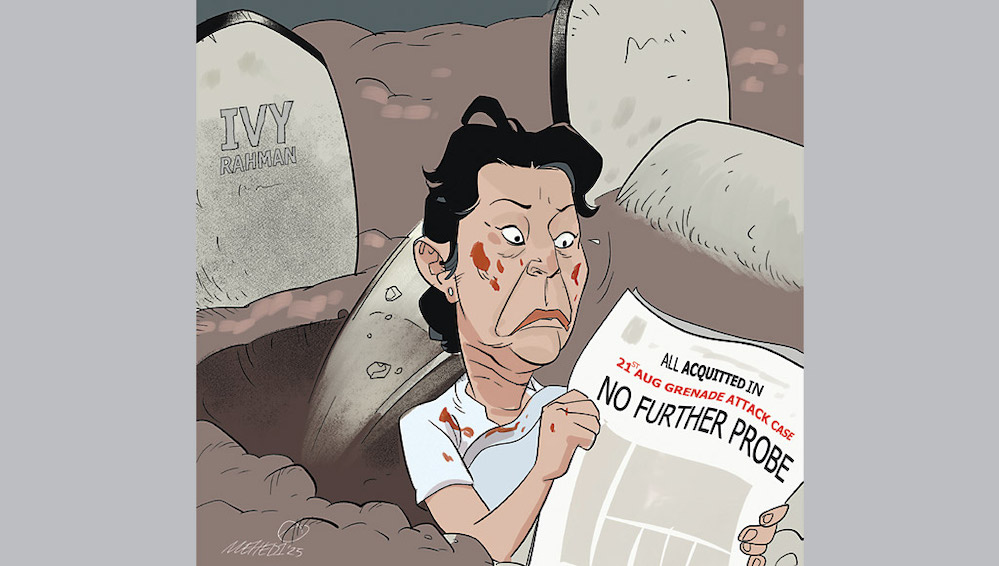
SC upholds acquittal of Tarique, all others in Aug 21 grenade attack case

The Appellate Division of the Supreme Court on Thursday upheld the High Court’s acquittal of BNP acting chair Tarique Rahman and 48 others in the August 21, 2004 grenade attack cases, effectively nullifying the lower court’s conviction of all 49 accused. At least 24 people, including senior Awami League leader Ivy Rahman, were killed and scores, including the then opposition leader and AL president Sheikh Hasina, were injured when grenades were hurled at the AL rally in front of the party central office at Paltan in the capital.

Meanwhile, any activities of the Awami League have been banned until the competition of trials of those involved in the crimes against humanity committed during the July 2024 mass uprising that ousted prime minister Sheikh Hasina and she fled to India on August 5, 2024.

On October 10, 2018, Dhaka’s Speedy Trial Tribunal-1 sentenced 19 people, including former state minister for home Lutfozzaman Babar, to death, Tarique Rahman and 18 others to life term imprisonment, and 11 more to various prison terms.

Tarique, along with 15 other accused, was tried in absentia, as he has been living in London since 2008. The Appellate Division also struck down the High Court directive for a further investigation into the attack, in the verdict that such an instruction to the executive branch violated the constitutional principle of separation of powers.

The apex court emphasised that courts should not interfere in matters of government policy, citing the constitutional principle of separation of powers. It also ruled that the HC observation amounted to judicial overreach by stepping into the domain of policymaking. As a result, the apex court ordered that part of the HC judgment to be expunged.

The chief justice, Syed Refaat Ahmed, pronounced the unanimous decision of the six-judge bench in 12 minutes in a crowded courtroom while dismissing the state’s appeal that challenged the High Court verdict delivered on December 1, 2024, acquitting Tarique, Babar, and 47 others of murder and charges related to explosives, citing legal and procedural flaws in the 2018 trial-court judgment.

Five other Appellate Division judges were Justice Md Ashfaqul Islam, Justice Zubayer Rahman Chowdhury, Justice Md Rezaul Haque, Justice SM Emdadul Hoque, and Justice Farah Mahbub. The Appellate Division issued an order in advance asking the jail authorities to immediately release all the acquitted individuals unless they were wanted in other cases.

It also cited serious doubts over the voluntariness of second confessional statements made in 2007 by three accused — Harkat-ul Jihad leader Mufti Hannan, his brother Mohibullah, and Moulana Sharif Shahidul Alam — all within five and a half hours in a single day.

The Appellate Division observed that the prosecution’s case was significantly weakened by the execution of accused Mufti Abdul Hannan before he could be examined under Section 342 of the Code of Criminal Procedure.

Mufti Hannan was executed on April 12, 2017 in connection with the grenade attack on then British high commissioner Anwar Choudhury in Sylhet on May 21, 2004. The attack injured Anwar Choudhury and killed two bystanders and a police officer. The apex court stated that the second-occasion confessions were either extracted under coercion or made under oppressive and unlawful conditions.

As a result, the apex court ruled, the confessions failed to meet the legal standard of reliability and could not be used as credible evidence. This finding played a key role in upholding the HC decision to acquit the accused.

The Appellate Division said that several accused, including Mufti Abdul Hannan, were in a prolonged custody — some in death-row cells — before being presented to magistrates in 2007 for recording the confessional statement. Others were held in police custody for extended periods without proper judicial oversight.

The court highlighted that the 2007 confessional statements by Hannan and three other convicts had been recorded on the same day by a single magistrate in what it called an ‘unusual haste,’ violating procedural safeguards.

It further pointed out that the accused had later retracted their confessions, alleging they were made under duress, including torture and illegal detention by law enforcement agencies. On October 10, 2018, Dhaka’s Speedy Trial Tribunal-1 sentenced the 19 people to death, Tarique and 18 others to life-term imprisonment, and 11 more to varying prison terms.

The High Court acquitted all the convicts and asked the home ministry to initiate a proper investigation by expert and impartial agencies to ensure justice for the victims. The verdict read, ‘This heinous and tragic incident requires a thorough and independent investigation to bring justice to the victims, including Ivy Rahman, the then AL leader, and others who lost their lives. The earlier proceedings failed to deliver fair justice.’

Earlier in 2011, a supplementary charge sheet added 30 new accused, including Tarique Rahman and Lutfozzaman Babar, based on Hannan’s second confession in 2007. This followed a fresh investigation launched in 2009 during the Awami League regime. Sixty-one witnesses testified during the trial. The original charge sheet, submitted in 2007, named 22 accused, including Mufti Hannan, former BNP state minister Abdus Salam Pintu, and Moulana Tajuddin. Altogether, 49 people were tried and convicted.

Two cases — one for the murders and another under the Explosive Substances Act — were filed by the police against unidentified people in connection with the grenade attack.

The HC verdict observed that 30 additional individuals, including Tarique, Babar, former prime minister Khaleda Zia’s political secretary Harris Chowdhury, Jamaat-e-Islami leader Ali Ahsan Muhammad Mujahid, who was executed in a war crime case, and former National Security Intelligence director general Rezzakul Haider Chowdhury, were named in a supplementary charge sheet.

Chief defence counsel SM Shajahan told New Age that it was true that many people were killed in the grenade attack but the trial targeted the wrong individuals to harass them politically as the real perpetrators were not properly identified due to a flawed investigation.

Md Jalal, branded as ‘Joj Miah,’ spent four years in jail after being falsely implicated in the August 21, 2004 grenade attack case. His wrongful detention highlighted flaws in the investigation during the BNP regime. Jalal, hailing from Senbagh, Noakhali, was imprisoned from June 10, 2005 to June 27, 2009. He was exonerated of the murder charges after CID superintendent Fazlul Kabir submitted the first charge sheet on June 9, 2008.


Passport service launched in Gulshan

A National API Connectivity Hub is being developed through Citizen Service to bring all services from government offices into one platform

Chief Adviser’s Special Envoy on International Affairs Lutfey Siddiqi, inaugurated passport services at the Citizen Service Centre in Gulshan, Dhaka. For the first time in the country, services related to passport application and renewal have been introduced at an entrepreneur-driven citizen service centre outside of a passport office.

The announcement was made on Thursday, in a Facebook post by the Chief Adviser’s Special Assistant, Faiz Ahmad Taiyeb. At present, Citizen Service is running pilot and learning programs with a total of 400 services, including those related to passports, driving licences, birth and death registration, national identity cards (NIDs), and land record services from various government offices, upazila parishads, and zila parishads.

Ten Citizen Service pilots will be launched simultaneously at the end of this month in six locations: Gulshan 1, Uttara Sector 6, Nilkhet, Ramna, Mohammadpur, and Banasree. Among them, the centres in Gulshan 1, Uttara, and Nilkhet are already fully operational.

The post stated that among the six centres in Dhaka (ten in total under the pilot program), citizens are encouraged to visit their nearest Citizen Service Centre, inform the centre about their service needs, and provide suggestions for improving the quality of services.

A National API Connectivity Hub is being developed through Citizen Service to bring all services from government offices into one platform, ensuring citizens receive hassle-free service.

As a result, it will no longer be necessary to apply separately through hundreds of different websites of various offices. Instead, all services will be available in one place through the National Connectivity Hub. Services of different ministries, online platforms, and digital centres created in the past as digital islands will also be interconnected and interoperable through Citizen Service.

This is the first Citizen Service Connectivity Hub in Bangladesh aimed at providing all essential services for citizens in one place.


EC finalizes boundaries of 300 parliamentary constituencies

The Election Commission (EC) has finalized the boundaries of 300 constituencies for the upcoming 13th National Parliamentary Election and issued a gazette notification. Senior Secretary of the EC Secretariat, Akhtar Ahmed, announced the move on Thursday evening, saying, “The boundary notification for the 300 parliamentary constituencies has been issued and will be published in the gazette.”

According to the final list, Gazipur has gained one additional seat, increasing its constituencies from five to six, while Bagerhat has lost one, reducing its constituencies from four to three. In Brahmanbaria-3, the constituency now covers Brahmanbaria Sadar Upazila and the unions of Ichapura, Champaknagar, Pattan, Dakhin Singerbil, Paharpur, and Harashpur in Bijoynagar Upazila.

Ahead of the election, a specialized committee reviewed constituency boundaries. On July 30, the EC published a draft that kept 261 constituencies unchanged from the 13th Parliament, with minor changes to 39 constituencies. Citizens had until August 10 to submit objections or suggestions.

The EC received 1,893 responses, including 1,185 objections concerning 84 constituencies across 33 districts, and 708 recommendations. Both supporters and opponents voiced opinions, which the EC first reviewed. From August 24–27, hearings were held over four consecutive days to examine the objections. Following the review, the secretary had said the final list would be published as soon as possible. Click Here to see the 300 seat distribution list.


Touhid: Govt to assist Tarique if he wants to return

Foreign Affairs Adviser Md Touhid Hossain has said BNP acting chairman Tarique Rahman’s desire to return to the country is entirely his own. If there was any problem regarding his travel documents, it will be resolved, he said on Thursday evening at the Ministry of Foreign Affairs while responding to journalists’ questions on contemporary issues.

The adviser said he was not aware whether Tarique Rahman has applied for a passport. “Whenever he comes, whatever passport or travel document is required, we will be able to provide it,” he added. Asked whether the government would take the initiative on its own, he said: “I think that is not necessary. When he wants to return to the country, we will definitely provide as much assistance as we can.”

On a question regarding whether there had been any contact with India after sending the most recent letter to bring back ousted prime minister Sheikh Hasina, he said: “After that, we did not send any more letters on this. It was sent once; if it is sent again, you will know.”


Trump admin names Brent Christensen as US ambassador to Bangladesh

The Trump administration has finally named its nominee for US ambassador to Bangladesh, choosing a seasoned career diplomat to fill the top post at its Dhaka mission.

Brent Christensen, of Virginia, a Career Member of the Senior Foreign Service, Class of Counselor, has been nominated to be Ambassador Extraordinary and Plenipotentiary of the United States of America to the People’s Republic of Bangladesh, according to an announcement on the White House’s official website dated September 2, 2025.

Christensen’s name was unveiled in a slew of appointments and nominations, that included the nomination of the current State Department spokesperson, Tammy Bruce, as ambassador to the United Nations, and Sergey Gor as ambassador to India.

All three nominations are subject to approval by the Senate.

Christensen has previous experience in Bangladesh, having served as Counselor for Political and Economic Affairs at the US Embassy here from 2019-2021, according to his official profile on the State Department’s website.

Early on in his career, he also served as Bangladesh Country Officer in the Office of Pakistan and Bangladesh Affairs, which no longer exists under that name, at the State Department.

His other appointments include Deputy Director, Office of Regional Security and Arms Transfers, Bureau of Political-Military Affairs at the Department of State (2016-2019), and as a Pearson Fellow on detail to the majority staff of the House Foreign Affairs Committee, Subcommittee on Asia and the Pacific (2015-2016).

He has also been Special Assistant to the Special Representative for North Korea Policy, Bureau of East Asia and Pacific Affairs Cyber Coordinator, Deputy Counselor for Economic Affairs at the US Embassy in Manila, Deputy Economic Counselor at the US Embassy in San Salvador, Economic Officer at the US Embassy in Riyadh, and Vice Consul at the US Consulate General in Ho Chi Minh City, Vietnam.

The US Embassy in Dhaka has been running without an ambassador since Peter Haas wrapped up his eventful tenure in the summer of 2024.

Since then, a series of charge de affaires or CDAs have filled the role, with Tracey Ann Jacobson, the current CDA, having been in the position since January.


Bangladesh names Ariful Islam as next Ambassador to US

The Bangladesh ambassador to Washington DC post has been vacant since Asad Alam Siam became foreign secretary

Dhaka: Ambassador Tareq Md Ariful Islam, who served as the permanent representative of Bangladesh to the UN Offices in Geneva, is going to be Bangladesh’s next ambassador to the United States. The post of Bangladesh ambassador to Washington DC has remained vacant for months since Ambassador Asad Alam Siam was appointed foreign secretary.

A senior official at the Ministry of Foreign Affairs told on Wednesday that Ambassador Tareq has moved out of Geneva to Washington DC. Tareq served as Bangladesh envoy to Sri Lanka before his appointment as Bangladesh envoy to the UN offices in Geneva in June 2024, succeeding Ambassador Mohammad Sufiur Rahman in this capacity. Ambassador Tareq, a career diplomat belonging to the 17th batch of the BCS (Foreign Affairs) Cadre, joined the service in 1998.

Prior to taking up the current position in November 2020, he was serving as the Deputy Permanent Representative in the Bangladesh Permanent Mission to the United Nations in New York.

As for his other assignments abroad, he had another stint (from 2005 to 2009) in the New York Permanent Mission as First Secretary initially and at the later part as Counsellor. He then served in the Bangladesh Deputy High Commission in Kolkata, India (2009-2012) as counsellor as well.

At the headquarters, he served as director general (South Asia Wing) and before that in various other capacities, including director (South Asia Wing), director (Foreign Minister’s Office) as well as in the personnel wing and the foreign secretary’s office.

Ambassador Tareq obtained a Master of Diplomacy and Trade degree from the Monash University, Australia and a Bachelor of Science in Civil Engineering from the Bangladesh University of Engineering and Technology (Buet).


Mob violence in the age of misinformation

Mob violence is carving deep, brutal scars into the fabric of Bangladesh — fuelled by rumours, sharpened by rage, and amplified by social media.

Miftahul Jannat: – When justice is hijacked by rage and rumour, it takes only minutes for a mob to become a murderer. Like those two men beaten to death in Sirajganj on August 4 over alleged cattle theft. Or the Hindu homes vandalised in Rangpur in July, triggered by a Facebook post. Or the lynching in Cumilla’s Muradnagar claiming the lives of a woman and her two children earlier that month. Or the 70-year-old barber and his son brutally attacked following accusations of hurting religious sentiments in Lalmonirhat in June. The man in Bhola whose eyes were gouged out by a mob in March. The Uber driver, mistaken for a mugger, beaten to death in Dhaka that same month. Or the mentally unstable Tofazzal killed for suspected theft in a university dorm last September.

Each of these incidents is a chilling reminder of how mob violence is carving deep, brutal scars into the fabric of Bangladesh — fuelled by rumours, sharpened by rage, and amplified by social media. In this digital era, where smartphones are ubiquitous and digital freedom runs largely unchecked, misinformation is becoming a deadly weapon, and the consequences are playing out in real time.

The orchestration of violence

According to Shahzada M Akram, Senior Research Fellow at TIB, the anatomy of a mob in Bangladesh often follows a grim pattern. While some outbreaks are purely driven by misinformation, circulated through social media or messaging apps, others are far more calculated.

“There are instances where misinformation is deliberately seeded to serve political or personal motives,” he explained. “Religious sentiment becomes an easy trigger.” In cases like Dinajpur, mobs have vandalised temples and shrines based on false claims, while incidents like the Cumilla Muradnagar beating show how local interest groups exploit digital rumours to incite violence. Often, law enforcement arrives too late to prevent the damage and, by then, the mob has already done its work.

Nur Khan Liton, a prominent human rights activist, pointed out that while mob beatings existed in the past, their nature has evolved drastically in recent years. “In earlier times, there were isolated incidents, sometimes planned, but what we see now is a coordinated culture of violence,” he explained.

These orchestrated mobs not only physically attack individuals; they target homes, properties, and even legal processes. “There have been instances where defendants in custody, brought before the courts, were assaulted. In some cases, mobs attacked the accused even when they were taken to the hospital for treatment,” observed Liton.

These events often involve politically motivated small groups seeking personal or ideological gain. “They don’t necessarily have formal political party structures, but they fish in troubled waters, exploiting chaos for their own interest,” he mentioned. “Such actors sometimes even co-opt law enforcement to facilitate attacks, further blurring the lines of accountability.”

The implication is clear: mob violence in Bangladesh is not merely spontaneous public outrage. While emotions play a role, many incidents are carefully orchestrated to destabilise communities, exploit religious or ethnic sentiments, and intimidate political and other social groups.

Misinformation and the digital echo chamber

In the midst of this orchestrated violence, social media has become the accelerant. Dr Md Khorshed Alam, Associate Professor in Mass Communication & Journalism at Dhaka University, highlighted the structural changes in media dissemination. “Traditional media like newspapers, TV, and radio had gatekeeping systems. Information passed through checks, and accountability was embedded,” he explained. “Social media, however, allows consumers to become producers, or prosumers, with little or no gatekeeping.”

This shift has enabled rapid, often unchecked, circulation of misinformation, disinformation, and mal-information. Even mainstream media, when publishing online, has tended to prioritise speed and virality over accuracy, sometimes adding sensational elements to attract likes, shares, and comments. Dr Alam noted that this “viralism” replaces careful journalism with a race to capture attention, often without verifying facts from all parties involved or considering potential consequences.

When such content circulates, it can catalyse real-world violence. Mobs, often ideologically motivated, consume these viral narratives and interpret them through personal or political lenses. This ideological lens, combined with low digital literacy, creates fertile ground for rapid escalation from online outrage to street-level attacks. “People see an excerpt, a photocard, or a video clip, and make decisions without context. Even if a correction is issued later, the initial impact is far more powerful,” explained Dr Alam.

A digital chain reaction

Neither misinformation nor mob violence are new phenomena. But what social media has done is intensify the chain reaction. A crime occurs, a video circulates online, and public outrage follows. What was once a local issue now reverberates across the country in minutes.

This repeated exposure to crime through visual content online can provoke a sense of collective anger. “When a crime happens, and its visual representation is out on social media, general people can get disproportionately enraged,” mentioned Qadaruddin Shishir, Fact Check Editor at AFP.

This effect is intensified in a society where visible justice is slow or absent, and the public may perceive taking matters into their own hands as the only option, resulting in mob justice, often brutal and tragically misdirected.

Md Rezaul Karim Shohag, a lecturer in Dhaka University’s Criminology Department, reinforced this point with insights from routine activities theory. The theory suggests that crime occurs when a likely offender encounters a suitable target in the absence of legal guardianship, emphasising factors such as availability, proximity, and exposure that influence crime rates.

“In many recent mob cases, those involved are often the likely offenders. When perpetrators go unpunished, groups with personal grievances see an opportunity and join in the violence,” he explained.

The role of impunity

The growing public participation in mob violence stems from a breakdown in accountability. When justice remains elusive and offenders walk free, ordinary citizens, who would normally fear the law, start to shed that fear, emboldened by the impunity they witness.

“The general people in the mob don’t wake up every day intending to commit crimes. But when they see perpetrators repeatedly go unpunished, their fear of the law disappears. They start to believe they too can cross the line and walk away,” said Shishir from AFP.

In such an environment, one misleading image or miscaptioned video can ignite rage. Sometimes even outdated photos, like those claiming attacks on BNP offices, are recirculated to stir political outrage and potentially violent responses.

Current weaknesses within the law enforcement amid the volatile political climate have reinforced this sense of impunity among people. Many officials fail to intervene, while others are complicit or sidelined. The result is a culture where mob beatings have become normalised. “People are adjusting to crimes without punishment, and this lack of deterrence only encourages further violence,” added Shohag.

The criminology expert also pointed out the deterrence theory, where ensuring the severity of punishment matters more than who committed the crime. “From last August to this August, many people have been beaten or killed by mobs, yet how many have actually received justice? If proper justice had been served even for just ten people — that alone could have deterred others and set an example. We are neither deterring crime nor creating such examples, which only encourages more people to join mob violence,” he said.

Political manipulation and ideological triggers

“Recent cases of mob violence have been serving political ends. Small groups without formal party structures use social unrest to advance agendas, intimidate minorities, and destabilise society,” said human rights activist, Liton. These orchestrators exploit emotional triggers, such as religious sentiment or perceived injustices, while simultaneously avoiding legal consequences.

Dr Alam echoed this, noting that ideological baggage among social media users intensifies mob activity. Users interpret viral content according to pre-existing beliefs. Photocard journalism, circulating excerpts, images, and snippets without context, further fuels the cycle, according to him.

When lies go viral

What makes this crisis especially dangerous is the speed of viral content. “By the time fact-checkers verify something, the damage is often done,” mentioned Apon Das, a researcher on information integrity at Tech Global Institute. The Facebook algorithm, like others, promotes content that generates high engagement, meaning sensational and fear-inducing posts travel faster than the truth.

Fact-checking efforts, while crucial, often fall short. “Fact-checkers don’t have the same reach as viral posts,” added Das. This gap is not just technical, it is deeply educational. Media and digital literacy remain worryingly low among Bangladesh’s general population. “Most people don’t know how to verify the content they consume, or even feel the need to.”

Minhaj Aman, co-founder of Activate Rights also draws attention to the algorithmic influence. “Social media platforms show you more of what you already believe. This creates an echo chamber,” he explained. When users consume one fake news item, the algorithm begins to serve more of the same, reinforcing their biases and skewing their perception of reality.

Disinformation as income

There is also another dimension to this: financial and reputational incentives. Many actors knowingly spread disinformation for money, political leverage, or sheer visibility. “For some, social media isn’t just a platform; it’s an income source. Outrage and sensationalism are profitable,” Das explained. The proliferation of monetised content has created a dangerous incentive system. The more outrageous the post, the higher the click count.

Yet Bangladesh lacks clear legal definitions and investigative mechanisms to address such targeted disinformation. While cyber laws exist, they often fall short — or worse, get misused. “The laws are vague about intentional misinformation and can be used to silence critics rather than penalise actual bad actors,” Das warned.

Media must do better

Media institutions, both traditional and digital, have a critical role in the current situation. Shishir argued that mainstream media’s editorial decisions can either inflame or calm volatile situations. Clickbait headlines and fear-inducing narratives amplify mob action. Dr Alam highlighted that online editions of newspapers often fail to replicate the rigorous verification applied in print. Reproductions of partially verified news, coupled with low treatment of corrections or rejoinders, further confuse the public. When clarifications are issued, they rarely receive the prominence of the initial story, leading to entrenched misconceptions that can trigger violence.

Education and digital literacy

Literacy, both general and digital, is crucial in curbing the spread of misinformation and mob violence. Dr Alam noted, “The internet, smartphones, and social media are accessible to everyone, but understanding varies widely. Those with lower comprehension are more easily influenced.” Apon Das and Aman advocated for national campaigns to increase media literacy, ideally integrated into school curricula, community workshops, and online platforms. Citizens must learn not only how to recognise fake news but also how to respond responsibly. Waiting before reacting to viral content, cross-checking information, and understanding context are essential steps.

Shishir added that unrestricted internet access without education is a recipe for misuse. Countries like Indonesia introduce media literacy early in education, a model Bangladesh could emulate. Digital literacy empowers citizens to resist misinformation and reduces the potential for collective violence.

Strengthening fact-checking and regulatory capacity

Currently, fewer than 30 active fact-checkers operate in Bangladesh, a stark mismatch for a population exceeding 50 million internet users. Aman emphasised the need for alliances between media, fact-checkers, and civil society, similar to India’s Shakti coalition, to counter false narratives effectively, especially before the election.

Dr Alam underscored the necessity of updating cybersecurity and digital security laws, ensuring that legal enforcement mechanisms can detect and respond to misinformation. He also suggested government negotiations with social media platforms to minimise the spread of harmful content, following international examples such as the way the EU fined Google for abusing its monopoly.

The delicate balance

Experts agree that solutions cannot rely solely on legal mechanisms. Capacity building — within the state, media, and civil society — rather than simple control is more crucial. Strengthening accountability, empowering fact-checkers, and enhancing digital literacy collectively form a sustainable approach.

Bangladesh stands at a crossroads between digital freedom and digital peril. Without decisive action the cycle of mob violence is likely to continue. Knowledge, vigilance, and democratic accountability remain the only antidotes to a society where rumours and rage can so easily override justice.