Chevron Corporation delegation calls on PM

DHAKA – A delegation of Chevron Corporation today paid a courtesy call on Prime Minister Tarique Rahman. The delegation met the Prime Minister at his Cabinet Division office in the Bangladesh Secretariat here this afternoon, said Prime Minister’s Additional Press Secretary Atikur Rahman.

Chevron Corporation’s Base Assets and Emerging Countries (BAEC) Division President Javier La Rosa and Chevron Bangladesh President Eric M Walker were among the delegation members.

Power, Energy and Mineral Resources Minister Iqbal Hassan Mahmood Tuku, Prime Minister’s Adviser for Finance and Planning Rashed Al Mahmud Titumir and State Minister for Power, Energy and Mineral Resources Aninda Islam Amit were present at the meeting.


Fuel loading begins at unit-1 of Rooppur nuclear power plant

ISHWARDI, Pabna – Fuel loading has begun at the first unit of the Rooppur Nuclear Power Plant (RNPP) that paves the way for the start of experimental production at the country’s first nuclear power plant in Pabna’s Ishurdi Upazila. The uranium loading began at the first unit of the plant after 3:30pm today and the authorities said they need 21-30 days to complete the process through which the country enters the nuclear era.

“Authorities have begun loading of uranium (fuel) into the reactor of the first unit of Rooppur Nuclear Power Plant (RNPP) for generating electricity,” said former project director Dr Shuwkat Akbor. “Fuel loading process will require around 21-34 days to complete. With this, production process of power plant has begun,” he said.

Initially, one percent of electricity will be generated, and later it will be two percent to 30 percent with an expected initial production of 300 MW of electricity, said a technical expert engaged in the plant said. The electricity is expected to be added to the national grid between late July and early August this year. Fakir Mahbub Anan, Minister of Posts and Telecommunications, Information Technology and Science and Technology, said all activities are being carried out according to the international standards.

“Safety is the first priority of Bangladesh. This nuclear power plant will further advance the historic relations between Dhaka and Moscow,” he while inaugurating the fuel loading ‘Physical Start-Up of Unit-1’ of the Rooppur Nuclear Power Plant at the project site. He said that after completion of fuel loading and others technical processes 300 MW of electricity will be commercially generated from the first unit by end July or first August.

“It will be possible to complete the whole process in stages and go into full-scale production by December this year or early next year (2027), he said. Prime Minister’s Advisor on Posts and Telecommunications Division, ICT Division and Ministry of Science and Technology Rehan Asif Asad said, “Today is a significant day for Bangladesh. Bangladesh has taken a step forward in terms of technology.”

Alexey Likhachev, Director General of the Russian State Atomic Energy Corporation Rosatom, Rehan Asif Asad, Adviser, Posts and Telecommunications Division, ICT Division and Ministry of Science and Technology and Md Anwar Hossain, Secretary of Ministry to Science and Technology spoke on the occasion. Rafael Mariano Grossi, Director General of International Atomic Energy Agency (IAEA) sent a video message.

“Today, Bangladesh has joined the group of nations that use peaceful nuclear energy as a reliable source of sustainable development. Undoubtedly, the Rooppur Nuclear Power Plant will become a key element of the country’s energy system. For Rosatom, this project marks another important step in the development of the global nuclear industry and in strengthening friendly relations with our international partners. We are pleased to work together with our Bangladeshi friends in building a modern and reliable nuclear power plant and see strong prospects for further cooperation,” said Alexey Likhachev.

According to the agreement, Russia provided uranium as main fuel of the unit of the plant. Russia will also supply fuel for the entire plant. According to project details, once the Rooppur project is completed, the plant will be operated by the Nuclear Power Plant Company of Bangladesh or NPCBL. It said that manpower structure and training have been provided by Russia. Initially, the power reactor will be commissioned under Russian operators while Bangladeshis will be as collaborators and gradually take over the leadership after three years.

Russian State Atomic Energy Corporation – Rosatom’s Engineering Department constructed the RNPP with Russian Economic and Technical Assistance. The construction work is being carried out through a general agreement with the Russian Federation. Earlier, a survey agreement was signed in 2013 and a construction agreement was signed in 2015. The construction cost of the project has been estimated at $12.65 billion, with two units having a total of 2400 MW generation capacity.

The project is being implemented by Russia’s latest technology III+ VVER 1200, among the most advanced reactor designs. The key safety systems including active safety systems, passive safety systems, five layers systems and core catcher. Each unit has a generating capacity of 1200 MW. The lifespan (production time) of this power plant is 60 years. After that, this capacity will be extended for 20 years and 20 years so electricity can be generated from this project for 100 years, according to project experts.

The construction work of the first unit of this project has been completed, in which the production process has started through fuel loading. The construction work of the second unit is still ongoing and is expected to be completed by the end of next year.


Bangladesh calls for accelerated nuclear disarmament at NPT Review Conference

Shibbir Ahmed, United Nation, New York: Bangladesh has called for renewed and strengthened global commitment to nuclear disarmament and non-proliferation at the 11th Review Conference of the Treaty on the Non-Proliferation of Nuclear Weapons (NPT) held at the United Nations Headquarters in New York today.

Speaking at the General Debate, Bangladesh’s Permanent Representative, Ambassador Salahuddin Noman Chowdhury, stressed that despite eight decades of the United Nations, the vision of a nuclear-weapon-free world remains unfulfilled. He warned that continued nuclear proliferation poses a grave threat to international peace and security, while also undermining global development aspirations.

Highlighting Bangladesh’s firm commitment to disarmament, the Ambassador noted that the country has consistently advocated for both nuclear and conventional disarmament and has voluntarily remained non-nuclear despite being located in a nuclear-armed region.

Ambassador Chowdhury urged nuclear-weapon States to fulfil their legal obligations under Article VI of the NPT and called for the universalization of disarmament treaties. He also reaffirmed Bangladesh’s strong commitment to advancing global disarmament through dialogue, trust-building, and collective action towards a safer world free from the threat of nuclear weapons.


Bangladesh Highlights Progress on Chittagong Hill Tracts Peace Accord at UN Forum

Shibbir Ahmed, New York, United Nations: Bangladesh has presented its progress on implementing the Chittagong Hill Tracts (CHT) Peace Accord at the 25th session of the United Nations Permanent Forum on Indigenous Issues, currently being held at the United Nations Headquarters.

Speaking at the forum, Mohammad Mizanur Rahman, Secretary of the Ministry of Chittagong Hill Tracts Affairs, outlined the government’s initiatives to implement the peace accord and promote the development, cultural preservation, and rights of indigenous and ethnic communities.

He emphasized that the Constitution of Bangladesh guarantees equal rights to all citizens regardless of religion, ethnicity, caste, gender, or place of birth. Regarding the implementation of the peace accord, he noted that the process is ongoing through an inclusive and participatory approach. Out of the 72 provisions of the accord, 65 have been fully implemented, 3 partially implemented, and 4 are currently in progress.

Rahman also highlighted measures taken to ensure security in the CHT region, maintain environmental balance, and resolve land disputes through land surveys and management initiatives. He informed the forum about broader development efforts undertaken by the government in the region.

He further stated that the government has recently appointed a Special Assistant on ethnic affairs with the status of State Minister, reinforcing its commitment to inclusive governance and participation of indigenous communities in decision-making processes.

In addition, the government’s initiatives to reduce poverty and inequality were highlighted, including expanded social safety nets, rural infrastructure development, digital connectivity, and livelihood diversification programs.

On preserving cultural and linguistic diversity, Rahman reaffirmed the government’s commitment to protecting the unique heritage of indigenous communities. He noted ongoing efforts to expand education and healthcare services, including scholarships, multilingual and e-learning systems, district hospitals, Upazela health complexes, community clinics, and mobile medical teams.

Addressing climate change, he mentioned that the government has adopted a plan to plant two million trees in the hill districts as part of broader environmental initiatives.

The two-week session of the United Nations Permanent Forum on Indigenous Issues is being held from April 20 to May 1, 2026. The Bangladesh delegation, led by Secretary Mohammad Mizanur Rahman, includes the Chairman of the Chittagong Hill Tracts Development Board, Major General (Retd.) Anup Kumar Chakma, along with representatives from the Prime Minister’s Office, Ministry of Foreign Affairs, and members of indigenous communities from both hill and plain regions.

The Permanent Forum on Indigenous Issues operates under the United Nations Economic and Social Council and works on global indigenous issues related to economic and social development, culture, environment, education, health, and human rights.


Security tightened at all airports, including Dhaka Airport

Dhaka: Security has been beefed up at all airports across the country, including Hazrat Shahjalal International Airport, following an intelligence alert over possible extremist attacks on key installations. Airport sources confirmed on Monday that surveillance has been intensified at sensitive points, particularly at Shahjalal International Airport. A warning letter issued by the Bangladesh Police headquarters prompted authorities to take immediate precautionary measures.

Following the alert, the Civil Aviation Authority of Bangladesh issued a high-level warning, instructing all law enforcement units operating at airports to strengthen security arrangements. Officials said additional personnel—both in uniform and plain clothes—have been deployed, while intelligence monitoring has been increased. Security checks at all arrival and departure points have also been tightened, with instructions to report any suspicious activity immediately.

A senior official at the airport said that although no specific threat has been identified, precautionary steps have been taken in advance. “Instructions have been given to strengthen security at all airports. This is part of our routine preparedness as well,” the official said.

He added that airports with limited nighttime operations have also been instructed to enhance security during night hours, and strict monitoring is being ensured at all entry points to prevent any lapse. The alert follows intelligence information suggesting that a banned extremist outfit may be planning coordinated attacks on key state installations.

According to an internal letter issued by police headquarters and signed by DIG (Confidential) Kamrul Ahsan, several individuals linked to the outfit have recently been in regular contact, raising concerns of a potential threat.

The letter also mentioned that two dismissed army personnel were reportedly in communication with a detained extremist suspect, Istiak Ahmed Sami, also known by aliases Abu Bakkar and Abu Mohammad. Potential targets listed in the alert include the Jatiya Sangsad Bhaban, as well as police and military installations, places of worship, entertainment venues and other key infrastructure.

Law enforcement officials said the group may attempt to carry out attacks using various methods, prompting heightened concern over national security. In response, police headquarters has directed all relevant agencies to strengthen security in vulnerable areas, enhance surveillance and improve intelligence coordination to prevent any potential incidents.


Militant networks re-emerge using old connections

Jamal Uddin & Sujon KoiriSujon Koiri: Concerns over renewed militant activity in Bangladesh have intensified following the emergence of a warning letter from Police Headquarters, prompting widespread public debate over whether extremist groups, long perceived as dormant, are reorganizing and reactivating. The issue has quickly become a national talking point, raising a central question: why are militant groups appearing to resurface after years of relative silence?

According to law enforcement officials, human rights activists, and security analysts, such groups never fully disappear. Instead, they enter phases of strategic dormancy, using periods of low visibility to restructure, rebuild networks, and consolidate strength.

Experts say this so-called “silence” often reflects a calculated effort to exploit favorable political conditions, institutional weaknesses, and social vulnerabilities. Extremist groups, they note, tend to re-emerge when opportunities align.

In the past, militant organizations such as Lashkar-e-Taiba (LeT) and Jamaat-ul-Mujahideen Bangladesh (JMB) have operated using cross-border networks. Recently, attention has turned to the Pakistan-based Tehreek-e-Taliban Pakistan (TTP), with intelligence sources indicating that possible links involving individuals within Bangladesh are under investigation.

The issue gained further urgency after a warrant officer of the Bangladesh Air Force (BAF), previously reported missing from a base in Chittagong, was located in a camp run by the banned TTP.

The development has prompted a comprehensive internal investigation into potential extremist infiltration within the armed forces. According to relevant sources, Pakistani authorities informed Bangladesh that the individual had been working on behalf of the TTP, an armed group engaged in conflict with the Pakistani state and known for its alignment with the Afghan Taliban.

While the presence of TTP-linked individuals in Bangladesh is not unprecedented, the involvement of a member of the armed forces marks a significant escalation. A 2013 US State Department report noted the arrest of three TTP members in Bangladesh, and as recently as last year, at least four Bangladeshi nationals linked to the group were reportedly killed in a Pakistani military operation.

In response, heightened surveillance and security measures have been introduced at key BAF installations, including Zahurul Haque, AK Khandaker, and Matiur Rahman bases. Law enforcement officials attribute the recent uptick in militant concerns to several factors. Among them is the escape of hardened militants following the fall of the Sheikh Hasina government on August 5, 2024. A number of detainees fled from Kashimpur High Security Prison during that period of instability.

Police Headquarters data indicates that as of December 2025, 133 of the 202 escaped prisoners remain at large. A senior officer of the Counter Terrorism and Transnational Crime (CTTC) unit, speaking anonymously, expressed frustration over what he described as a lack of clear directives regarding fugitives and individuals released on bail.

“The home affairs advisor of the interim government and the IGP have repeatedly said that militancy does not exist in Bangladesh,” the officer said. “After such statements from the top level, there is little we can do at the field level.”

Intelligence officials have also pointed to changes in regional mobility. The easing of visa procedures for travel to Pakistan since the political transition has increased cross-border movement, which some believe may be contributing to the current security concerns. Additionally, unease has been expressed among field-level officers over reports of visits by influential figures linked to the Taliban administration in Afghanistan, coupled with what critics describe as a lack of official response.

Dr Md Tawohidul Haque, an associate professor of Institute of Social Welfare and Research and criminologist at the University of Dhaka, described the developments as a serious warning signal.

“The significance of this issue extends beyond internal discipline within a force,” he told. “It raises broader concerns about national security. If extremist influence penetrates sensitive institutions such as law enforcement, it could pose a major threat.”

Human rights activist Nur Khan Liton echoed similar concerns, arguing that the current situation is not a sudden development but the result of long-standing structural issues.“Milit ants have not suddenly emerged,” he said. “They have existed at various levels within the state, society, and system for a long time.”

According to him, militant groups have continued covert organizational activities even during periods of apparent inactivity. The political changes following the fall of the Awami League government have, he suggested, created new opportunities for previously fragmented networks to regroup and expand. He also pointed to a recent explosion at a madrasa in Keraniganj as a possible indicator of militant activity. Investigations and media reports have suggested links to extremist elements, raising concerns that explosives produced there may have been distributed to other parts of the country.

“Militants are not only increasing their activities but also making various preparations,” Nur Khan said, adding that allegations of involvement by members of certain forces have resurfaced, heightening the need for vigilance. Despite these concerns, he expressed cautious optimism: “Since the issue has been identified, the government is expected to take necessary steps to restore public confidence and prevent further criminal activities.”

Additional Inspector General of Police (Crime and Operations) Khandaker Rafiqul Islam said that law enforcement agencies remain vigilant. “Bangladesh Police is always on alert to prevent militant activities,” he told. He added that specialized units, including the CTTC and Anti-Terrorism Unit (ATU), are actively monitoring developments. Rafiqul Islam noted that several militant suspects released on bail over the past year and a half have been rearrested, while others remain under surveillance. However, he said there is no confirmed information regarding the involvement of police personnel in extremist activities.



Bangladesh urges information integrity and inclusive global communication at UN

Shibbir Ahmed, New York: Bangladesh called for enhanced global efforts to ensure information integrity, combat misinformation and promote inclusive communication at the 48th session of the Committee on Information at United Nations Headquarters in New York today.

Addressing the general debate of the committee that takes place annually at the UN headquarters and deals with global communication, public information, and outreach efforts, Bangladesh’s Permanent Representative Ambassador Salahuddin Noman Chowdhury highlighted the growing challenges posed by misinformation, disinformation, hate speech and the misuse of artificial intelligence and digital platforms, which are fueling divisions and eroding trust across societies. He stressed the need for responsible use of information and communication technologies as well as for bridging the digital divide both between and within countries.

Highlighting Bangladesh’s contributions to UN peacekeeping including the deployment of women peacekeepers, the Permanent Representative called for continued efforts to counter anti-peacekeeping narratives and to promote accountability and environmental responsibility.

Ambassador Chowdhury also drew attention to disinformation-driven crises, including the Rohingya situation in Myanmar and the humanitarian crisis in Gaza, calling for accurate information dissemination and increased global awareness. He reaffirmed Bangladesh’s strong commitment to strengthening global communication efforts in line with the principles and values of the United Nations.


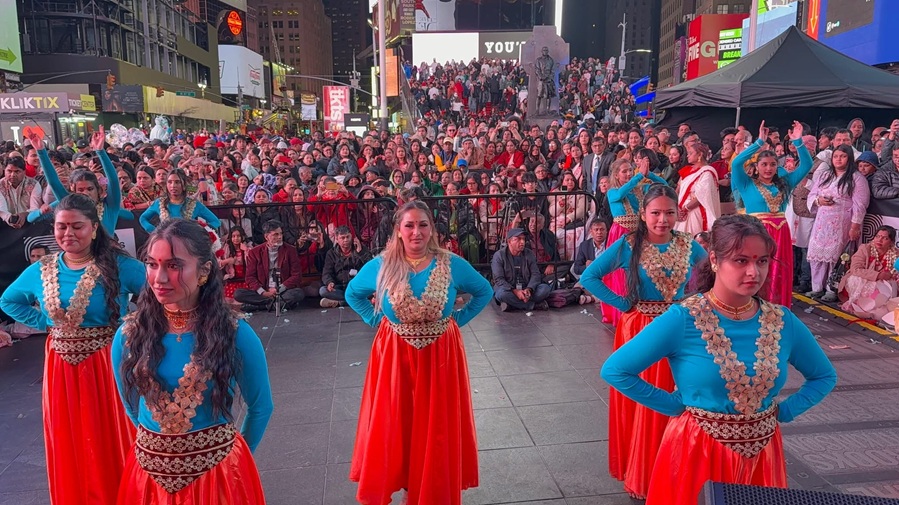
Thousands Celebrate Bengali New Year at Times Square

Shibbir Ahmed, New York: Times Square in New York City turned into a vibrant hub of celebration on Saturday as thousands gathered to welcome the Bengali New Year 1433. The day-long event, organized by NRB Worldwide with support from the New York State Senate, brought together members of the Bangladeshi diaspora, artists, writers, and American political figures. A total of 27 segments throughout the day kept the audience engaged.

The opening ceremony featured distinguished participants including Bishwajit Saha, Rokeya Haider, Hossain Kabir, and Mohitosh Talukdar Tapas. Greetings displayed on a large digital screen included messages from prominent figures such as Brad Hoylman-Sigal, Donovan Richards Jr., Grace Meng, and John Liu. A tribute was also paid marking the birth centenary of renowned writer Shamsuddin Abul Kalam, followed by a literary discussion hosted by Tofazzal Liton. The opening musical performance was delivered by Kartik Chandra.

The first half of the day featured music and dance performances, including solo acts by children, songs by Alvan Chowdhury, dance performances by Ranjani, and artistic showcases by Chitra. A special presentation of “Mymensingh Geetika” was performed by Jibon Chowdhury. Artists from Nepal, Laos, and Thailand also participated, highlighting multicultural diversity. A thematic performance titled “Six Seasons” further enriched the program.

At midday, an award ceremony honored international guests and community representatives, hosted by Dr. Kollol Basu. A commemorative publication was unveiled by Rokeya Haider and Bishwajit Saha.

In the afternoon, a stage play titled “Jyoti Songhita” was performed. The program also included a colorful procession, a tribute to legendary composer Salil Chowdhury, a performance of protest songs by Rahman Tito, dance presentations by Adda and Srishti Academy, folk songs by Shah Mahbub, and a performance by the Odissi Dance Academy. A special tribute segment was dedicated to iconic actor Uttam Kumar.

In the evening, children participated in a mass choral performance titled “Shatokonthe Borshoboron,” followed by a collective performance by senior artists. The program concluded at 10 PM with closing musical performances by Rituporna Banerjee from Kolkata and Nakul Kumar Biswas from Dhaka.

In their closing remarks, organizers stated that the Times Square celebration has grown into a significant cultural event on the international stage, symbolizing unity and cultural pride among the global Bengali community.


Govt cancels gazette of 481 fake freedom fighters: minister

SANGSAD BHABAN – Liberation War Affairs Minister Ahmed Azam Khan today said the government has so far cancelled gazette of 481 fake freedom fighters as part of its initiative to update the list of genuine freedom fighters. “The Liberation War Affairs Ministry is working to find out fake freedom fighters who have enrolled themselves as freedom fighters and taken financial facilities during the immediate past fascist regime,” he said.

The minister said this while giving a statement responding to an emergency important public notice raised by treasury bench lawmaker Mohammad Abdul Malique of Sylhet-3 under rules 71 and earlier adopted in the House with Speaker Hafiz Uddin Ahmed in the chair.

The government has cancelled the gazette of 481 fake freedom fighters during the period between August 2024 and March, this year, he said, adding that concerned ministry is working to cancel the enrollment of the fake freedom fighter after concluding necessary verification.

The enrollment of the fake freedom fighters took place enormously during the fascist regime. The National Freedom Fighters Council (Jatiya Muktijoddha Council – JAMUKA), an autonomous Bangladesh government body under the Ministry of Liberation War Affairs, responsible for identifying, listing, and ensuring the welfare of the freedom fighters.

Although it is a routine work and ongoing process of the council to carry out probe and hearing based on the complaint of the enrollment of ‘fake freedom fighters’, Azam told the parliament.

If the concerned ministry and the council get any complaint on fake freedom fighters then a sub-committee formed comprising with the members of the National Freedom Fighters will give recommendation to cancel the gazette of the fake freedom fighters following carrying out necessary investigation and hearing, said the minister.

Based on the recommendation of JAMUKA sub-committee, the government will cancel the gazette of the fake freedom fighters. Replying to another part of the notice, the minister said that the government will provide digital certificate and smart card to the expatriate freedom fighters, adding that the expatriate freedom fighters will get the recognition after receiving their application.


US ambassador calls on PM

DHAKA – US Ambassador to Bangladesh Brent T. Christensen today paid a courtesy call on Prime Minister Tarique Rahman. The US envoy met the premier at his Cabinet Division office in the Bangladesh Secretariat here this noon, said Prime Minister’s Additional Press Secretary Atikur Rahman Ruman.

During the meeting, the US ambassador handed over two photographs and a replica of the White House to the Prime Minister. One photograph features Shaheed President Ziaur Rahman and former US President Jimmy Carter, while the other shows former Prime Minister Begum Khaleda Zia and former US President George Bush Sr.

Foreign Minister Dr Khalilur Rahman and Prime Minister’s Adviser for Foreign Affairs Humaiun Kobir were present at the meeting. During the meeting, they discussed various issues of mutual interest.