Faiz Ahmad Taiyeb leaves for Germany

The chief adviser’s special assistant on ICT and Telecommunications, Faiz Ahmad Taiyeb, left Bangladesh for Germany on Saturday through Hazrat Shahjalal International Airport in Dhaka. HSIA executive director SM Ragib Samad, also Bangladesh Air Force group captain, said that Faiz Ahmed Taiyeb left Bangladesh for Germany by an Emirates flight EK 583 at about 9:55am on Saturday.

An official of the ministry said that he had taken farewell from both ICT and Telecom divisions on February 9 and February 10.

‘As the new lawmakers’ gazette has published, he will go back to his own work,’ he added.

Posts, telecommunications and information technology ministry’s public relations officer Jashim Uddin could not be reached over the phone despite several attempts. On March 5, 2025, Yunus-led interim appointed Taiyeb as the special assistant to the chief adviser with the status of a state minister. On January 14, 2026, Taiyeb was also appointed as a member of the board of directors at the Biman Bangladesh Airlines. Taiyeb graduated from the electrical engineering department at the Bangladesh University of Engineering and Technology.


Celebratory procession at DU sings anti-razakar song

A group of left-leaning students of Dhaka University staged a celebratory procession, dancing to the song titled Razakar Al-Badar Kichui Rabe Nare, on the Dhaka University campus on Friday. The procession began at the Teachers-Students Centre, led by a truck equipped with a music box, a day after the Bangladesh Nationalist Party won a decisive victory defeating Bangladesh Jamaat-e-Islami in the 13th Jatiya Sangsad elections. It paraded through Jagannath Hall, VC Chatwar, Hall Para, Dhaka University Central Students’ Union and Madhu’s Canteen before concluding at the TSC.

Event organiser cultural activist Faria Motin Ilalala told New Age that although a significant number of people in the country voted for Jamaat, the majority of the country’s people still upheld the spirit of the War of Independence.

‘When we took these anti-razakar songs to the streets, we have witnessed public enthusiasm, which claim that people no longer care about the Liberation War are baseless,’ Faria noted.

Our existence is rooted in the Liberation War, she added, mentioning, ‘This programme does not support the BNP; rather, it has been organised to inform the next generation about the history of the Liberation War.’

She also said that their message to the BNP was that whatever role the party played in the coming days, they would remain prepared to criticise and protest any actions reminiscent of past governments.

Another organiser Anamul Hasan Onoy, a student of the political science department, said that anti-Bangladesh Jamaat forces had been attempting to revive their old anti-Liberation War politics over the past one and a half years ahead of the election.

‘We saw how recognised war criminals’ photos were displayed at the TSC and how they were being idealised. We witnessed their aggressiveness and rhetoric,’ he said.

He added that through the election, the country’s people had resisted anti-1971 forces. ‘Although Jamaat is now effectively in the opposition, it is an alarming matter for Bangladesh.’

As part of strengthening our stance against the anti-1971 agenda and preparing to consign them to their final political grave, we have staged this programme, he mentioned.Bangladesh cultural tours


Who will be in the BNP cabinet?

Tanvir Hasan: After securing a sweeping majority in the 13th National Parliamentary Election, the Bangladesh Nationalist Party is preparing to form the new government. The government has already published the official gazette listing the elected members of parliament. According to Article 148 of the Constitution, elected representatives must take oath within three days of the publication of the official results. The elected members of the 13th National Parliamentary Election will take their oaths on Tuesday, and the cabinet will also take their oaths later that day. Election Commission Secretary Akhtar Ahmed confirmed the schedule at a press briefing on Saturday.

Party sources say Tarique Rahman is set to assume office as Prime Minister after the government is formed. Alongside experienced politicians, the party plans to assign key responsibilities to younger and highly educated leaders. A blend of senior and new leadership is expected in important ministries such as Home Affairs, Law, Finance, and Foreign Affairs.

Several BNP policymakers have indicated that the cabinet will not be overly large. It is expected to consist of between 32 and 42 members. BNP Chairperson Tarique Rahman has already begun consultations with senior leaders regarding the formation of the cabinet. However, the allocation of specific ministries will be known only after the oath ceremony.

BNP Standing Committee member Salahuddin Ahmed said the nation will need to wait a little longer to see the final shape of the cabinet.

For the post of Foreign Minister, BNP Joint Secretary General Humayun Kabir is being discussed, given his active role in strengthening the party’s international relations. Dr Reza Kibria is being considered for the position of Finance Minister. He previously served as a senior economist at the International Monetary Fund.

Amir Khasru Mahmud Chowdhury is being considered for the Commerce Ministry, a position he held in the past. BNP Secretary General Mirza Fakhrul Islam Alamgir is being discussed for the Local Government Ministry. He previously served as State Minister for Agriculture and later for Civil Aviation and Tourism.

Former Attorney General and senior Supreme Court lawyer Md Asaduzzaman is being mentioned for the Law Ministry. Salahuddin Ahmed is also in discussion for the Home Ministry, while Mirza Abbas is being considered for the Road Transport and Bridges Ministry.

Dr AZM Zahid Hossain is likely to take charge of the Health Ministry, and Ruhul Kabir Rizvi is being discussed for the Information Ministry. Other names reportedly under consideration include Nazrul Islam Khan, Dr Abdul Moyeen Khan, Gayeshwar Chandra Roy, Major (Retd.) Hafiz Uddin Ahmed, Iqbal Hasan Mahmud Tuku, Selima Rahman, Andaleeve Rahman Partho, Mizanur Rahman Minu and Shama Obayed, among others.

There is also speculation that the presidency may see a change after the new government is formed. Senior Standing Committee member Dr Khandaker Mosharraf Hossain is being discussed for the post. However, if Mirza Fakhrul Islam Alamgir is nominated for president, a major reshuffle in the cabinet could follow.

Other figures being discussed include Ashrafuddin Nizam, Zonayed Saki, Ishraq Hossain, Abdul Awal Mintoo, Andaleeve Rahman Partho, Nitai Roy Chowdhury, Kazi Shah Mofazzal Hossain Kaikobad, Shahid Uddin Chowdhury Anee, Anindya Islam Amit, Khandaker Abdul Muktadir, Ariful Haque Chowdhury, Osman Faruque, Bobby Hajjaj, Hummam Quader Chowdhury, Nayab Yusuf, Zahir Uddin Swapan, Barrister Farzana Sharmeen Putul, Nurul Haq Nur, Naoshad Zamir, Mir Helal, Asadul Habib Dulu, Ali Asghar Lobby, Ruhul Quddus Talukder Dulu, and Md Shariful Alam.

Ultimately, the final composition of the cabinet will depend on the decision of the party’s Standing Committee and Chairperson Tarique Rahman. As Prime Minister, he may revise the final list at any time, according to party insiders. The newly elected MPs will be sworn in Tuesday morning by Chief Election Commissioner AMM Nasir Uddin, while President Md Sahabuddin will administer the oath to the cabinet members in the afternoon.

Under the Constitution, the President will appoint as Prime Minister the parliamentary leader of the party that secures a majority in the National Parliament. As per convention, after the elected members are sworn in at the Parliament Secretariat, both the ruling party and the opposition will hold separate meetings to elect their parliamentary leaders.

The elected parliamentary leader of the majority party or alliance will then pay a courtesy call on the President at Bangabhaban. During that meeting, the President will formally invite the leader to form the government.

Following this invitation, the Prime Minister-designate will submit the names of ministers, state ministers, and deputy ministers to the President. The President will immediately forward the list to the Cabinet Division, which will complete preparations for the oath ceremony at the earliest possible time.

The Cabinet Secretary will personally call each designated cabinet member, inviting them to attend the oath ceremony at Bangabhaban. Official vehicles will also be sent to their residences. Sources said the Cabinet Division has already collected the names and personal phone numbers of the newly elected MPs. New folders and flags have been procured for the oath ceremony, and official vehicles have been made ready for the incoming cabinet members.


Congressional Briefing Exposes Pogrom Against Hindus in Bangladesh

Washington, DC, February 11, 2026: The Coalition of Hindus of North America (CoHNA) and HinduAction convened a congressional briefing presenting urgent testimony on the escalating persecution of religious minorities in Bangladesh under Chief Advisor Muhammad Yunus, ahead of a deeply contested national election scheduled for February 12. The briefing amplified voices from the ground—journalists, human rights advocates, survivors, and young Bangladeshi Hindus in the diaspora—who described a deepening climate of fear, institutional collapse, and impunity.

“We need to listen to victim voices”, said CoHNA board member Sudha Jagannathan, emphasizing the depth of state failure in Bangladesh. “Silence is not an option and the congressional briefing is one important way to draw attention to the pogrom underway.”
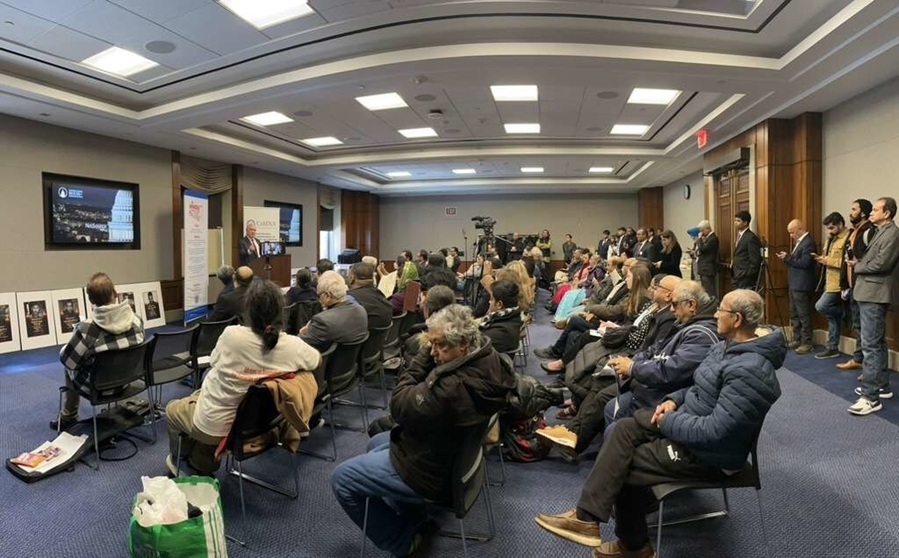
A broad variety of speakers presented data and urged Congress and the State Department to 1) publicly condemn the violence in Bangladesh, and hold congressional hearings, 2) designate Bangladesh as a Country of Particular Concern, 3) designate the Jamaat-e-Islami as a foreign terrorist organization, and 4) apply Magnitsky sanctions on Muhammad Yunus.

Michael Rubin, senior fellow at the American Enterprise Institute, who delivered the keynote address, led the call for sanctions against Yunus under the Global Magnitsky Human Rights Accountability Act—which allows the U.S. to freeze assets and ban entry of foreign human rights violators. He also compared the Islamist crisis in Bangladesh with those in Turkey and Iran, and warned that the U.S. is repeating with Yunus the mistake made with Aung San Suu Kyi in Myanmar—embracing a Nobel laureate whose commitment to liberal principles was “a complete fabrication.”

Congressional Engagement

Rep. Tom Barrett (R-MI), a former U.S. Army officer with 22 years of service, noted that while major battlefronts have wound down, extremist threats have not disappeared. “I know that’s a big reason why you’re here today. I encourage you to continue to advocate, and I appreciate the awareness that you’re raising to bring about a shift in policy,” he said.

Reacting to expert testimony presented at the event, Rep. Suhas Subramanyam (D-VA) wondered if the February 12 elections will be “truly free and fair” as they will proceed without representation from one of the largest mainstream political parties—Sheikh Hasina’s Awami League, which has been banned since May 2025 and its student wing declared a “terrorist organization” since October 2024.

In a recorded message, Samuel Brownback, former U.S. Senator and co-chair of the International Religious Freedom Summit, highlighted the deep impacts of state-sanctioned violence against minorities on population stability and economic prosperity. “If Bangladesh goes in the wrong direction, you’re going to see them drive out most of their religious minorities,” he said.

The briefing drew over 70 attendees including staffers from the offices of Sen. Cory Booker (D-NJ), Rep. Mike Levin (D-CA), Rep. Young Kim (R-CA), and Rep. David Min (D-CA), alongside diplomatic officials, underscoring broad legislative and diplomatic concern over the deteriorating human rights situation in Bangladesh.

Witnesses Testify: “Hindus Will Not Survive Another Decade in Bangladesh”

SriRam, speaking under an alias for safety, and human rights advocate Shubho Roy shared harrowing firsthand accounts of being Hindu in Bangladesh—especially during December 2025, when both witnessed the intensifying crisis on the ground.

In a video testimony, SriRam described coordinated violence and institutional takeover by Islamist groups. He recounted his mother being surrounded by neighbors who chanted that Hindus were traitors and should be expelled from the country. His brother, a doctor, saw his family hospital taken over by Islamist groups and now faces constant threat of attack due to his religious identity. He also noted that December 16—Victory Day, commemorating Bangladesh’s independence from Pakistan in 1971—passed without celebrations, unlike previous years.

Roy, who was also in Dhaka during the same period, testified: “I witnessed it, I went through the trauma. From 1971 till today—we are facing the same. They are going after Hindus. They’re targeting minorities.” Both witnesses warned of imminent erasure. “Hindus will not survive another decade in Bangladesh,” SriRam said. “We will be erased from our homeland.”

The atmosphere of terror in Bangladesh now traumatizes even Hindus living in North America. Gita Sikanji, associate professor at the University of California, Irvine, described organizing rallies in 25 American cities to raise awareness. When she invited an ISKCON leader in California to participate, he began crying and declined. “If I come to the rally and my face is seen in the video, in Bangladesh they will increase the violence on my people,” he told her. “Even American Hindus here are traumatized by this series of events,” Sikanji testified.

Diaspora Youth Mobilizes: Documenting Violence, Demanding Action

Some of the most powerful testimony came from young Hindus raised in America yet deeply moved by events in Bangladesh.

Ritvik Hari, policy analyst at CoHNA, urged Congress to publicly condemn the violence, hold hearings, and designate Bangladesh as a Country of Particular Concern. Puja Debi, Stony Brook University student and co-founder of Bengali Hindus of New York City, described how she has been documenting attacks after realizing mainstream coverage was absent. Pramit Acharjee, senior at Bronx High School of Science, warned that, “minority families are being forced to vote a certain way, and they are killed or displaced if they do not comply.” Swastika Biswas, a Queens high school student, spoke about how language enables violence. “When words strip people of their humanity, violence follows.” Sayan Shil, a young engineer from New York, described the collapse of “psychological safety” for minorities in Bangladesh.

Experts Warn: Bangladesh Risks Becoming a Terrorism Hub

Multiple speakers also documented the systematic breakdown of state institutions and the complicity of security forces in violence against minorities.

Priya Saha, from South Asian Minorities Collective, cited the cases of Hindu police officer Santosh Chowdhury, who was handed over by the Bangladesh army to a mob that lynched and burned him, garment worker Deepu Chandra Das, who was similarly killed after being handed over by factory management, and the violent crackdown in Hazari Goli, where police and military beat and arrested over 80 peaceful Hindu protesters—all of which pointed to direct state involvement, she said. Arifa Rahman Ruma, associate professor at Bangladesh Open University, documented how Islamist militants have been released from prison with full indemnity. National Press Club of Dhaka president Farida Yasmin described the systematic dismantling of a free press with mobs torching major newspaper offices in December 2025.
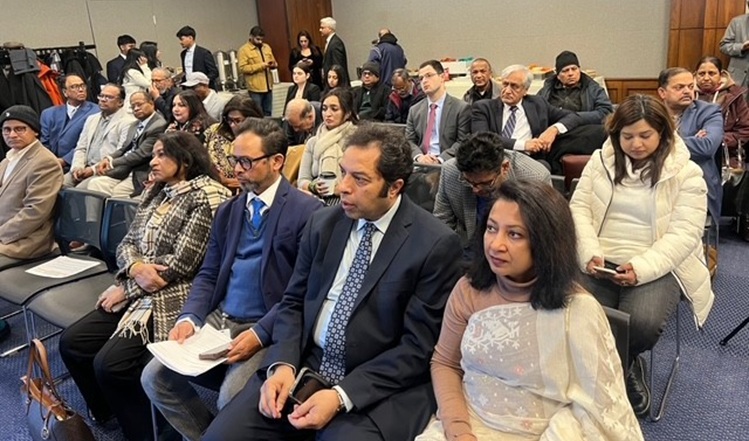
Rana Hassan Mahmud from the Center for U.S.–Bangladesh Relations warned that Bangladesh is heading toward “a sham election with predetermined results.” He cautioned that by allowing Muhammad Yunus to remain in power, “we are enabling the creation of a new hub of terrorism whose repercussions will extend far beyond Bangladesh’s borders.” Utsav Chakrabarti of HinduAction framed the crisis in stark historical terms, warning that “the ongoing pogrom risks escalating into a full-scale repeat of the 1971 genocide—wherein, over the course of 10 months, millions of Hindus were systematically targeted and slaughtered in an orgy of state-backed violence.” He called for the U.S. to hold Jamaat-e-Islami accountable, noting that it is “the very party that collaborated with the Pakistan Army in perpetrating the 1971 genocide, and its return to influence poses a grave threat to regional stability.”

The briefing was part of CoHNA’s sustained grassroots campaign across North America to mobilize attention and defend Hindus in Bangladesh. As the speakers emphasized, the cost of silence extends beyond Bangladesh’s borders—threatening regional stability, emboldening transnational extremism, and undermining American leadership on human rights and religious freedom.


Newly elected MPs to be sworn in on Tuesday

The oath-taking ceremony of the newly elected members of parliament will take place on Tuesday. Parliament Secretariat Secretary Kaniz Moul confirmed the date on Saturday. Another official said the new government may take oath the same day. Buoyed by a decisive mandate, the BNP is set to return to power after two decades.

Emerging from 17 years of self-imposed exile in the UK, Tarique Rahman has led the party to an absolute majority in a historic election — the first in Bangladesh held without the Awami League, which was barred from contesting in the aftermath of the 2024 Uprising. Parliamentary polls were held on Thursday across 299 constituencies, with results declared in 297 seats.

The BNP emerged dominant, winning 209 seats. Its former ally, the Jamaat-e-Islami, secured 68 seats, positioning itself as the principal opposition force in the new parliament. Late on Friday night, Election Commission Secretary Akhtar Ahmed published the official gazette naming the 297 elected lawmakers.

Even as the formalities move forward, uncertainty persists over who will administer the oath to the newly elected MPs, as the speaker of the outgoing parliament, Shirin Sharmin Chaudhury, remains out of public view. Amid the discussion, Cabinet Secretary Sheikh Abdur Rashid said on Saturday that, under the Constitution, the president will administer the oath of office to the cabinet.

Speaking to reporters at his Secretariat office earlier in the day, he said that in the absence of a speaker or deputy speaker, the chief justice or the chief election commissioner is also constitutionally empowered to swear in members of parliament.

Following the parliamentary elections in 2024, Shirin Sharmin assumed office as speaker when the Awami League formed the government. She is now facing cases. The then deputy speaker Shamsul Haque Tuku, who is also a suspect in multiple cases, is currently in jail, creating a procedural complication over the administration of oaths for the new MPs. Asked about the timeline, the cabinet secretary said the gazette notification had already been issued and that, under the law, lawmakers must take their oaths within three days.

“That three-day period will begin tomorrow and [MPs] must take oath by the 17th [of February],” he said.

He added that once the oath process is completed, the parties represented in parliament will select their respective parliamentary leaders. The leader chosen by the majority will then formally inform the president that he commands the confidence of the majority of members.


CEC terms 13th national election a good one in country’s history

Chief Election Commissioner (CEC) AMM Nasir Uddin today said the 13th national election is one of the good elections in the country’s history in any standard. He made the remarks at an official briefing from the Central Results Collection and Presentation Centre at Election Commission (EC) here.

The CEC said, “If you judge, it can be considered a pretty good election. I am feeling good. We promised to present an election in a festive atmosphere. We promised to present a completely neutral and credible election to the nation and we do believe we have achieved it. Everyone is recognising this.”

Expressing his gratitude to media and the country’s people, he said, “We are grateful to journalists, people, voters and political leaders.”

“With the overall cooperation of all, we have been able to present an acceptable election,” he said.


We all are free from today: Tarique Rahman

BNP Chairman Tarique Rahman today said that the people of the country are now free from today. He said that pro-democracy people of the country have once again made the BNP victorious; and described this victory as a win for Bangladesh and for democracy, pledging to build a safe, humane, and democratic Bangladesh in the days ahead.

“Alhamdulillah, this victory belongs to Bangladesh. This victory belongs to democracy. This victory belongs to the people who yearn for democracy. From today, we are all free.”

Tarique Rahman made the remarks at a post-election press conference held in the Ballroom of the InterContinental Hotel in the city today. BNP Chairman said the people have paved the way for establishing democracy in the country by overcoming all obstacles. However, he noted that their journey must begin amidst a fragile economy left behind by fascism, dysfunctional constitutional and statutory institutions, and a weak law and order situation.

“After more than one and a half decades, a parliament and government accountable to the people are set to be established through direct voting. Everyone to remain united so that no anti-democratic force can re-establish fascism in the country or turn Bangladesh into a subservient state,” he said.

Tarique Rahman extended heartfelt congratulations to the 51 political parties that participated in the election, including Jamaat-e-Islami, NCP, Islami Andolan Bangladesh, Jamiat Ulema-e-Islam, and Ganadhikar Parishad.

“In a democratic state and politics, political parties are essentially the lighthouses of democracy. If the government and the opposition each play a responsible role from their respective positions, democracy will undoubtedly become institutionalized,” he said.

Calling upon every democratic political party that participated in the election to share their ideas for nation-building, he stated, “Our paths and opinions may be different, but we are all united for the sake of the country. I believe national unity is our strength, and division is our weakness.”

He specially thanked the interim government and the Election Commission for successfully holding a peaceful, free, fair, and impartial election, dispelling all public doubts. Tarique Rahman also praised the role of all election-related officials, the armed forces, law enforcement agencies, and domestic and international media and observers.

Tarique Rahman expressed deep respect for those who were martyred or injured in the movement to establish democracy over this long period from the Liberation War of 1971 to the war to protect the freedom of the country and its people in 2024. He prayed for salvation of their departed souls. He also mentioned that the absence of the uncompromising leader and former Prime Miniter Begum Khaleda Zia weighs heavily on the party during this joyous moment.

He said, “In anticipation of such a democratic time for establishing people’s rights in the state and politics, she fought uncompromisingly against fascism. She never compromised with autocracy or fascism.”

Referring to BNP’s 31 point ‘roadmap for state repair’, he said, through consultations with other parties and the public, BNP has formulated its election manifesto. Highlighting BNP’s signature to the July Charter, Tarique Rahman assured that every commitment made to the people will be implemented in phases. BNP chairman said his party didn’t bring out any victory processions even after an absolute victory to maintain peace and order, but celebrating the triumph by offering gratitude to Allah.

He asserted, “My statement is clear: peace and order must be maintained at any cost. No injustice or illegal activities will be tolerated.”

He further said, “Regardless of party, opinion, religion, or caste, attacks by the powerful on the weak will not be accepted under any pretext. Justice will be the ideal. If the rule of law is not established, all our efforts will go in vain.”

He urged everyone to be cautious so that any misunderstandings arising from electoral competition do not turn into revenge or retaliation. While appealing to the pro-democracy people, the BNP Chairman said, “Just as we played role in the struggle to establish democracy, let us now each to play our part from our respective positions to build Bangladesh as a safe and humane state by controlling corruption, maintaining law and order, and ensuring accountability to the people.”

Concluding his speech, the BNP Chairman Tarique Rahman once again congratulated and thanked all democratic forces, expatriate Bangladeshis, and the freedom-loving people across the country for the victory.

BNP Secretary General Mirza Fakhrul Islam Alamgir, Standing Committee Member Mirza Abbas, Amir Khasru Mahmud Chowdhury, Dr Khandakar Mosarrof Hossain, Nazrul Islam Khan, Gayeshwar Chandra Roy, Major (retd) Hafiz Uddin, Dr Abdul Moyeen Khan, Selima Rahman, Salahuddin Ahmed, Sultan Salauddin Mahmud Tuku,among others were present during the press conference.

Journalists from the local and foreign media joined the press conference. After concluding the written speech Tarique Rahman answered different questions from the journalists.


BNP will pursue foreign policy protecting Bangladesh’s interests with China, India, & Pakistan

Bangladesh Nationalist Party (BNP) Chairman Tarique Rahman on Saturday said the party will follow a foreign policy that protects the country’s interests in its dealings with China, India, and Pakistan. Speaking to journalists at a post-election press conference at Hotel Intercontinental in Dhaka, Tarique said Bangladesh’s foreign policy will be guided by “the greater interests of Bangladesh and its people.”

Asked about the main challenges he would face as head of government, Tarique said, “We have several challenges. Our economy faces challenges, and the country’s law and order situation is a concern. We must ensure the security of the people. The previous government politicized almost all institutions. Therefore, we must ensure good governance.”

On Bangladesh’s future relations with China and the Belt and Road Initiative, Tarique said: “We will try to protect the interests of the people of Bangladesh. If something is not in Bangladesh’s interest, naturally we cannot pursue it. I am certain that mutual interests will be our first priority.”

Regarding the Belt and Road Initiative, he added: “If it benefits Bangladesh and supports the economy, we will make a decision.” When asked whether he would consult with youth in decision-making, Tarique said, “People have supported us, and we will certainly listen to the youth. But there are more people in this society. Everyone has some issue or the other; we have to listen to everyone.”

On reviving SAARC, Tarique said: “You know, SAARC was established through Bangladesh’s initiative. We want it to function. We will discuss with our friendly states and try to revive SAARC.”

Asked whether BNP would seek the extradition of Sheikh Hasina from India, he said: “That depends on the legal process.” Responding to another question on China, Tarique said: “They have been Bangladesh’s long-term development partners. We hope to create areas where we can work together.”

On plans to address a fragile economy, low investment, and inflation, the BNP chairman said: “We will bring in new investments and create employment.”


Tarique Rahman: Law and order must be maintained at any cost

Tarique Rahman, chairman of the Bangladesh Nationalist Party (BNP), on Saturday called for maintaining law and order “at any cost” and sought cooperation from all in building a safe and humane Bangladesh. “We need everyone’s cooperation to build a safe and humane Bangladesh. This time, everyone must play a responsible role in rebuilding the country. No injustice can be done to anyone on any excuse. Law and order must be maintained at any cost,” Tarique said.

He made the remarks at an official press briefing in the afternoon at Hotel InterContinental in the capital after securing an absolute majority in the election. Tarique said the freedom-loving people of the country had made BNP victorious, describing the outcome as “the victory of the people.”

“From today, everyone is free. Congratulations to all. With the participation of all, the journey of a fascism-free state has begun in the country,” the BNP chairman said. He noted that besides BNP, Bangladesh Jamaat-e-Islami, NCP and Islami Andolon Bangladesh also participated in the election, which he described as peaceful. “Everyone’s thoughts are important in building the country. We will build the country based on everyone’s opinions,” Tarique said.

The BNP chairman thanked the Election Commission and congratulated the administration and all election officials. “Without your cooperation, such a beautiful election would not have been possible,” he added. BNP Secretary General Mirza Fakhrul Islam Alamgir and other top party leaders were present at the press conference. Representatives of allied parties of the simultaneous movement and distinguished citizens were also in attendance.

Although it was a press briefing, a festive atmosphere prevailed as newly elected members of parliament from across the country and well-wishers gathered at the venue. Representatives of foreign media were also present.


Headline: Armed Forces Day to be Observed on November 21 with Nationwide Programs

Armed Forces Day will be observed on Friday, November 21, with due respect and enthusiasm across the country. Various programs will take place nationwide to mark the occasion. The day’s events will begin with special Fazr prayers and supplications at all army, navy, and air force base mosques, seeking the welfare and prosperity of the country, the advancement of the armed forces, and the blessings for the souls of the martyrs who sacrificed their lives during the Liberation War.

On this occasion, President and Commander-in-Chief of the Armed Forces, Md. Shahabuddin, and Chief Adviser Professor Muhammad Yunus have issued separate messages. According to a press release from the Inter-Services Public Relations (ISPR), to honor the members of the armed forces who sacrificed their lives in the 1971 Liberation War, the President and the Chief Adviser will lay floral wreaths tomorrow morning at the Eternal Flame at Dhaka Cantonment.

Following this, the Army Chief General Waker-uz-Zaman, Navy Chief Admiral Mohammad Nazmul Hasan, and Air Chief Marshal Hasan Mahmud Khan will also lay floral wreaths on behalf of their respective services.

The Chief Adviser will exchange greetings with the three service chiefs at his designated office in the Armed Forces Division at Dhaka Cantonment and spend some time in courtesy meetings. Subsequently, the service chiefs will also pay a courtesy call on the President at Bangabhaban.

On the occasion, the Chief Adviser will host a reception at the Army Multipurpose Complex, Dhaka Cantonment, for selected gallantry award-winning freedom fighters and their heirs. During the event, the Chief Adviser will present commemorative gifts and exchange greetings with 101 selected gallantry award recipients and their heirs, in the presence of senior officials.

A reception program will also be organized in the afternoon at Senakunja, Dhaka Cantonment, where distinguished guests will attend.

Besides Dhaka, receptions will be held at military bases in Barishal, Cox’s Bazar, Bogura, Sylhet, Ghatail, Chattogram, Comilla, Jessore, Rangpur, and Khulna, organized by the respective area headquarters.

Across the country, outside Dhaka, various programs will also be held at army garrisons, navy, and air force bases to mark the day. Navy ships, specially decorated in Dhaka, Khulna, Chandpur, Barishal, and Chattogram, will remain anchored at nearby jetties for public viewing until sunset.

To highlight the significance of Armed Forces Day, Bangladesh Television will broadcast a special program, ‘Bisesh Onirban’, following the 8:00 PM Bangla news on Thursday. Bangladesh Betar will air ‘Bisesh Durbar’ on the evening of November 21.

The ‘Bisesh Onirban’ program produced for television will also be broadcast later on private TV channels. Special inserts will be published in national newspapers, and various educational institutions run by the armed forces will hold essay and drawing competitions in observance of the day.