Protest Held in Front of the United Nations Condemning Ban on Awami League

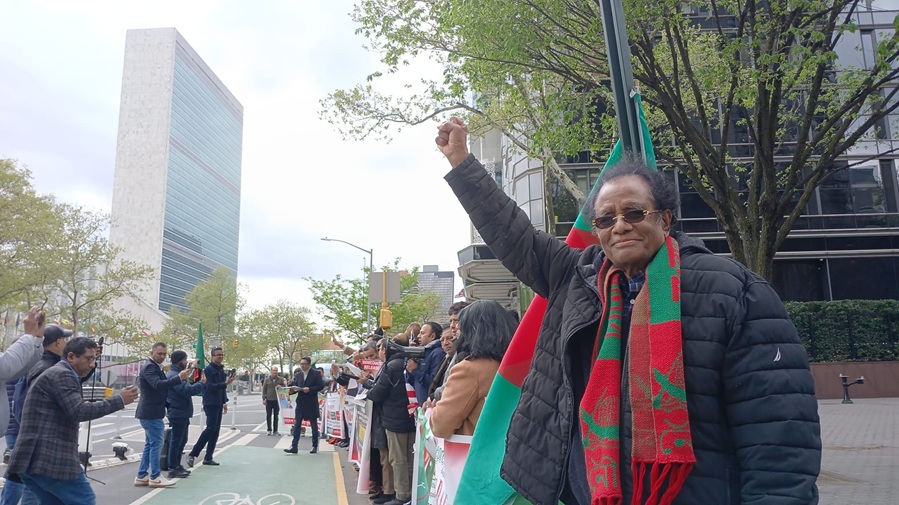
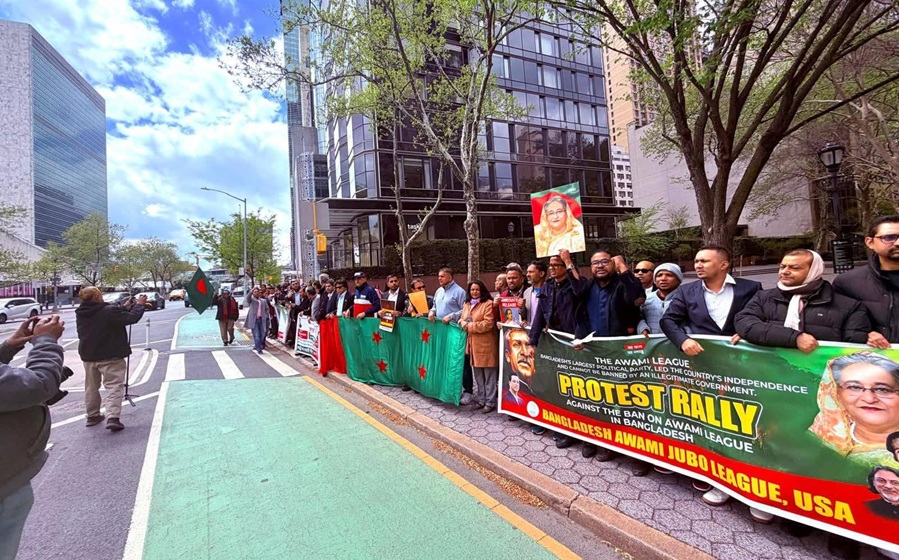
Shibbir Ahmed, United Nations, New York: A large protest rally was held in front of the United Nations on April 20, where demonstrators strongly condemned the reported ban on the Awami League in Bangladesh and demanded its immediate withdrawal. Protesters warned that if the decision is not reversed, a strong আন্দোলন (movement) would be launched from the United States to overthrow the Jamaat-BNP-led government under the leadership of Tarique Rahman.

The main organizer of the program, Dr. Pradip Kar, an advisor to the United States Awami League and a freedom fighter, also called for intervention from President Donald Trump and the United Nations to address the rise of militancy and terrorism in Bangladesh.

Among those who spoke at the rally were leaders and activists from various affiliated organizations, including the Awami League, Jubo League, Chhatra League, and Mohila Awami League. Key speakers included Dr. Siddiqur Rahman, Abdus Samad Azad, Dr. Masudul Hasan, Abul Hasib Mamun, Abdur Rahim Badsha, Rafiqul Rahman, Imdad Chowdhury, Shaheen Azmal, Mohiuddin Dewan, Sheikh Atik, M.A. Karim Jahangir, Hakikul Islam Khokon, Advocate Shah Bakhtiar, Solaiman Ali, Sakhawat Ali, Advocate Rokibuddin Dulal, Advocate Morsheda Zaman, Rumana Akter, Baker Bhuiyan, Jalal Uddin Jalil, Tarek ul Haider Chowdhury, Sheikh Jamal, Jewel Ahmed, Shahidul Islam, and Hriday Mia, among others.

During the rally, Dr. Pradip Kar announced a peaceful human chain demonstration to be held in front of the U.S. State Department on May 4 from 1:00 PM to 2:00 PM, demanding the repeal of the law banning the Awami League. He also stated that a memorandum would be submitted to the U.S. Secretary of State. Additionally, a memorandum has already been submitted to the Secretary-General of the United Nations following the protest.

Meanwhile, the United States Awami League, along with its New York State and city units, has also announced another protest rally scheduled for April 30 at 12:00 PM in front of the State Department and the White House to oppose the passage of the law banning the Awami League.


Historic Resolution in New York Recognizes April 14 as Bengali New Year Day

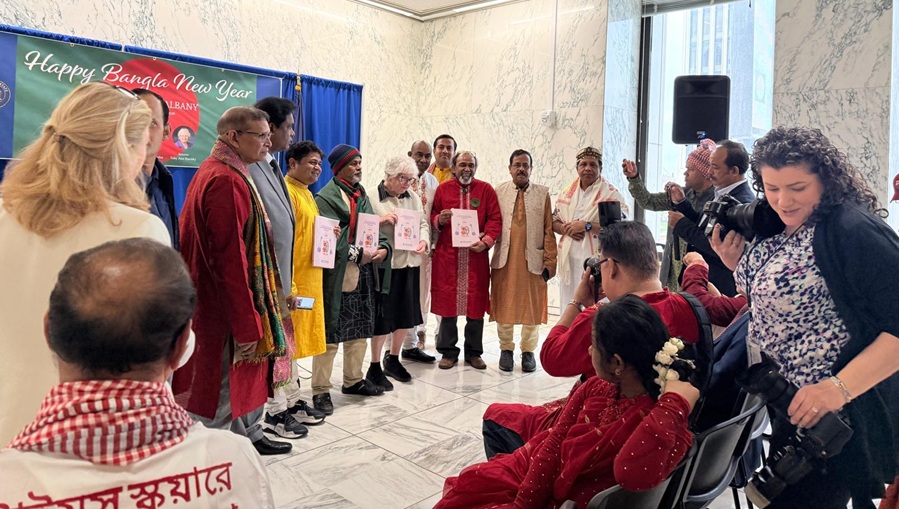
Shibbir Ahmed, New York: A historic milestone has been achieved in New York, as a resolution has been adopted recognizing April 14 as “Bengali New Year Day,” marking a significant acknowledgment of Bengali culture and heritage. The resolution was passed on April 22 during a legislative session held in the state capital, Albany, bringing a grand conclusion to three days of vibrant New Year celebrations.

The proposal was introduced in the New York State Senate by Senators Luis Sepúlveda, Nathalia Fernandez, and Toby Ann Stavisky. Speaking in support of the resolution, Senator Stavisky emphasized the vital contributions of the Bengali community in education, business, and culture across New York’s diverse society. Her remarks were met with enthusiastic applause from fellow lawmakers and attendees. Approximately 50 prominent members of the Bengali diaspora were present at the session, rising to their feet in recognition of the moment.

The resolution calls upon Governor Kathy Hochul to officially proclaim April 14, 2026, as Bengali New Year Day in New York State. It highlights the festival as a secular and inclusive cultural celebration with roots in the agrarian economy of the Mughal era, bringing together people of all backgrounds through music, dance, art, and traditional heritage.

It further acknowledges the Bengali-speaking population—one of the largest linguistic communities in the world—for its strong cultural presence in New York. From the late 19th century to the present day, Bengalis have made notable contributions in education, research, business, healthcare, and literature across the United States.

The resolution also recognizes the decades-long cultural contributions of Muktadhara Foundation, including its festivals and book fairs, and highlights the role of its founder Biswajit Saha. His contributions have been formally acknowledged by the state legislature, as his name is included among those receiving official copies of the resolution.

Following the formal proceedings, a cultural program began at 1:00 PM. The event opened with Rabindra Sangeet performances led by music director Mahitosh Talukder Tapas. Senator Stavisky delivered remarks during the program, praising the role of community organizations such as NRB Worldwide and the Muktadhara Foundation in promoting Bengali language and culture in New York.

Additional speakers included NRB Worldwide Vice President Kallol Basu, General Secretary Tofazzal Liton, and Mahitosh Talukder Tapas. In his remarks, Biswajit Saha expressed his vision of elevating Bengali New Year celebrations beyond the diaspora and into the broader American mainstream.

The cultural segment featured performances by young dancer Bhasha Saha and singer Durga Khatriya. Folk artist MD Shahin Hossain captivated the audience with traditional music. Under the musical direction of Mahitosh Tapas, five special songs were performed, making the hour-long program lively and festive. The event concluded with a collective rendition of the national anthem of Bangladesh.

The celebration, organized by the New York State Senate and led by Biswajit Saha under the banner of NRB Worldwide, began on April 11–12 in New York City—notably in Times Square and Jackson Heights—and concluded on April 22 at the State Capitol in Albany.

With the adoption of this resolution, Bengali New Year is now on a clear path toward official recognition as a cultural observance in New York State—marking a proud and historic achievement for the Bengali community in the United States.


Power supply slashed, daytime load shedding surges to 8–9 hours nationwide

District towns across Bangladesh are experiencing acute power outages as global energy supplies continue to be disrupted due to ongoing conflict in the Middle East. The situation has led to a sharp decline in electricity generation, with supply in many areas dropping to nearly half of the demand. In several regions, load shedding has taken a severe turn, with outages exceeding 10 hours a day.

On Thursday, power distribution companies struggled to maintain supply from morning until evening. Although scheduled outages were supposed to last one hour in different areas, the nationwide average exceeded two hours. Outside Dhaka, the situation is particularly dire, with some areas facing power cuts lasting eight to nine hours daily.

In Chittagong, residents are enduring daily power cuts ranging from seven to eight hours, severely disrupting normal life amid intense heat. Industrial production has also been affected. Rural areas are facing even worse conditions than the city, with electricity available for less than 10 hours out of 24.

Md Rafique, a resident of the Shangeet Residential Area under Panchlaish thana, told, “Load shedding has become unbearable over the past few days. Power goes out 10 to 12 times daily, and once it goes, it returns after about two hours. We are without electricity for at least seven to eight hours a day. In this heat, the situation has become intolerable and needs urgent resolution.”

Responding to the situation, Md Akbar Hossain, assistant director (Public Relations) of the Bangladesh Power Development Board (BPDB) in Chittagong, said that electricity distribution in Chattogram, the three hill districts, and Cox’s Bazar is managed from the Agrabad office.

“For the past four to five days, Chittagong has been experiencing load shedding of six to seven hours daily. During off-peak hours, outages reach up to 111 megawatts, but during peak hours, the situation worsens due to higher demand,” he said.

According to BPDB sources, peak hours typically run from 5:00 pm to 11:00 pm, when electricity demand is at its highest. Off-peak hours span from 11:00 pm to 5:00 pm the following day, when demand remains comparatively lower. However, the intensity of load shedding has been significantly higher during peak hours.

A report published on April 15 by the Chittagong Power Development Board revealed a significant gap between electricity demand and supply. On that day, power demand during off-peak hours stood at 1,384.09 megawatts, while peak-hour demand reached 1,432.73 megawatts. In contrast, load shedding amounted to 111.09 megawatts during off-peak hours and rose to 170.73 megawatts during peak hours.

Meanwhile, residents of Barisal are enduring prolonged power outages, with load shedding lasting five to six hours within a 24-hour period. The situation has left city dwellers struggling to cope with the intense heat, while business owners report mounting financial losses.

According to sources at the 33 kV substation control room in Rupatali, the combined daily electricity demand in Barisal and Jhalokathi ranges between 90 and 95 megawatts. However, only around 42 megawatts are being supplied. As a result, authorities are compelled to implement at least six hours of load shedding daily, with outages more frequent during peak hours.

Residents, including Mizanur Rahman of Kaunia and Sadeq Hossain of Circular Road, expressed frustration over the worsening situation. They said that as temperatures rise, power outages have increased, causing severe inconvenience to families. Nighttime outages, in particular, have made it difficult for children to sleep, adding to the overall hardship.

Business owners are facing even greater challenges. Traders from Chawk Bazar, including Minal Kanti Saha and Mohammad Shahin, said that due to the electricity crisis, the government has instructed shops to close by 6:00 pm. While they are complying with the directive, frequent outages between 9:00 am and 6:00 pm, often occurring four times a day, are severely affecting their operations. Each outage typically lasts over an hour, discouraging customers during crucial business hours. As a result, many traders are struggling to cover daily expenses.

They also expressed concern over the lack of clear information regarding when the situation might improve, alleging that authorities have not provided definite assurances.

When contacted, Manjur Kumar Swarnakar, executive engineer of Barisal Power Sales and Distribution Division-1, told that his area has a demand of 78.5 megawatts but is receiving only 50 megawatts of electricity supply. “Under these circumstances, we are left with no option but to resort to load shedding,” he said.

Executive Engineer Manjurul Islam of Barisal Electricity Sales and Distribution Division-2 said the demand in his jurisdiction stands at 39 MW, while only 21 MW is being supplied. “Under these circumstances, we have no option but to implement load shedding,” he told.

Echoing similar concerns, Akhteruzzaman Palash, executive engineer of the Barisal 33 kV substation, said they are receiving less than half of the required electricity. “As a result, we are compelled to enforce load shedding for five to six hours daily,” he added.

In the Mymensingh zone—comprising Mymensingh, Jamalpur, Netrokona, Sherpur, Tangail, and Kishoreganj—the daily electricity demand is around 1,075 MW. However, only 750 MW is being supplied, leaving a deficit of up to 325 MW. Officials say this shortfall is causing four to five hours of daily load shedding, with rural areas experiencing nearly double that duration.

Masudul Haque, executive engineer of Power Grid Bangladesh PLC in Mymensingh, noted that the extent of load shedding fluctuates throughout the day. “It is comparatively lower during off-peak hours and increases during peak demand periods,” he said.

He further explained that the Mymensingh Power Station, with a capacity of 210 MW, is currently generating only 30 MW due to gas shortages. Likewise, the United Jamalpur and United Mymensingh power plants, which have a combined capacity of 315 MW, are producing just 67 MW amid a shortage of furnace oil. The situation has been exacerbated by a recent hike in furnace oil prices by Tk 24.59 per litre. In addition, electricity supply from major plants, including Ashuganj, Sirajganj, and Bibiyana, has declined.

However, Engineer Abul Kalam, assistant chief engineer of the Bangladesh Power Development Board in Mymensingh, claimed that load shedding remains minimal. He attributed frequent outages in rural areas to weather-related disruptions. “Storms and rainfall often cause trees to fall on power lines, leading to temporary outages. Restoration efforts take time, which may create the impression of increased load shedding,” he said.

Residents, however, paint a different picture. Abdullah, a resident of Gopalnagar village, said prolonged outages are a daily reality. “Electricity remains unavailable most of the time. Once it goes out, it takes one to two hours to return. We experience four to five hours of load shedding daily. During storms or heavy rain, outages can last the entire day,” he said, highlighting the persistent challenges faced by rural communities.

Load shedding continues unabated in Sylhet, with frequent power outages both day and night causing widespread public suffering. The situation has become particularly challenging for Secondary School Certificate (SSC) examinees, whose examinations are scheduled to begin on April 21.

According to the Bangladesh Power Development Board (BPDB), Sylhet is currently experiencing load shedding of around 20–25 percent of its daily electricity demand. However, residents claim that the actual outages are more frequent and prolonged than official estimates suggest.

Panna Roy, a resident of Akhalia and a private sector employee, told, “We are going through a miserable time with our children due to constant power cuts. There was no electricity in my house from 12:00 am to 3:30 am on Wednesday. Again, it was out for an hour from 8:00 am on Thursday. Even at the office, power kept coming and going. It feels like we get electricity for an hour, only to lose it the next. On average, we are facing nine to ten hours of load shedding daily.”

Echoing similar concerns, Kobi Nombrom Shankar from Kushighat said he experienced three power outages within just two hours while visiting an office in the Nayasarak area. “We are facing at least seven to eight hours of load shedding every day,” he added.

Business owners in Sylhet have also expressed frustration over the worsening situation. Abdul Rahman Ripon, president of the Sylhet Metropolitan Business Unity Welfare Council, said, “Shops have to close by 7:00 pm, and by the time we open around 11:00 am, half the day is already gone. Even then, electricity is unavailable for a significant portion of the day. If this continues, we may be forced to shut down our businesses.”

BPDB sources said that on Wednesday, the Sylhet region recorded a demand of 170 MW against a supply of only 130 MW, resulting in a shortfall of 40 MW and approximately 25 percent load shedding. In Sylhet district alone, demand stood at 110 MW, while supply was limited to 83 MW, leading to outages exceeding 25 percent.

Mohammad Imam Hossain, chief engineer of BPDB’s Sylhet division, said the situation stems from a mismatch between supply and demand. “We are experiencing an average of 20–25 percent load shedding daily due to insufficient power supply. This is not limited to Sylhet; similar conditions prevail across the country amid the global energy crisis,” he said.

Load shedding has intensified nationwide since early April, driven in part by rising temperatures. While urban areas are coping relatively better, rural regions are facing more severe outages, often lasting six to seven hours daily on average. The situation has also increased reliance on generators.

In Rangpur, residents are experiencing power outages at intervals of one to two hours, significantly disrupting daily life. Although scheduled outages are supposed to last one hour, they often extend beyond two hours. In areas outside the district town, power cuts have reportedly reached up to 10 hours a day. The situation is even more severe at the upazila level, where load shedding occurs almost every hour after evening, totaling 10 to 12 hours daily in rural areas.

Residents said the city has been enduring continuous load shedding for the past 10 days. On Thursday morning, between 5:00 am and 9:00 am, outages occurred almost every hour across most parts of the city, except for some priority areas. Traders at District Council Super Market and Jahaj Company Shopping Complex said frequent outages are severely affecting business operations. “We don’t even get enough time to charge IPS systems,” they said, adding that daily power cuts last eight to nine hours.

Students, including SSC candidates, are also struggling to continue their studies amid persistent disruptions, raising concerns over their preparation for the upcoming exams. Shamsul Islam, an engineer at the Northern Electricity Supply Company (NESCO) in Rangpur, said, “We are compelled to implement load shedding due to insufficient power supply from the national grid. There is little we can do under the circumstances.”

The situation is particularly acute in eight upazilas of Rangpur, where rural electrification systems are in place. These areas are experiencing at least 10 hours of load shedding daily. Biplab Kumar Pal, deputy general manager of the Badarganj Rural Electrification Association, said, “The demand in my area is 20 MW, but we are receiving only 8 MW. Under such conditions, it is impossible to meet consumer demand, leaving us with no option but to enforce load shedding.”

Khulna is facing severe and frequent load shedding as electricity supply in many areas has dropped to nearly half of the demand, pushing the situation into a critical state. In several locations, power outages are lasting for more than 10 hours a day. According to data from the West Zone Power Distribution Company (WZPDCL), load shedding reached 202 megawatts during the peak hour at 1:00 pm on April 16, with Khulna city alone accounting for 115 megawatts of the shortfall. Central control room data of WZPDCL shows that at the same time, total electricity demand under its jurisdiction stood at 762 megawatts, while supply was only 560 megawatts, resulting in a deficit of 202 megawatts.

In Khulna city, demand was 160 megawatts against a supply of 131 megawatts, leaving a shortfall of 29 megawatts. In the wider Khulna zone, demand stood at 573 megawatts while supply was 458 megawatts, creating a deficit of 115 megawatts. In the Barisal zone, demand was 189 megawatts against a supply of 102 megawatts, resulting in an 87-megawatt shortfall.

However, the ground reality appears to be more severe than official figures suggest, with residents reporting outages lasting more than 10 hours in many areas. A responsible source from the Rampal Power Plant said the facility generated 1,250 megawatts of electricity on April 16 and that production has remained stable despite ongoing global energy supply challenges. The plant continues to play a significant role in supporting the national power grid.

Despite this, residents of Khulna city report frequent outages throughout the day. Locals say power cuts occur every 30 to 60 minutes and last for 60 to 90 minutes at a time. “In our area, when electricity goes out, it does not return for one and a half hours. Even after it returns, it goes off again within 30 minutes. Overall, we are experiencing 10–11 hours of load shedding daily,” said Azmal Hossain, a resident of the Goborchaka area in the city.

Residents of Ward No. 23 in Khulna city also reported outages lasting up to two and a half hours on April 16 at midday, along with brief interruptions in the morning, afternoon, and evening. Reports were compiled by correspondents from Khulna, Barishal, Mymensingh, Sylhet, Chittagong, and Rangpur.


Bangladesh starts receiving 5,000 more tonnes of diesel from India

DINAJPUR – Bangladesh today has started receiving 5,000 more tonnes of diesel from India through the cross border pipeline, said officials familiar with the process. “Another 5,000 tonnes of diesel has stated coming to Parbatipur Padma Oil depot from India through the India-Bangladesh Friendship Pipeline,” Parbatipur Padma Oil depot Manager Md Ahsan Habib Chowdhury said.

He said that the Parbatipur Rail Head depot has started getting the supply since the morning of April 16. According to the ministry, 8,000 tonnes of diesel came to Parbatipur depot from Numaligarh, India on April 14, while 22,000 tonnes of diesel in March. A total of 30,000 tonnes of diesel so far arrived at Parbatipur depot from Numaligarh, India from March to April 14, the sources said.

The depot authorities said that another 7,000 tonnes of diesel will come from Numaligarh Refinery Limited, India, in the next 4 to 5 days. In April Bangladesh will receive a total of 25,000 tonnes of diesel.

“The government is continuing to import diesel from India through pipelines to maintain normal fuel stocks and ensure uninterrupted supply,” said the depot manager. The depot authorities kept the depot open on Friday (holiday) to ensure smooth fuel supply, he said.


Bangladesh Calls for Bridging Digital Divide and Strengthening Data Systems at UN CPD59

Shibbir Ahmed, New York: At the 59th Session of the Commission on Population and Development at the UN Headquarters in New York today Bangladesh’s Permanent Representative Ambassador Salahuddin Noman Chowdhury called for strengthening research and data systems, bridging the digital divide through enhanced international cooperation, technology transfer and capacity building, promoting the ethical use of emerging technologies with strong data privacy safeguards, and investing in digital skills particularly for women and youth while delivering its statement.

Highlighting the critical role of technology and research in achieving ICPD objectives and the Sustainable Development Goals, he noted that nearly one-third of the global population still lacks internet access, limiting opportunities in essential services.

In his statement the Ambassador underlined Bangladesh’s progress in reducing maternal mortality, expanding immunization coverage, strengthening community-based healthcare, promoting women’s empowerment and enhancing collaboration with research institutions. He also emphasized the use of digital health solutions, including telemedicine and real-time disease surveillance.

Stressing the importance of investing in youth, skills development and innovation, Ambassador Chowdhury also acknowledged challenges such as urbanization, climate change, and non-communicable diseases as barrier for sustainable development.


Bangladesh Reiterates Strong Commitment to UN Peacekeeping at Mission Event

New York: The Permanent Mission of Bangladesh to the UN hosted a luncheon in honor of the Heads of Military Components and Force Commanders serving in United Nations peacekeeping missions at the Mission today hosted by the Permanent Representative of Bangladesh Ambassador Salahuddin Noman Chowdhury. The event was attended by the United Nations Under-Secretary-General for Peace Operations Jean-Pierre Lacroix, Under-Secretary-General for Operational Support Atul Khare, Acting Military Adviser of the Office of Military Affairs Lieutenant General Cheryl Pearce along with distinguished Force Commanders, senior UN officials and diplomats.

In his welcoming remarks, the Permanent Representative of Bangladesh Ambassador Salahuddin Noman Chowdhury expressed deep appreciation for the leadership of Force Commanders and Heads of Military Components serving in challenging UN peacekeeping missions. Paying rich tribute to the peacekeepers who made the ultimate sacrifice in the line of duty, Ambassador Chowdhury underscored Bangladesh’s readiness to further strengthen its contributions in partnership with the United Nations and the international community.

The programme was moderated by Brigadier General Mohammad Golam Rabbani the Defence Attaché of the Mission who concluded the event by expressing his sincere gratitude to all distinguished guests for their presence.


Bangladeshi Intelligence Officials to Visit Washington Following U.S. Invitation

Dhaka: Six senior officials from Bangladesh’s leading intelligence agencies are set to visit Washington, D.C., following an official invitation from the United States. The visit is scheduled to take place from April 10 to April 15. According to sources, the delegation includes two officials each from three major agencies: the Directorate General of Forces Intelligence (DGFI), the National Security Intelligence (NSI), and the Special Branch (SB). They are expected to depart from Hazrat Shahjalal International Airport in Dhaka.

The primary objective of the visit is to strengthen bilateral intelligence cooperation and enhance information sharing on internal and regional security matters. During the visit, discussions will focus on security collaboration, strategic coordination, and exchange of intelligence between the two countries.

The Special Branch representatives reportedly include an Additional Inspector General and a Special Superintendent of Police. However, the identities of officials from the other agencies have not been disclosed. The visit has been approved by Bangladesh’s new government, and analysts believe it could further deepen security ties between Bangladesh and the United States.


Bangladeshi-origin Doly Begum becomes federal MP in Canada

Doly Begum, a former New Democratic Party (NDP) MPP who recently defected to the federal Liberal Party, has won the Scarborough Southwest federal byelection, securing a seat in Ottawa. Her victory keeps the riding under Liberal control following the departure of longtime MP Bill Blair, who stepped down to take up a diplomatic role as Canada’s high commissioner to the United Kingdom.

The win also helps Prime Minister Mark Carney secure a narrow majority government. The Liberals now hold 174 seats in parliament—surpassing the 172-seat threshold required for a majority—after a series of recent defections from opposition parties.

Addressing supporters after the result, Begum said: “Tonight, we celebrate something so powerful—a community coming together, putting aside their differences to choose hope, compassion, and progress.”

Begum secured nearly 70% of the vote, although voter turnout remained relatively low, with only about one-third of eligible voters casting ballots. Among the other candidates, Conservative nominee Diana Filipova received just over 18% of the vote, while NDP candidate Fatima Shaban secured around 6%. Green Party candidate Pooja Malhotra received approximately 2.5%.

Several political figures attended Begum’s victory event, including MP Nathaniel Erskine-Smith, MPP Andrea Hazell, and former provincial Liberal candidate Qadira Jackson.

Begum’s transition to federal politics comes just two months after she resigned as a provincial representative for Scarborough Southwest. First elected in 2018 at the age of 29, she was one of the youngest members of the NDP caucus and later served as deputy leader.

Her decision to run as a Liberal candidate in the byelection drew criticism from within the NDP, including from party leadership. A provincial byelection for the now-vacant Scarborough Southwest seat has yet to be announced.


PM seeks $2b from development partners to meet energy demand

DHAKA – Prime Minister Tarique Rahman today sought US$ 2 billion fund from development partners to meet the Bangladesh’s immediate energy needs and safeguard its economic stability.

“The situation before us demands urgency, solidarity, and decisive action. Immediate support for the most vulnerable countries must be at the top of our collective agenda,” he told the Asia Zero Emission Community (AZEC) Plus Online Summit. “We urge the intentional community to respond swiftly and positively to this call,” he said.

Highlighting the ongoing global energy crisis, the Bangladesh prime minister said the crisis is a stark reminder of their shared vulnerability and interdependence. No nation- regardless of its size or strength- can overcome this challenge in isolation, he said, adding that it demands a coordinated and forward-looking Asian response, to strengthen regional energy security, address immediate supply disruptions, and support the most vulnerable countries.

Tarique Rahman said the energy crisis has already disrupted Bangladesh’s economy. “In response, we have taken a range of short-term measures to contain the impact.”

He said the measures include demand-side management through the rationing of government office and market hours; stabilisation fuel supplies through emergency imports and diversification of sourcing; and consumption controls, including fuel rationing and limits on retail sales to prevent hoarding and panic buying through initiatives such as ‘Fuel App’.

The premier said Bangladesh is concerned that the scale and consequences of this crisis could exceed those of the 1970’s oil shock, which triggered a decade of stalled development in the 1980s.

Since gaining independence in 1971, he said, Bangladesh has worked relentlessly to drive economic growth, lift millions of out poverty, and improve the quality of life for its people.

“Today, these hard-own gains are in danger, facing the real threat of reversal,” he added. Tarique Rahman said Bangladesh is not alone in facing this risk, “nor can we overcome it through national effort alone”.

This moment calls for a decisive and co-ordinated global action, to contain the impact of the ongoing energy crisis, particularly to protect vulnerable countries, including the Least Developed Countries (LDCs), from its severe economic and social impact, he said.

Tarique Rahman appreciated Japanese Prime Minister Sanae Takaichi for convening this timely and important Summit. Malaysia Prime Minister Anwar Ibrahim and heads of the government and states of Japan, the Philippines, Singapore, Thailand, Vietnam, Timor Leste and representatives of different countries took part in the online summit.

Japanese Prime Minister Sanae Takaichi delivered concluding remarks at the meeting. While Prime Minister Tarique Rahman delivered his speech at the summit from his Sangshad Bhaban office this afternoon, Foreign Minister Dr Khalilur Rahman and Foreign Affairs Adviser M Humayun Kabir were present.


Govt moves to make, implement action plans under 180-day programme: PM

SANGSAD BHABAN – Prime Minister Tarique Rahman today said that the government has taken necessary steps to formulate and implement action plans based on a 180-day programme to implement the commitments made in the election manifesto.

“In line with the election manifesto, several important programmes have already been taken up on a priority basis and significant progress has been achieved in implementing those,” he said in reply to a starred question from treasury bench member from Pabna-5 Md Shamsur Rahman Simul Biswasin in the Jatiya Sangsad (JS) with Speaker Hafiz Uddin Ahmad, Bir Bikram, in the chair.

Tarique Rahman, also ruling BNP chairman, said his government has initiated the ‘Family Card’ programme, considering the family as the core unit of development.

The programme has been launched with providing Taka 2,500 per month through ‘Family Card’ to the female heads of 37,814 families in 13 districts and three city corporations primarily to give protection to marginalised and low-income families, he added.

The Prime Minister also said the ‘Farmer Card’ programme was launched on April 14 aimed at ensuring agricultural development and providing benefits to farmers such as subsidized agricultural inputs, irrigation facilities, and easy access to agricultural loans and machinery. In the pre-pilot phase, he said, the programme is being implemented in 11 agricultural blocks across 11 upazilas in 10 districts.

Additionally, as per the ruling BNP’s election pledge, Tarique Rahman said agricultural loans up to Taka 10,000 in crops, livestock, and fisheries sectors have been waived. To this end, he said, the government has already allocated a budget of Taka 1,567.96 crore, benefiting about 13 lakh 17 thousand 500 farmers across the country.

The Prime Minister said under the 180-day priority programme of the Ministry of Religious Affairs, honorarium and festival allowances have already been sent to the bank accounts of 9,102 people working in mosques, temples, Buddhist monasteries/pagodas and churches under a pilot scheme.

The process of expanding the programme is underway, he added. Tarique Rahman also mentioned that an initiative has been taken to introduce ‘e-Health Cards’, and a project is awaiting approval to this end. Under the project, providing medical services through the e-health card to the people of five districts- Khulna, Noakhali, Bogra, Sirajganj and Narsingdi- will be launched within 180 days, he said.

About the canal excavation program, the Prime Minister said, the canal excavation/re-excavation programme under the government’s 180-day plans started on March 16. Until June this year, the Ministry of Water Resources, Local Government Department and Ministry of Agriculture will excavate/re-excavate 1,204 kilometers of canals, he said.

Besides, the Ministry of Disaster Management and Relief will re-excavate/renovate 1,500 kilometers of canals through Kabikha (food for work), Kabita (money for work) and TR (Test Relief) during this period, the premier added.

“Our plan is to excavate and re-excavate a total of 20,000 kilometers of canals and rivers in the next 5 years,” the Leader of the House said.

Tarique Rahman said that 1.5 crore saplings of various species have already been produced for afforestation with the aim of planting 25 crore trees and creating green jobs in five years.

“The produced saplings will be planted in the upcoming monsoon this year,” he added.

About the education sector, the Prime Minister said activities are going on to distribute uniforms among 2 lakh government primary school students free of cost in this fiscal year.

In addition, the implementation of the ‘One Teacher One Tab’ plan has started in various schools in phases, he said, adding, free Wi-Fi will be introduced in 2,336 technical institutions and 8,232 madrasahs across the country within 180 days to modernize technical and madrasa education.

About the infrastructural development, the Prime Minister said a committee formed at the central level is working to determine playgrounds and develop infrastructure in urban and rural areas across the country. He said the government has a plan to create open playgrounds on 8 bighas and 10 bighas of land in each union and upazila respectively.

About the IT sector, Tarique Rahman said a committee has been formed to effectively operate the Hi-Tech/Software Parks and ICT Centers and to take effective initiatives to start PayPal’s operations in Bangladesh.

In line with BNP’s election pledge, he said sports allowance has been introduced for national athletes under the salary structure. “Initially, a plan has been made to bring 500 athletes under this allowance, of which 129 athletes have been provided with allowances in the first phase,” the BNP chairman said.

Noting that the loan limit for language student visas has been increased from Taka 3 lakh to Taka 10 lakh without security, the Prime Minister said this loan has been simplified for students going to Japan on the basis of a Certificate of Eligibility (CoE) before obtaining a visa.

About the energy sector, he said as part of generating 20 percent renewable electricity by 2030, a total of 35 megawatts of electricity has already been added to the national grid through the National Rooftop Solar Programme and net metering.

Regarding employment, Tarique Rahman said the government has decided to recruit five lakh government employees, out of which the process of recruiting 2,879 people against vacant posts in the Ministry of Public Administration and subordinate offices and organizations is underway.