Metro rail a successful, commuter-friendly project: minister

DHAKA- Road Transport and Bridges Minister Shaikh Rabiul Alam today said metro rail has already gained people’s trust as a successful and commuter-friendly project. The tireless work and sincere efforts of the concerned officials and employees have played an important role behind this success, he said.

The minister made the remarks while exchanging views with officials and employees after visiting the Diabari metro rail depot after traveling by metro rail from the capital’s Bangladesh Secretariat Station today. Speaking as the chief guest at the meeting, the minister said development projects should be implemented by preventing wastage of public money and without compromising with the quality of the project.

The new government is determined to ensure accountability and transparency to the people, he said. He said a plan has been taken under the leadership of the Prime Minister to bring about radical changes in the country’s communication system. Considering the metro rail as the ‘backbone’ of the communication system, the possibility of launching monorail in populated areas in the future is also being considered, he said.

Alam said the government is giving importance to developing an integrated modern public transport system in the capital by giving importance to these three sectors – monorail, metro rail and buses. With the cooperation of all concerned, he said, it will be possible to ensure visible development in the communication sector in the near future.

Through this, safe travel can be ensured for the people in less time, in a comfortable and pleasant environment, the minister said. State Minister for Road Transport and Highways Division Habibur Rashid also spoke. The meeting was presided over by Road Transport and Highways Division Secretary Dr Mohammed Ziaul Haque.


Let govt work, don’t create anarchy: Mirza Abbas

DHAKA- BNP standing committee member and Dhaka-8 lawmaker Mirza Abbas today urged all not to create chaos in the country and called for giving the government a chance to work. He said those who are trying to incite instability or force the government to fall in various ways should remain patient and consider the country’s stability.

Mirza Abbas made the remarks while speaking as the chief guest at an iftar mahfil organised by the Institute of Engineers, Bangladesh (IEB) in the capital this evening. The event was presided over by IEB interim convener Engineer Md Kabir Hossain.

Addressing the gathering, Abbas said no problem or anarchy should be created in the country, adding that a democratic government has come to power after a long time and should be given an opportunity to work.

“A democratic government has come after 18 years. Please let the government work. The people will decide in the next election whether this government should remain,” he said.

The BNP leader also said the party is working to build Bangladesh in a new way. Referring to the roles of Shaheed President Ziaur Rahman and former Prime Minister Khaleda Zia in the country’s development, he expressed hope that BNP Chairman and Prime Minister Tarique Rahman would contribute to building a more prosperous Bangladesh in the future.


Begum Khaleda Zia is an indomitable symbol of democratic progress: Dr. Zubaida Rahman

DHAKA – Eminent physician Dr. Zubaida Rahman said BNP’s former chairperson Begum Khaleda Zia was an ‘indomitable symbol of the progress of democracy’. Dr. Zubaida Rahman, spouse of Prime Minister Tarique Rahman, made the remarks while speaking as a special guest at the ‘International Women’s Day 2026’ celebration and ‘Best Indomitable Woman’ award distribution ceremony here.

Dr. Zubaida Rahman and her daughter Barrister Zaima Rahman were present as special guests on the programme. Recalling the outstanding contribution of Shaheed President Ziaur Rahman with deep respect, Dr. Zubaida highlighted his role for the establishment of multi-party democracy in the country. Noting that the greatest strength of a person is morale, she said despite hundreds of oppressions and injustices, Khaleda Zia was uncompromising, patient and steadfast.

“Important lessons can be learned from Begum Zia’s life about the determination of women and the courage of leadership,” Zubaida commented. She said Khaleda Zia had great feelings to the oppressed and oppressed people of the country and her strong voice was always against dictatorship and exploitation. Calling a guide for democracy-loving people, Dr. Zubaida said, Begum Zia is a mother, a warrior and a strong voice for justice.

“When women move forward . . . a nation moves forward,” Zubaida Rahman, the daughter-in-law of late President Ziaur Rahman, quoted a popular United Nations (UN) reference as saying. She said that International Women’s Day 2026 should be celebrated as a day of renewed commitment to establishing a society based on equality, dignity and justice.

Dr. Zubaida thanked the Ministry of Women and Children Affairs for organizing the event beautifully. Minister for Women and Children Affairs Professor Dr. AZM Zahid Hossain, MP, presided over the event. State Minister for Women and Children Affairs Farzana Sharmin, MP, UNDP Bangladesh Resident Representative Stefan Liler, and Director General of the Directorate of Women Affairs Zeenat Ara also spoke.


US Awami League Demands Withdrawal of Ban on Awami League

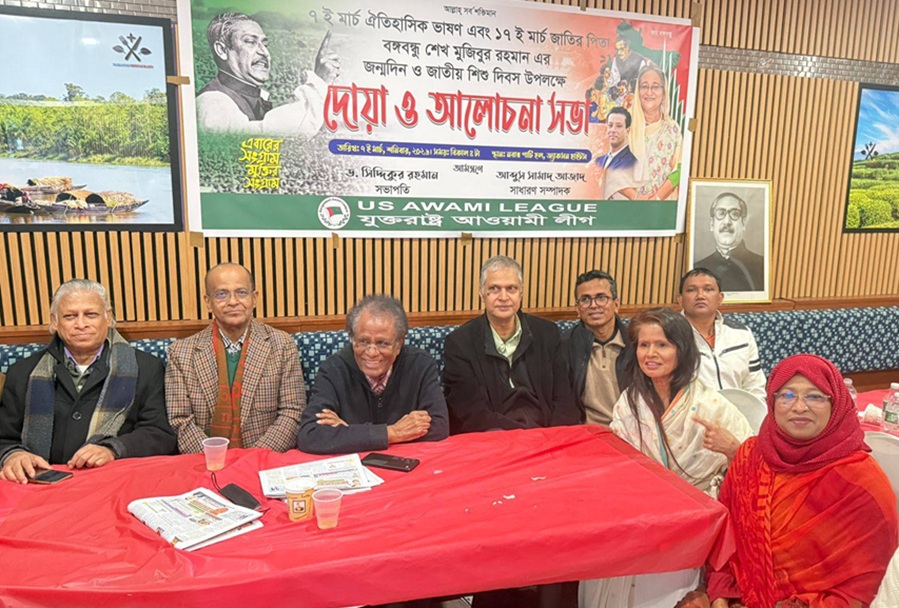
The US Awami League observed the historic March 7, the birth anniversary of Father of the Nation Bangabandhu Sheikh Mujibur Rahman, and National Children’s Day with due respect and dignity. The program was held at Nabanna Party Center in Jackson Heights, New York—often referred to as the capital of the world—with the presence of leaders and activists from all wings and affiliated organizations of the US Awami League. The hall was filled with party members and supporters.

The event was chaired by US Awami League President Dr. Siddiqur Rahman and conducted by General Secretary Abdus Samad Azad. Speakers at the event expressed concern that the newly elected BNP government has prevented the proper observance of the historic March 7 speech of Bangabandhu Sheikh Mujibur Rahman—an address internationally recognized as an epic declaration of independence—thereby pushing the nation toward division.

The speakers also urged the BNP government to immediately withdraw the ban imposed on the Awami League and its affiliated organizations through what they described as an illegal ordinance issued by the “killer-fascist Yunus government.”

Leaders from the US Awami League, New York State and City Awami League, Mahila Awami League, Swechchhasebak League, Jubo League, and the US Chhatra League took part in the discussion.

—Press Release


Dhaka airport descends into chaos

Shahjalal International Airport has turned into a scene of confusion and frustration as multiple flights to Saudi Arabia, Kuwait, and other Gulf destinations were abruptly suspended amid regional tensions. Passengers reported a total lack of information from airlines, with hotlines unreachable and departure boards blank, leaving many stranded in sweltering terminals and walkways.

Md Rubel, a Faridpur resident scheduled to fly to Saudi Arabia on Biman Bangladesh Airlines, described the uncertainty: “They are not telling us when the flight will leave. Even the monitor shows empty times. They don’t say whether it’s cancelled. What are we supposed to do?”

Flights to Dammam, Kuwait, Dubai, Abu Dhabi, Doha, and Bahrain were affected, leaving Umrah pilgrims and expatriates trapped. Government assurances of overnight arrangements were not visible as of 11pm, and police and Ansar personnel struggled to manage crowds arriving from outside Dhaka.


Trump claims Khamenei is dead

US President Donald Trump has claimed that Iran’s Supreme Leader Ayatollah Ali Khamenei has been killed, describing him as “one of the most evil people in history” in a post on Truth Social. Trump said Khamenei had been unable to evade US intelligence and “highly sophisticated tracking systems”, adding that the operation had been carried out in close coordination with Israel.

Trump said the development represented “the single greatest chance for the Iranian people to take back their country”. He also claimed Washington had received indications that many within Iran’s Revolutionary Guards, military and security forces no longer wished to continue fighting, suggesting the United States could offer them “immunity”.

The US president also warned that “heavy and pinpoint bombing” would continue “uninterrupted throughout the week, or as long as necessary to achieve our objective”. There has been no independent verification of Khamenei’s reported death, and Trump did not provide evidence to support the claim.


Ali Khamenei is dead after US-Israeli attack on Iran

Iran’s tyrannical Supreme Leader Ali Khamenei was killed Saturday in an unprecedented, joint military attack by the US and Israel called Operation Epic Fury — which President Trump said would give Iranians their “greatest chance” to “take back the country.”

“Khamenei, one of the most evil people in History, is dead,” Trump declared on his Truth Social about 15 hours after the start of the onslaught. “This is not only Justice for the people of Iran, but for all Great Americans, and those people from many Countries throughout the World, that have been killed or mutilated by Khamenei and his gang of bloodthirsty THUGS.”

The tyrant’s daughter, grandchild, daughter-in-law and son-in-law were also killed in the joint military attack, according to Iranian state media, though it’s unclear where they died. Israeli officials told Fox News that more than 40 top Iranian security and regime figures were eliminated in the opening strikes this morning, and as many as 10 high-ranking leaders were killed in the initial strike on Khamenei’s fortified compound.

The body of the 86-year-old Khamenei was reportedly recovered in the rubble and a photograph of his corpse was shown to Israeli Prime Minister Benjamin Netanyahu, a senior Israeli official told Reuters. US officials, including Trump, agree with Israel’s assessment that Khamenei is no longer alive.

“He was unable to avoid our Intelligence and Highly Sophisticated Tracking Systems and, working closely with Israel, there was not a thing he, or the other leaders that have been killed along with him, could do,”

Trump’s post continued. “This is the single greatest chance for the Iranian people to take back their Country.” In an address to his nation, Netanyahu said there were “many signs” Khamenei was dead. Khamenei has ruled Iran since the 1989 death of his predecessor, Ayatollah Ruhollah Khomeini, the founder of the Islamic Republic. The attacks follow a massive US military buildup in the Middle East and come after Trump repeatedly warned Tehran that it would face consequences if it didn’t make a deal with the US to scrap its nuclear program.

Trump emphasized that a main objective of the campaign was “to defend the American people by eliminating imminent threats from the Iranian regime.”

“Its menacing activities directly endanger the United States, our troops, our bases overseas and our allies throughout the world. For 47 years, the Iranian regime has chanted ‘Death to America’ and waged an unending campaign of bloodshed and mass murder targeting the United States, our troops and the innocent people in many, many countries,” Trump said in an eight-minute video announcing the strikes Saturday morning. Many regime forces appear to by laying down their arms, Trump said.

“We are hearing that many of their IRGC, Military, and other Security and Police Forces, no longer want to fight, and are looking for Immunity from us,” Trump wrote. “As I said last night, ‘Now they can have Immunity, later they only get Death!’”

The president called on the IRGC and state police to “peacefully merge with the Iranian Patriots, and work together as a unit to bring back the Country to the Greatness”. “That process should soon be starting in that, not only the death of Khamenei but the Country has been, in only one day, very much destroyed and, even, obliterated,” Trump added.


Afghan Taliban open to talks after Pakistan bombs Kabul, Kandahar

Afghanistan’s Taliban rulers said on Friday they were willing to negotiate after Pakistan bombed its forces in major cities and dozens of troops were killed in the most serious clashes between the allies-turned-foes. The strikes by Pakistan were the first time it had directly targeted its former allies over allegations they are harbouring militants; it described the situation as “open war”.

Targets in the capital Kabul and the city of Kandahar, where Taliban leaders are based, were hit, signalling a stark rupture in ties between the Islamic neighbours. Thick plumes of black smoke rose from two sites in Kabul and a huge blaze was also visible in video verified by Reuters.

“The plane came and dropped two bombs, then flew away again. After that, we heard explosions,” said Kabul taxi driver Tamim, who was asleep when the strikes hit. “Everyone, in panic, ran down from the second floor of the house. The ammunition inside the depot kept exploding on its own.”

Security sources in Pakistan said the strikes involved air-to-ground missile attacks on Taliban military offices and posts in response to Afghan attacks on Thursday. The Taliban said Afghan forces had used drones to hit Pakistani military targets. Pakistan said all the drones had been brought down and there was no damage.

Multiple ground clashes were reported along the border. Pakistan said it killed 274 Taliban officials and militants while Afghanistan said it killed 55 Pakistani soldiers – figures which Reuters was unable to verify. Pakistan confirmed that 12 of its own soldiers were killed and Afghanistan said it had lost 13 Taliban fighters.

The Taliban, which denies sponsoring militant attacks on Pakistan and makes similar accusations against its neighbour, said it had launched what it described as retaliatory attacks on Pakistani military installations on Thursday but was ready to negotiate.

“Afghanistan has never been a supporter of violence and has always preferred to resolve issues based on mutual understanding and respect,” the Afghan foreign ministry quoted Foreign Minister Amir Khan Muttaqi as telling Qatar’s junior Foreign Minister Mohammed bin Abdulaziz Al-Khalifi by telephone.

“However, this approach will be effective only if the other party demonstrates a practical and sincere willingness to find solutions.”

Qatar, which helped stop the fighting between the two countries last year, is working with other countries to help resolve the latest crisis, the statement added. The strikes threaten to unleash a protracted conflict along the 2,600-km (1,615-mile) frontier.

“Our cup of patience has overflowed. Now it is open war between us and you (Afghanistan),” Pakistani Defence Minister Khawaja Muhammad Asif said on Friday.

Pakistan’s foreign ministry warned that any new provocations by the Taliban, or attempts by any “terrorist group” to target Pakistanis, will be met with a “measured, decisive and befitting response”.

Pakistan is nuclear-armed and its military capabilities are vastly superior to Afghanistan. However, the Taliban are adept at guerrilla warfare, hardened by decades of fighting with US-led forces, before returning to power in 2021.

Reuters witnesses in Kabul said many ambulance sirens could be heard following loud blasts and the sound of jets. Taliban spokesperson Zabihullah Mujahid said that Pakistani forces carried out air strikes on parts of Kabul, Kandahar and Paktia on Thursday night, and on Paktia, Paktika, Khost, and Laghman on Friday.

While there were no casualties in the night strikes, there were civilian casualties in Friday’s strikes, he told reporters without sharing numbers.

“The Islamic Emirate of Afghanistan has always tried to resolve issues through dialogue, and now also we want to resolve this matter through dialogue,” Mujahid said.

Clashes between Pakistan and Afghanistan in October killed dozens of soldiers until negotiations facilitated by Turkey, Qatar and Saudi Arabia brought an end to the hostilities. Pakistan has been on high security alert since it launched air strikes earlier this week that Islamabad said targeted camps of Pakistani Taliban and Islamic State militants in eastern Afghanistan. Kabul and the United Nations said the strikes killed 13 civilians and the Taliban warned there would be a strong response.

The government of Pakistan’s Punjab province said it was on high alert for militant attacks on Friday and had conducted a series of security operations, taking 90 Afghan nationals to holding centres for deportation.


Govt working to restore non-functional state institutions: Mirza Fakhrul

THAKURGAON – Local Government, Rural Development and Cooperatives Minister Mirza Fakhrul Islam Alamgir today said the new government is working to make state institutions, long rendered ineffective, functional and properly institutionalized once again. He also confirmed that local government elections will be held on schedule.

Mirza Fakhrul, also the BNP Secretary General, made the remarks while responding to journalists after laying the foundation stone of a multi-storey building at Hajipara Hafizia Madrasa here. In reply to a question, he said, “For a long time, we have heard that the previous fascist government had weakened and rendered ineffective various state institutions. The major challenge before the new government is to restructure these institutions, ensure accountability, and restore the framework of good governance.”

He further said, “I am most indebted to the people of Thakurgaon. They supported me by giving their valuable votes. I want to work responsibly to repay their trust and affection.”

District BNP President Mirza Faisal Amin, leaders and activists of the party at various levels, dignitaries and local residents were present.


180 vacant sergeant posts to be filled soon: Home Minister

DHAKA – Home Minister Salahuddin Ahmed today said that 180 vacant sergeant posts will be filled soon as part of efforts to strengthen law enforcement. He said the recruitment process would be expedited to ensure the vacancies are filled without delay, enhancing policing efficiency and public safety.

The move is aimed at increasing operational capacity, reducing the workload on existing personnel, and maintaining law and order more effectively. Officials concerned said necessary procedures have already been initiated and the recruitment will be conducted following due process to select qualified candidates. Filling the vacant posts is being treated as a priority to reinforce the security framework and improve public service delivery.